



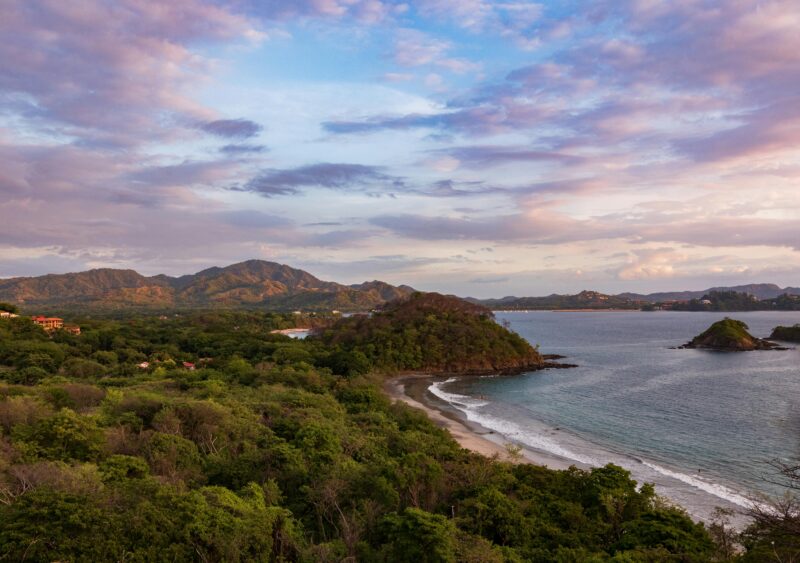
An aerial photo of Guanacaste, Costa Rica. Image from Photo by Jean Paul Montanaro via Pexels. Free to use.
Water scarcity is not typically what comes to mind when picturing a tropical, coastal country such as Costa Rica. Yet Guanacaste, the country’s northwestern province named after the national tree, is its driest region. Adored for its black-sand beaches and arid tropical landscapes, the region could easily be mistaken for part of the Canary Islands.
Costa Rica’s environmental record provides significant grounds for celebration. More than 25 percent of its territory is protected through national parks and reserves, and it has set ambitious goals to achieve 100 percent renewable electricity, supported by a long-standing public energy model. A closer inspection, however, tells a different story.
Guanacaste is a tropical dry forest region where temperatures can reach up to 35 degrees Celsius during the dry season, which generally lasts from December to April. In the past, much of the region was converted into pastures for cattle ranching, leading to widespread deforestation through clearing and the use of fire to maintain grazing land. As a result, tropical dry forests have become one of the most threatened ecosystems in the tropics. Historical marginalisation has also meant relatively limited state presence and weaker planning institutions in the region, which can make environmental regulations and zoning restrictions difficult to enforce.
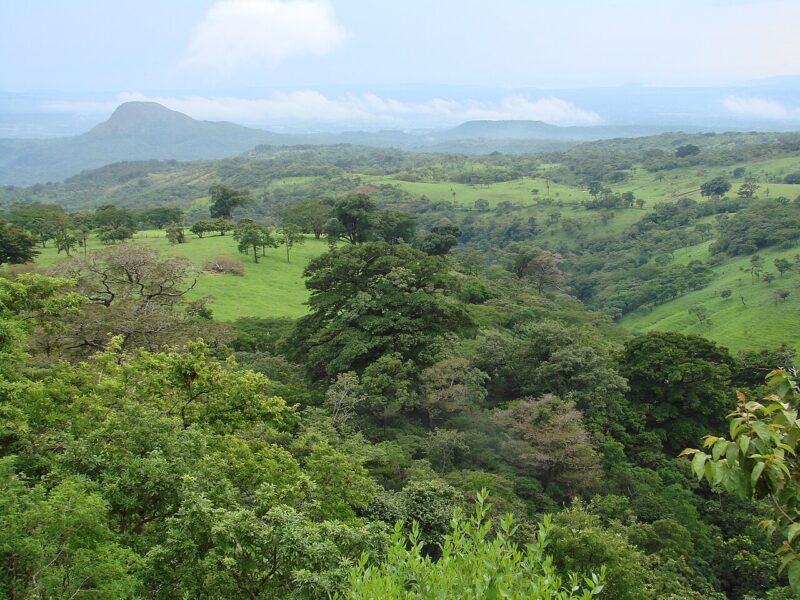
A snapshot of the Guanacaste in Costa Rica. License CC BY-SA 3.0, via Wikimedia Commons.
While forest cover has been repaired in recent decades, new pressures are always on the horizon. Real estate investors and foreign buyers now seek coastal land for speculation and second homes. Since the COVID-19 pandemic (also before, but especially since), the region has become popular with the digital nomad community, and what I ambivalently call lifestyle migrants. These are fairly well-to-do folks from wealthy countries (mostly North America) who either live full-time in the region or have a second home and spend at least part of the year in the sun.
Along Guanacaste’s coastline, and in towns like Tamarindo and Nosara, up to 60 percent of houses are unoccupied for six months of the year or more; a vacancy rate born of a real estate boom that positions the region as one of the fastest-growing sites of speculation. Beyond making housing less accessible for local residents (what developers might call “opportunity”) this has a pernicious impact on both the environment and the local economy. At the same time, the region’s historical remoteness now enhances its appeal to developers and lifestyle migrants.
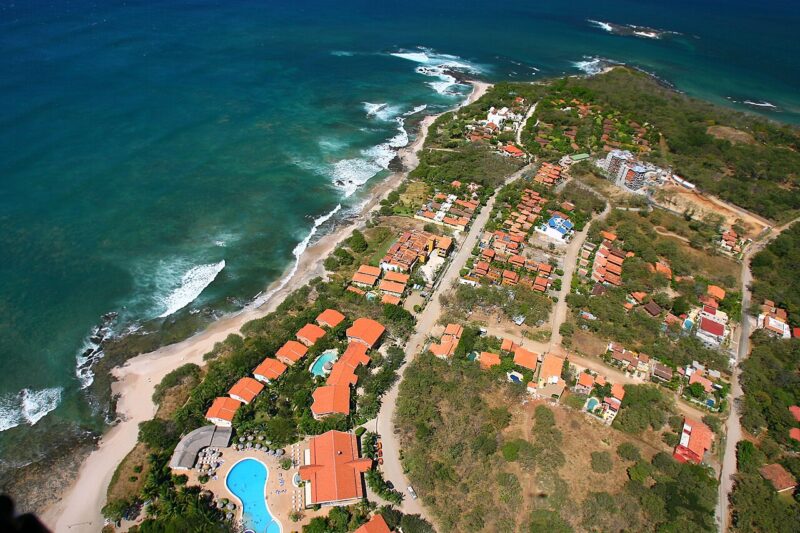
An aerial photo of Tamarindowiki from 2007. License CC BY-SA 3.0, via Wikimedia Commons.
“Remote” beach houses, “secluded” villas, or ocean-view apartments are attractive for the exclusivity of retreat they provide, allowing residents to live apart from the pressures and routines of their home countries, even as they participate in global flows of wealth and consumption.
Economically and socially detached from surrounding communities, enclave-style tourism developments take the form of gated neighbourhoods, luxury resorts, and vacation homes that operate as self-contained spaces.
In Guanacaste, hillside villas and ocean-view homes embody this model. Their spatial design offers little opportunity for interaction with the local population, as many of these homes are built on hills or along the coast, away from the villages where people have traditionally lived. While these developments create some service-sector jobs, such as gardeners, cleaners, security guards, and waitstaff, much of the profit generated by these properties ultimately flows abroad.
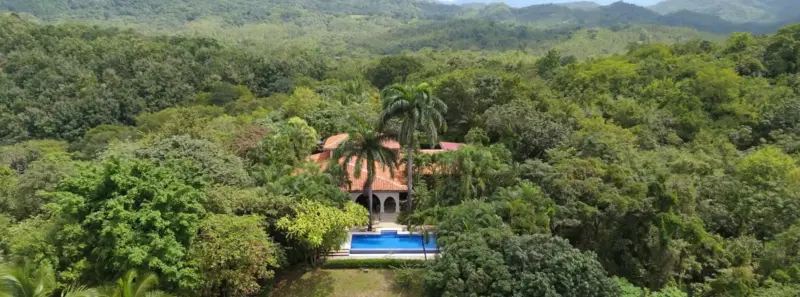
A hillside, off-grid villa in Costa Rica. Screenshot from YouTube.
These unequal global social relations are most obvious in the disparity of wealth between well-off foreigners living in Guanacaste and the Nicaraguan migrants whose essential labor underpins the construction and service sectors.
A crisis beneath the surface
Policies aimed at attracting the ultra-wealthy and foreign investment have fueled rapid and often unregulated residential development. Although the province is geographically large, this growth has been concentrated along the coastal strip. Together, these pressures have turned access to water into the region’s most pressing environmental issue.
Luxury housing developments not only change the landscape and local economy, they also strain the water system. Guanacaste has always been a dry tropical region, shaped by long droughts and seasonal variation, but climate change is intensifying these conditions, placing even greater pressure on the already dry ecosystem.
These pressures have not been matched by effective water governance. For years, public institutions have lacked reliable data on how much water coastal aquifers in Guanacaste can sustainably provide, even as thousands of wells extract unknown quantities beneath the surface. Research shows that several aquifers along the Pacific coast are already overused or contaminated by seawater, particularly in areas of intense tourism and residential development.
Real estate speculation has also put coastal communities’ access to drinking water at risk. In some cases, it has enabled dubious land concessions in public coastal areas such as the Maritime Terrestrial Zone, a legally protected strip of land intended for public use, and contributed to the destruction of mangrove ecosystems to make way for large-scale developments.
While large hotels and high-end housing projects often secure continued access to water, local communities increasingly face shortages and restrictions. Since 2020, Costa Rica’s constitution has formally recognised access to drinking water as a fundamental human right, yet in places like Guanacaste, communities say the rapid expansion of tourism and real estate development is testing how that right is applied in practice. An investigation into water quality in Guanacaste’s aqueducts, published in March 2026, highlights how underinvestment in water systems has contributed to declining water quality in the region. According to the regulator of public services, ARESEP, dozens of aqueducts show signs of contamination, including faecal coliforms, often linked to ageing infrastructure and the limited technical and financial capacity of local water operators.
In this context of strained infrastructure and uneven investment, water has increasingly become a strategic resource tied to tourism and real estate interests. In some communities, control over water infrastructure has shifted away from residents toward private actors, deepening fears of dispossession. The line between public provision and private control has been further blurred by the government’s reliance on private financing for water systems, reinforcing the influence of developers over local resources and fueling mistrust over who ultimately governs access to water.
As it turns out, developers are not such good neighbours. Since the early 2000s, the expansion of tourism and residential development has repeatedly sparked conflicts between communities, investors, and state authorities over access to water.
Across Guanacaste, similar conflicts have emerged wherever tourism and residential development have expanded fastest. In the rural community of Sardinal, plans to divert water from an inland aquifer to supply coastal hotels and housing triggered protests after residents learned the project had advanced without their knowledge. In Potrero, a traditionally fishing-based coastal community that has become a popular tourist destination, pressure from developers and state authorities threatened the autonomy of a long-standing community-run aqueduct, raising fears that local water would be redirected toward luxury projects. In the case of the Nimboyores aquifer in Santa Cruz, government plans to exploit it (framed as a response to regional water scarcity) sparked years of community resistance, as residents argued that the real issue lay not in local shortages but in the growing demand from tourism and real estate development.
More recently, the coastal community of Marbella has become another boiling point in the water wars. Real estate interests took control of the rural aqueduct while illegal wells were drilled inside residential complexes to supply second homes. Authorities have identified large numbers of unauthorised wells in the area, intensifying concerns over aquifer depletion and salinisation. Despite judicial rulings and media investigations highlighting irregular land use and water extraction, construction has continued, and community members who oppose the projects report intimidation. In response, local residents have organised to defend their right to water against what they describe as an extractive development model that prioritises luxury housing over basic access.
The pressures Guanacaste faces are not unique. A report published ahead of the 2026 UN Water Conference, Global Water Bankruptcy: Living Beyond Our Hydrological Means in the Post-Crisis Era, warns that aquifers worldwide are approaching a breaking point after decades of intensive extraction, combined with pollution and rising demand from expanding agriculture and growing cities in a warming climate.
In an era marked by intense transnational mobility, the uneven distribution of rights and experiences in host communities reflects underlying dynamics of power and privilege that demand further scrutiny.