



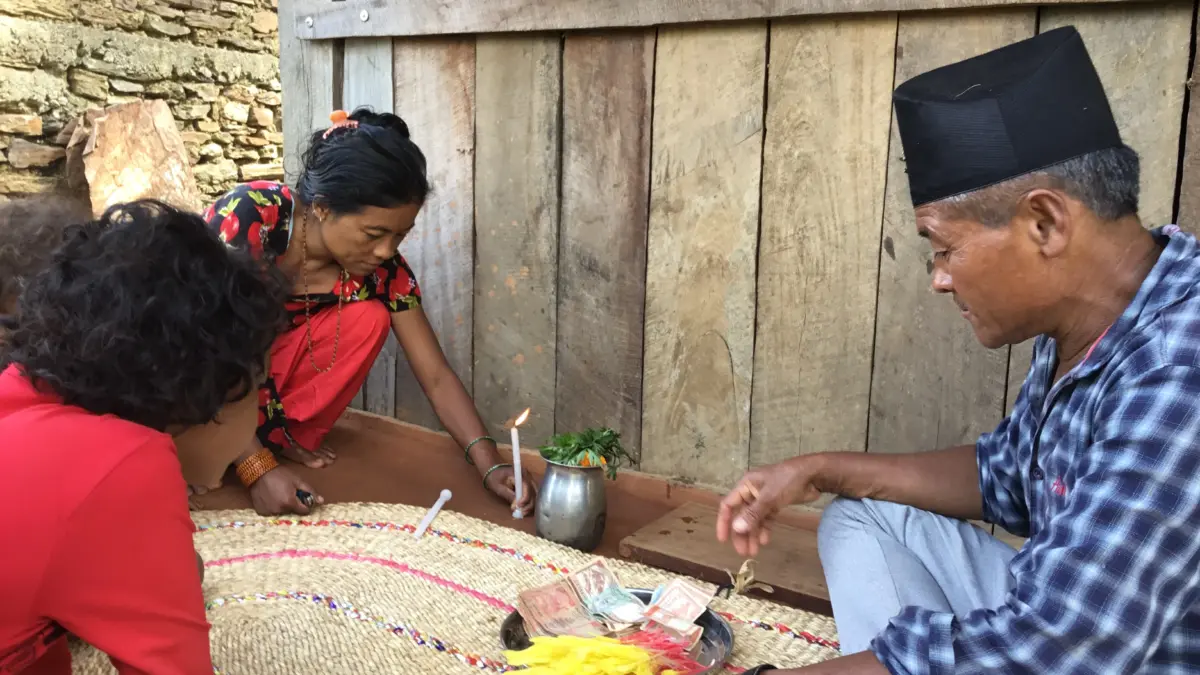
Festival preparation in Chepang village. Photo of Jimling Village in Rapti Municipality of Chitwan District, Nepal. Photo by Biswash Chepang. Used with permission.
In Nepal, investing in social protection appears to be driven more by political will than by the country’s economic capacity. Article 43 of Nepal’s Constitution (2015) guarantees the right to social protection, including social protection allowances for senior citizens, economically disadvantaged groups, Dalits, people with disabilities, children, single women, and members of endangered castes, in accordance with the Government of Nepal’s fiscal programs.
This social security acts as an effective tool for enhancing human capacity and productive employment opportunities, particularly for individuals, communities, and Indigenous tribes at the bottom of the social and economic pyramid. However, an estimated 20.1 million people in Nepal remain without any form of social protection.
There is an ongoing debate over whether the government should prioritize creating job opportunities and empowering low-resource communities or provide direct cash allowances to address this issue. The discourse around social security allowance can be broken down into two camps: one that sees it as supportive, and another that suggests it may unintentionally contribute to the further disempowerment of community members at the lower end of the social hierarchy.
The following interviews explore the positive implications of social security allowances for some of Nepal’s most vulnerable communities. Addressing existing challenges, strengthening local governance capacity, and ensuring inclusive program design are likely to contribute to genuine empowerment within these communities.
Nepal is a signatory to several international-level conventions and treaties, which obligate officials to implement social protection measures for its citizens. This includes ILO Convention No. 169 and Article 22 of the UN Declaration on the Rights of Indigenous Peoples (UNDRIP). The International Covenant on Economic, Social, and Cultural Rights (ICESCR) (UN 1966) recognizes social security as a universal human right. Similarly, the 2030 Agenda for Sustainable Development (UN 2015) mentions social protection as a key means to eliminating extreme poverty and reducing multi-dimensional poverty, which are included in the UN’s 17 Sustainable Development Goals (SDGs).
There are more than 85 social security programs in Nepal, which provide some form of allowance to around 3,800,000 people. This represents approximately 13 percent of Nepal’s total population. The Nepal government has committed to providing financial support to 10 endangered Indigenous communities, each with a population below 10,000 people. The officially recognized endangered Indigenous groups are the Bankariya, Hayu, Kisan, Kusbadhiya, Kusunda, Lepcha, Meche, Raji, Raute, and Surel.
To better understand the implications of the social security system for endangered Indigenous communities in Nepal, Global Voices interviewed Santoshi Bankariya, a member of the Bankariya community via phone. She emphasized the importance of the Endangered Community Social Security Allowance, explaining how the funds allow her family to access basic education, healthcare, and other essential needs. She noted that although public education is officially free, families still face indirect costs such as school bags, uniforms, stationery, and basic utility expenses. According to her, every individual belonging to the Bankariya community is entitled to a monthly allowance of NPR 4,000 (USD 27), provided through the Ministry of Federal Affairs and General Administration.
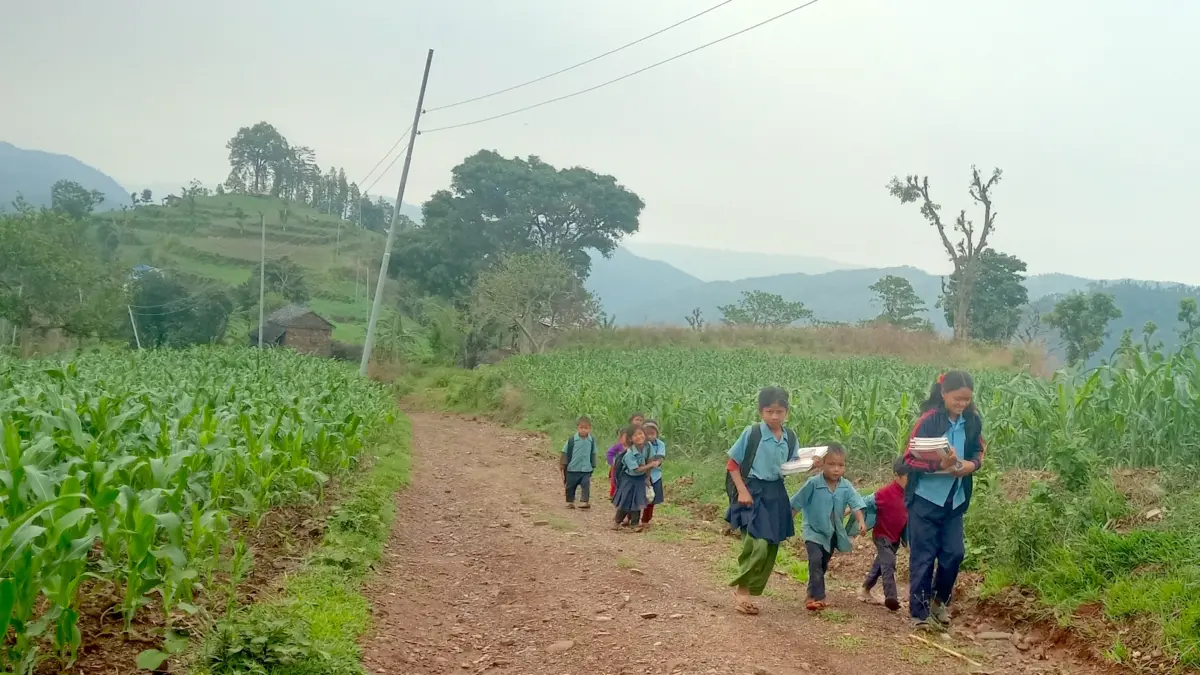
Children going to school – Photo of Jimling Village in Rapti Municipality of Chitwan District, Nepal. Photo by Biswash Chepang. Used with permission.
A study conducted on the Raji community in Chaukune Rural Municipality of Surkhet District highlighted increasing economic and social resilience linked to social security allowances. Community members reported using the support to start small businesses, cooperative savings programs, and cultural preservation initiatives.
However, experts argue that social security allowances must be complemented by more comprehensive development programs, such as focused educational initiatives, improved healthcare services, and livelihood diversification. Achieving long-term socioeconomic progress for the Raji community will likely depend on addressing these structural challenges through inclusive and sustained policy measures.
Regular cash transfers, without parallel livelihood investment, may create a risk of dependency. For example, OnlineKhabar has highlighted that some members of the Raute community are increasingly relying on government allowances rather than on traditional forest-based livelihoods. This shift weakens self-reliance and contributes to the erosion of traditional skills. In addition, field reports have shown that in some endangered communities, allowance money has contributed to increased alcohol consumption and related social challenges. Such trends point to the pressures faced by nomadic groups that are increasingly dependent on government support for survival.
There is currently no comprehensive official data on the number of Indigenous Peoples enrolled in social protection programs. Indigenous communities continue to face multiple barriers in accessing social security allowances, both in terms of coverage and adequacy. These barriers are not merely technical; they are rooted in historical injustices, structural discrimination, geographic isolation, lack of citizenship documentation among some people, exclusion from formal labor markets, gaps in reliable data, and program designs that often fail to reflect Indigenous realities.
Gaps and challenges in social protection systems
Nepal’s social protection landscape is characterized by a multitude of fragmented programs that do not operate cohesively. Although there are various initiatives aimed at poverty reduction, these programs often fail to meet their targeted goals. The problems are rooted in socio-economic disparities, political dynamics, and institutional weaknesses. In addition, many Indigenous people remain unaware of their entitlements under social protection schemes due to insufficient information dissemination.
Political instability further disrupts the continuity of programs designed to support vulnerable communities. During my trip to vote in the national elections in Nepal, I heard villagers discussing their support for candidates from the Communist Party of Nepal (Unified Marxist–Leninist). Some speakers suggested that social protection benefits were primarily the result of their party’s initiatives. As a result, several villagers appeared to associate old-age allowances with the leadership of former Prime Minister Khadga Prasad Sharma Oli, noting that such benefits were frequently highlighted in his past and current election campaigns.
This shows that social protection can become entangled in political narratives and become weaponized as a political tool. The situation is further complicated by a highly politicized bureaucratic environment, where political patronage may influence the allocation of resources and positions, ultimately weakening effective governance and public accountability.
A way forward
Social Security programs have been proven to enhance social equity and justice. Activists argue that the federal government should also be involved in the management of the distribution of this allowance, as this involves a large number of beneficiaries and the scale of budget allocations across cash-based social assistance programs.
Targeted orientation programs for Indigenous groups and communities could help promote the effective and responsible use of social security allowances, enabling households to invest in ways that support long-term wellbeing. Such initiatives may also strengthen their ability to exercise the right to self-determination, as recognized in international instruments such as Article 3 of the United Nations Declaration on the Rights of Indigenous Peoples and Article 7 of ILO Convention No. 169.
This approach could create a meaningful opportunity to integrate Indigenous Peoples’ knowledge, priorities, and lived experiences into the design and implementation of social security programs. In doing so, it may help strengthen collective ways of life, sustain traditional knowledge systems, and support Indigenous food practices.
The Government of Nepal should continue to promote electronic payment systems for social security allowances, while also ensuring that these systems are accessible to all beneficiaries and safeguarded against duplication and misuse.
Hence, there is a clear need for a balanced and empowering approach. Linking allowance with livelihood programs, such as Indigenous enterprise development, which would revitalize the traditional skills of the community. From a policy perspective, it may also be worth considering longer-term support measures, including access to land, secure housing, residential education opportunities, and fair representation in government employment, as complementary strategies to direct cash assistance rather than relying on cash transfers alone.