



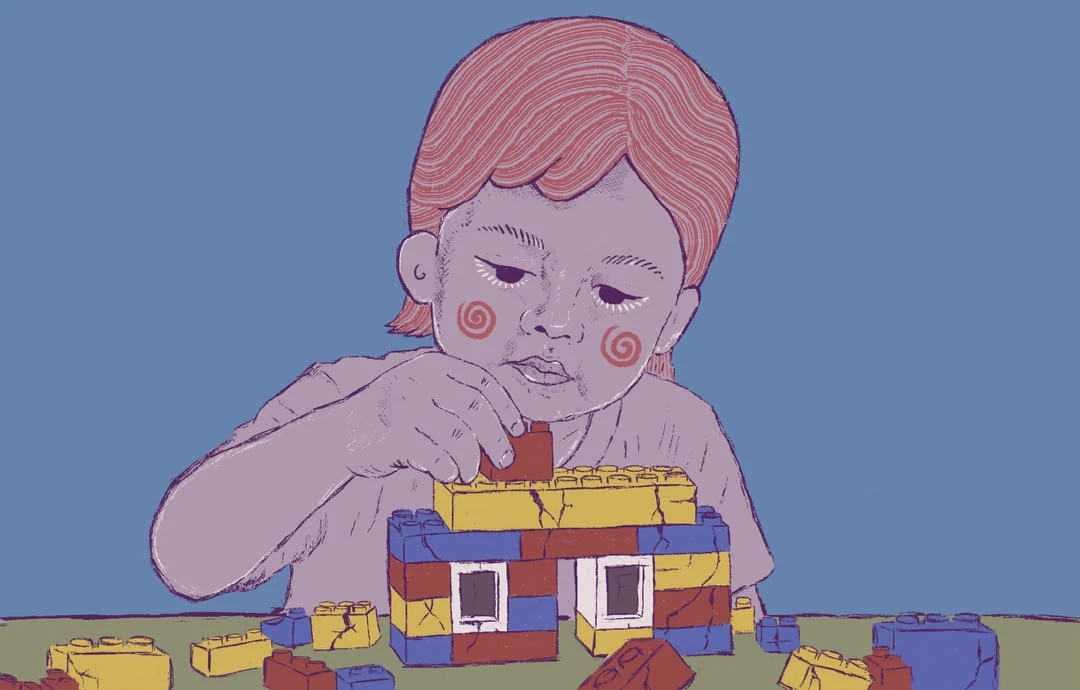
Illustration made by Omarela Depablos, 2026. Used with permission.
This article is as part of the Special Coverage “Inside Venezuela’s Earthquake Disaster,” where we examine the aftermath of the earthquakes, share stories from the ground, and explore the human impact, recovery efforts, and challenges facing affected communities. The names of the children have been changed to guarantee their protection.
This story was produced with the support of Moving Minds Alliance (MMA) through the Reporters for Early Age Children in Crisis (REACH) Advocacy Stories Fund.
“Why is the earth angry with people?” five-year-old Elyas asks his grandmother, as he lays in the middle of a maze of bunk beds set up beneath a white tent at a sports complex in La Guaira, Venezuela. His family do not have the answer to such a profound question.
The double earthquake on June 24 erased part of the city where he grew up. Dozens of structures he knew are now piles of rubble. Meanwhile, other buildings that remain standing like cracked skeletons threaten to come crashing down at any moment.
Elyas’s family is concerned by the precision with which he describes how a two-storey wall collapsed onto his father’s back and cut his grandmother’s hand. “We try to distract him, but he starts talking about it on his own and asks everything,” says his mother, Sandra.
In the child’s new routine, rain is no longer just water falling from the sky. With every downpour, he anticipates his mother’s warning that “the earth is going to shake again.” According to her, the roar of thunder reminds him of the sound that cracked apart his home in Punta de Mulatos in La Guaira, the most devastated section of the six states along Venezuela’s northern coast that the earthquakes impacted.
“He hears an airplane and gets scared; thunder and he gets scared […] there was an event with Mickey Mouse, and when they set off the confetti gun, it went ‘Pow!’ and he started running.”
Janet Guerra, a psychologist at Andrés Bello Catholic University and a specialist in child development, explains that while children in their early years of life do not process these events logically, they remain “etched in the body.” The period between zero and five years of age, which is vital for their biological growth, is also vital for the development of the psyche.
“If this fear is not drained, the child may develop a cycle of paralysis or emotional dysregulation in the face of future stressful events,” warns Guerra, noting that this consequence can even extend into adulthood, where they will react without rationally understanding the origin of their distress.
Nearly 3.9 million children live in the areas affected by the earthquakes, according to UNICEF, and hundreds of thousands face an urgent need for housing, food, and psychological support.