



The private secondary education market for international students in Ontario is growing quickly, yet a lack of regulation raises concern about quality as well as children’s safety.
The number of private schools for international students in Ontario has increased by more than 265 per cent since 2017.
At that time, research found only 48 private schools for international students. Our 2025 research documented 174 schools explicitly targeting international students in a larger dataset of 370 private secondary schools in Toronto.
While government policy and media critique has focused on international university students in Canada, secondary schools have attracted far less attention.
Read more:
Canada’s high schools are underfunded and turning to international tuition to help
Our recent research has found that the private secondary education market for international schools in Ontario is concerning.
Drawing on a “netnography” approach — a qualitative methodology for adapting ethnography for the online world — we analyzed the 174 school websites, examining and coding data about how they market themselves to families from the Global South.
Among the larger number of secondary schools in our study, we identified 138 as “schools of concern,” with regard to four themes: exploiting the notion of western superiority; selling the Canadian advantage; potentially over-promising students’ safety and care; as well as dubious-quality offerings.
Exempt from post-secondary caps
International education is lucrative. International students in Canada spend more than $37.2 billion in tuition and expenses annually.
International education can be mutually beneficial for education providers, local economies and students seeking options for study across the world. However, the recent Canadian government caps on international student numbers in higher education have been introduced ostensibly to “ease the strain on housing, health care and other services.”
International secondary students are exempt from these caps, and the market for private schools that cater to their needs is growing.
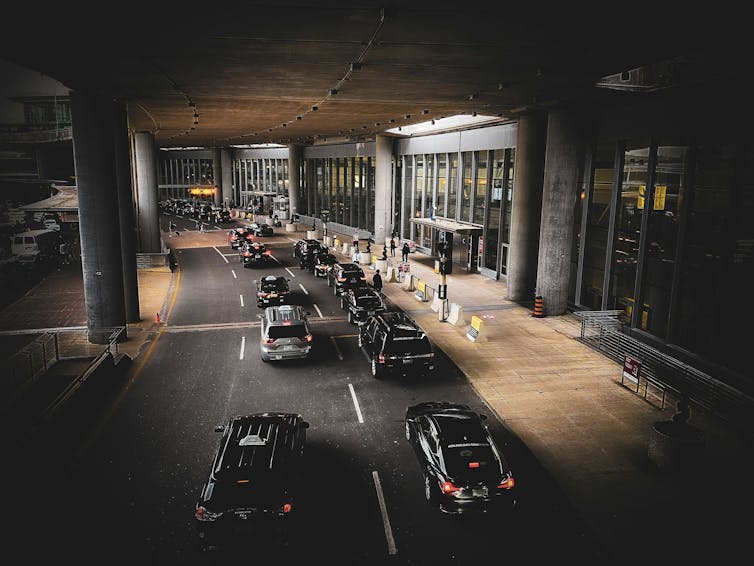
Some marketing websites for international secondary schools advertise how international children aged 12 to 17 can fly into Toronto’s Pearson International Airport alone. Airport pickup services are available to take students to accommodation, which is also arranged by schools.
Custodianship services and study permit support are also marketed by schools and sold for a fee.
(Jason Grant/Unsplash)
Western advantage guaranteed
Many private secondary schools in Toronto advertise that they’re exempt from recent government caps on international study permits. They are marketed as providing western advantages to customers from the Global South.
Promises of a better future, to “support study dreams” and provide a “Canadian university pathway” were common. Schools suggested they would provide students a way to stay in Canada in the long term. Elite programs charged a premium for extra assurance of university entry in Canada.
International students have to apply for a renewed study permit to attend a tertiary institution, but many secondary schools in our study assured potential students that this would not be a problem.
Guarantees of elite university access were common. For example, one program marketed itself as:
“…specially designed for international students who seek admission to prestigious Canadian universities.”
Many websites promised that 100 per cent of students were offered university places.
Children’s English-language learning was also assured to overseas customers. Sending children for four years of secondary school was sold as a way of avoiding English-language testing and requirements for university entry.
Merits of private schools?
Bold claims about the merits of private schools suggested better teaching and learning environments than in Toronto’s public schools.
Private school was sold as more individualized, with smaller classes and a more suitable environment for international students who want to go to university.
Living in Toronto was also presented as an appealing place for children to be located. Toronto was depicted, in the words on one school’s website, as a “haven for diverse communities” where students could “blend into Canadian local culture and traditions.”
Many websites for private schools targeting international secondary students marketed Canada’s “famous,” “high-quality” education system as well. Ontario’s credit system for Grades 9 to 12 was promoted. One school noted: “We leverage the high-quality content of Ontario’s education curriculum … the best education system in North America.”
Claims like this draw on Ontario’s reputation for high-quality education. But because of concerning regulatory gaps and some marketing communications riddled with spelling and grammar errors, there was further evidence that the quality of education ranges from unconfirmed to dubious.
Province doesn’t license schools
Among other private schools, the schools serving international students are listed on the Ontario government’s website but the province advises: “Do not read these lists as endorsements.”
Schools may be inspected by the Ontario government (if they offer Ontario Secondary School Diploma courses), according to government policy.
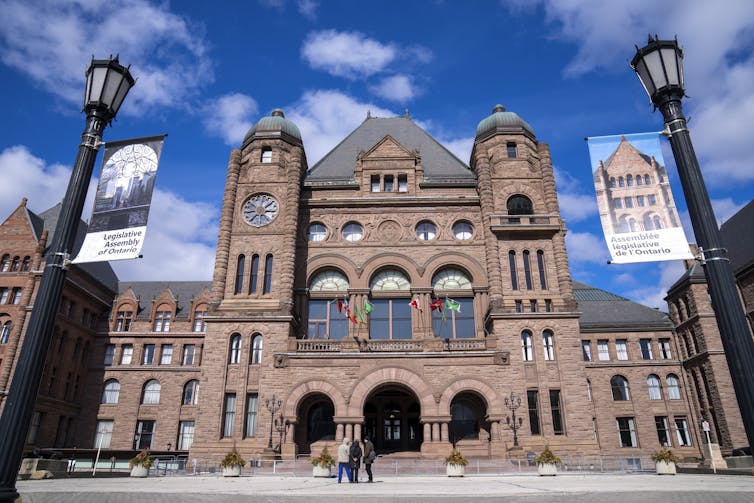
The province’s website notes such inspections “make sure that the standard of instruction” meets curriculum requirements and assessment and evaluation practices. However, it also notes the province does not accredit or license the schools and relays: “We do not inspect or approve items such as: the condition of premises, health and safety practices [or] staffing.”
These schools receive no public funding and are not systematically regulated for quality.
THE CANADIAN PRESS/Frank Gunn
Promises of student safety and care
For a fee, schools proposed to offer safety, care and support for students both inside and outside of school hours.
Custodianship arrangements were proposed to provide students a “home away from home,” but this picture stands in contrast with research that has highlighted unsafe situations for some international secondary school students. For example, Ontario teacher Helen Liu documented “discrepancies between the services and support that were advertised in comparison to what [students] actually experienced in Canada” in her education doctoral research.
In our study, high student-to-teacher ratios were frequently presented as a source of care beyond academic support, and promised to offer, in one case, “teachers and support staff that can engage with students on both an academic and emotional level.”
However, our findings that a-la-carte online education packages appear to be used by some schools made us question the nature of face-to-face interactions and educational quality.
Communications quality, online education
Most concerning is that 33 per cent of the schools seemed to be bringing students to Canada to learn online.
Many schools describe online learning platforms to deliver courses, seemingly instead of in-class instruction. There were vague promises of flexibility, such as:
“Versatile classes: We offer in-person or virtual classes with active and adaptive schedules for the students.”
Read more:
Ontario’s ‘choice’ of fully online school would gamble on children for profit
Forty-seven schools were listed as “on-site” by the Ontario government, but appeared in our analysis to be online only.
We identify an urgent need for further investigation and regulation of this market to protect vulnerable people from exploitation.