



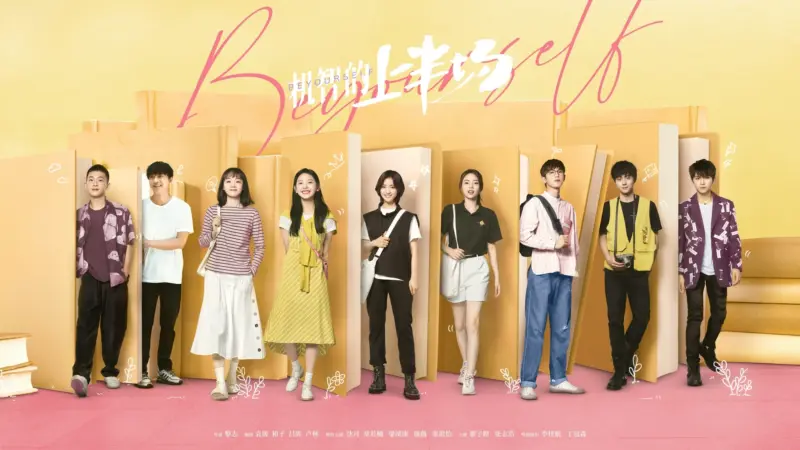
A poster for a popular Chinese drama, ‘Be Yourself’ (機智的上半場 2023), which features four independent women growing up in contemporary China. Image from the drama’s official Weibo account. Fair sse.
Grace answered the phone at 10:30 p.m. Beijing time, after another 12-hour workday.
“I can’t rely on anyone else,” she told me.
Her words could almost be a line from “Be Yourself,” a popular Chinese drama about four young women navigating work, relationships, and adulthood on their own terms. In recent years, stories of independent women have become increasingly prominent in Chinese popular culture, resonating with a generation of women whose lives have been shaped by expanded access to education, professional opportunities, and mobility.
A week later, Scarlett sat in a Manhattan lounge drinking warm fruit tea. Having left a job in finance in Hong Kong for graduate school in New York, she described independence differently.
“I can leave anytime.”
Another woman I interviewed, Iris, was in Hawaii, killing time until her new job began.
These three women are all part of China’s one-child generation. Each of them is an only child. All grew up with intense parental investment and a strong emphasis on achievement. Although their lives look different, a shared inheritance connects them: They were raised to see themselves as the primary authors of their own lives.
Their stories point to a contradiction at the heart of China’s demographic debate.
China’s declining birthrate is often discussed as a consequence of economic pressures, changing attitudes toward marriage, or the rising costs of raising children. But these explanations overlook a deeper transformation. The women China now hopes will marry earlier and have more children are the same women it spent decades encouraging to pursue education, achievement, mobility, and independence — expanding their life options far beyond traditional expectations.
Nowhere is that contradiction clearer than among China’s only daughters.
For decades, China’s modernization project depended on expanding opportunity. In urban families shaped by the one-child policy (1979–2015), wherein many Chinese families were restricted to having only one child, daughters became the focus of extraordinary parental investment. Parents poured resources into education, extracurricular training, and academic success. Many encouraged their daughters to pursue lives larger than the ones available to previous generations of women.
By conventional measures, this project succeeded.
Women now make up more than half of university students in China and have entered elite professions in unprecedented numbers. For years, this transformation was celebrated as evidence of social progress.
But this success has also created an unexpected dilemma.
The same qualities once cultivated as assets — ambition, education, independence, and mobility — are increasingly discussed as obstacles to marriage and childbearing. The vocabulary surrounding womanhood has shifted. Women are increasingly evaluated not as students, professionals, or individuals, but as demographic actors expected to solve a fertility crisis.
The women I spoke with rarely describe their choices in ideological terms. They talk about autonomy, meaningful work, and the refusal to organize life entirely around external expectations.
Across their accounts, independence takes different forms: For Grace, survival is shaped by her workload; for Scarlett, safety comes from financial flexibility; for Iris, mobility and uncertainty give her purpose.
Iris’s story helps explain where this expectation of self-direction came from.
Her childhood was filled with piano lessons, swimming classes, and enrichment programs designed to expand future opportunities. Years later, she came to see those investments differently. Her mother had not simply been paying for skills. She had been investing in the ability to pursue opportunities wherever they appeared.
Like many urban parents during China’s years of rapid economic growth, Iris’s mother believed that a larger future could be built through planning, education, and effort. Overseas study, professional achievement, and geographic mobility were not distant dreams; they were goals to work toward.
Yet when those possibilities became real, many parents began to hesitate. The same families that encouraged daughters to explore the world often hoped they would ultimately remain close to home, marry on a familiar timetable, and help sustain family continuity.
In other words, many only daughters followed the lessons they were taught. The tension lies in the fact that those lessons led somewhere their parents, and perhaps the state itself, did not fully anticipate.
What is often missing from discussions of China’s fertility decline is how deeply the expectation of self-direction has been internalized. Education not only expanded opportunity; it expanded the range of imaginable lives, shifting marriage and motherhood from assumed endpoints to choices women could evaluate for themselves. As women gain greater educational, economic, and social independence, motherhood can become less an assumed obligation and more a matter of individual choice and reproductive rights. Recent research by Hong Kong University on Chinese women’s attitudes toward marriage and childbearing similarly points to a broader shift in which marriage is no longer seen as the necessary condition for a woman to build a family.
For decades, an implicit bargain seemed possible: Daughters would receive unprecedented investment and opportunity, and marriage and caregiving would eventually follow.
But the first half of that bargain changed women more profoundly than many anticipated.
The women I interviewed do not reject marriage or motherhood. Most still imagine those possibilities. What they resist is the assumption that those outcomes should automatically take precedence over every other aspiration.
China’s only daughters did not reject the future they were offered.
They stepped into it.
The country’s fertility crisis may be one of the clearest signs that they succeeded.
