



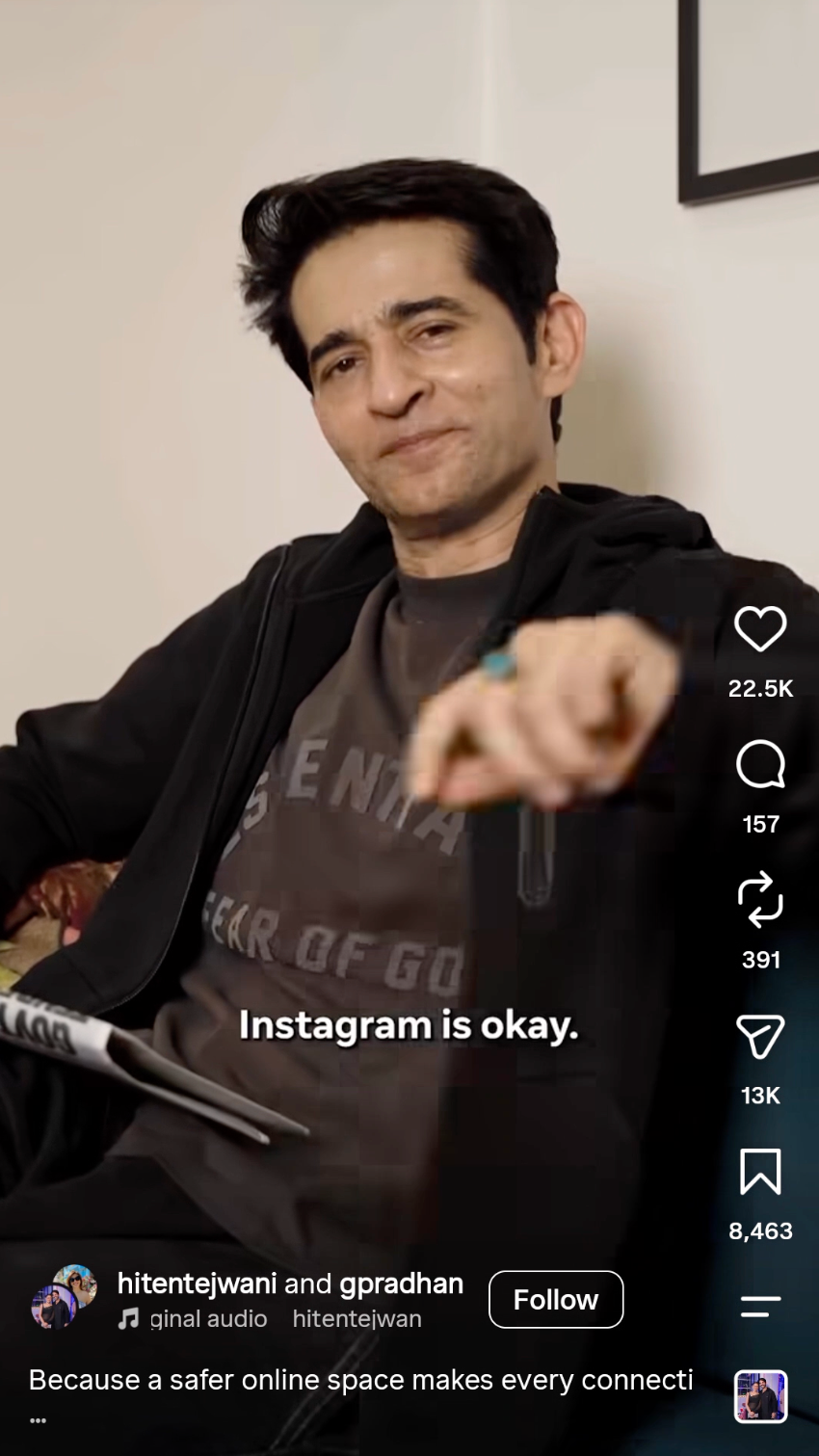
In June, Indian actor Hiten Tejwani told his 732,000 followers that “Instagram is okay” in a reel promoting Meta’s Teen Accounts. Ironically, Tejwani had barred his 17-year-old twin son and daughter from using social media until they turned 16.
The reel was made after a Zoom call with Meta representatives, who explained what their campaign endorsed. Teen Accounts, launched in 2024, gives 13- to 16-year-olds private accounts, screen-time limits, and age-appropriate content. Tejwani, who was paid for the campaign but did not disclose the amount, told Rest of World that he agreed to participate because he saw it as an effort to inform parents rather than encourage every child to join social media.
There has been a global rise in the number of such reels in recent months, as Meta pursues influencer campaigns promoting Teen Accounts, particularly in countries that are mulling a social media ban for children under 16, according to a recent report by Tech Transparency Project, a Washington-based research organization.
Meta is using parent influencers to both soften its image and fight back against the existential threat of social media bans for kids under 16, Katie Paul, director of Tech Transparency Project, told Rest of World.
The campaign comes at a time when Meta is facing heat in the U.S. over child safety concerns. On August 26, the company settled a major trial in the U.S., agreeing to make several safety limitations the default option for teens. Australia, Brazil, and Indonesia have already banned social media for kids under 16. At least 22 other countries are reportedly designing and proposing similar policies.
“If countries around the world follow the lead of Australia and enact these bans, Meta will be cut off from young people who are essential to its growth plans,” Paul said.
Tech Transparency Project found that Meta has been pushing a narrative of safety through “momfluencers” across the world, from India to Canada to Indonesia.
While the campaign plays out slightly differently in each country, the fundamental strategy is this: Meta pays Instagram influencer parents or celebrities with large followings — and in some cases, child safety groups — to promote Teen Accounts, Paul said. A teen account on Facebook or Instagram allows parents to supervise content and communication for under-16s.
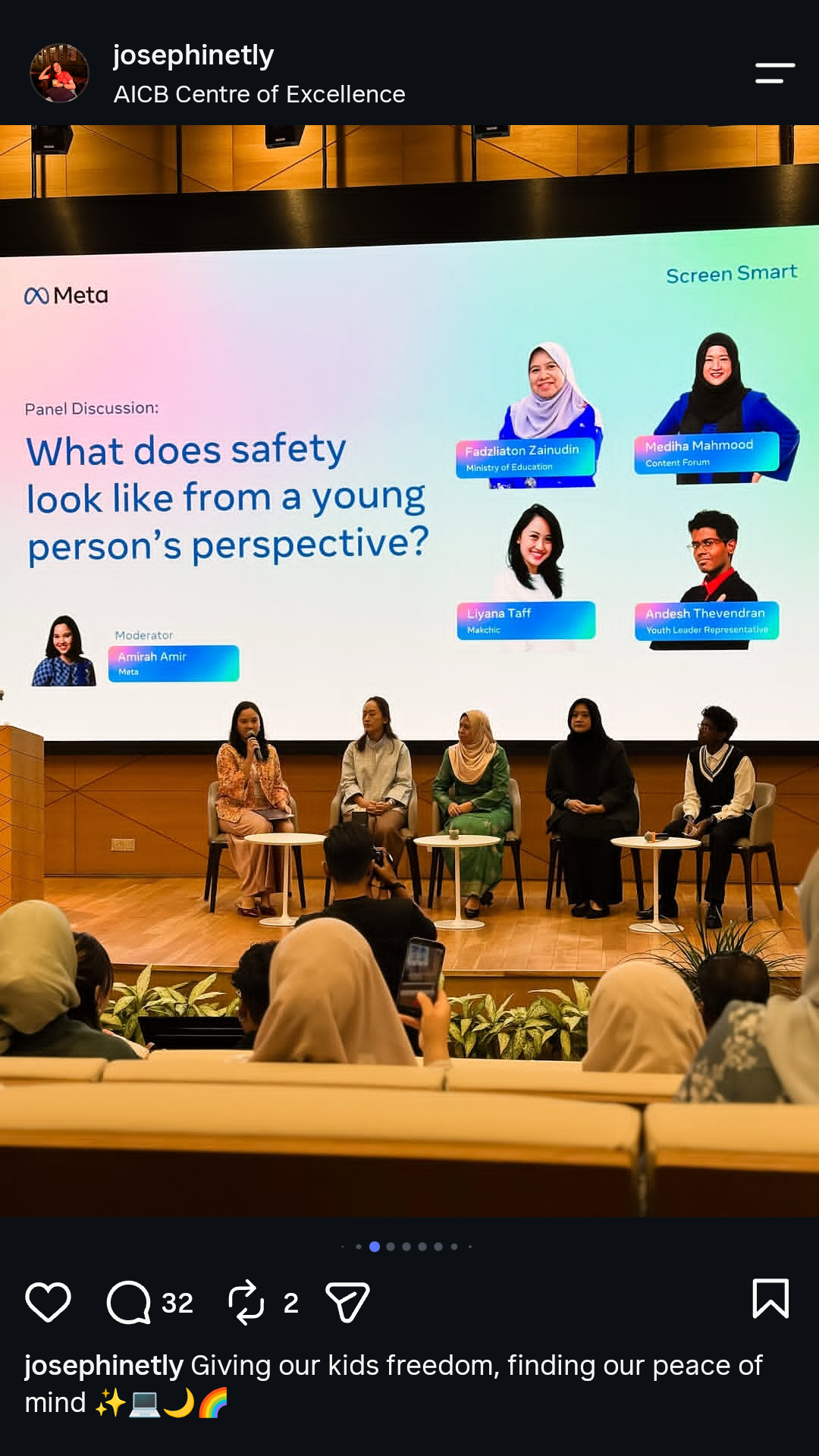
Instagram/@josephinetly
“The underlying message is that Meta is capable of self-regulating child safety protection and that bans are unnecessary,” Paul said. “Some of these influencers have hundreds of thousands and even millions of followers, making them a potent tool for Meta’s corporate messaging.”
Meta has also hosted several “screen smart” events across the world, including in the U.S., New Zealand, Malaysia, and the Philippines, to promote teen safety and parental supervision. In Australia, it sponsored a youth mental health service conducting “safety camps.” In Indonesia, Meta commissioned a survey, which revealed “overwhelming” parental support for teen accounts with safety features.
Influencing controls
Age verification tools are less than ideal, but they’re still better than outright bans, David Green, senior counsel at nonprofit digital rights group Electronic Frontier Foundation, told Rest of World.
“Mandated age limits are designed to deny young people their fundamental human rights — to access information, arts, and culture, to form communities, to speak, and to play,” Green said. “Age estimation technology threatens all users’ privacy by collecting people’s sensitive, personal information, exposing them to risk of data breaches and government data demands, and chilling speech on sensitive issues.”
Parental tools and youth accounts are a better option than bans, he said. There is probably a role for broader-based social media literacy education as well, “whether that happens through influencers, the government, parents, or peers.”
Instagram/@hitentejwani
Snehaalata Shah, an Indian parenting and travel blogger, was approached by an agency for the Teen Accounts campaign. She did not wish to disclose the name of the agency. This was her first paid campaign for Meta.
“They gave us a brief idea where I have to inculcate the teen account features in the middle of the script,” she told Rest of World. “I made a script, and a little bit of changes were done by the agency.” The teen account for her 14-year-old daughter lets Shah keep track of follow and direct message requests and screen time.
“The main takeaway for parents is that there are tools and safeguards available to make social media more age-appropriate for teenagers and to give parents more control and reassurance,” Sonam Jaggi, who runs the account @momavengers with 322,000 followers, told Rest of World. The promo shot by the mom of two kids — 8 and 1 — has amassed 310 million views, and more than half a million likes.
A November 2025 report by a Meta whistleblower and several online kids safety organizations evaluated 47 out of 53 safety features for teens. It found that 64% of the features were broken, missing, or ineffective.
Shah posted a promo reel for Teen Accounts for her 238,000 followers on July 7 — coincidentally the same day Meta published a statement claiming it had “zero-tolerance” for child sexual abuse material, and that it had taken down more than 160,000 accounts.
“If every country bans Instagram or Facebook under 16, of course, there would be loss to [Meta],” Shah told Rest of World. She said she recognized there may be a business motive driving these ads. But given that her 6-year-old son knows how to switch accounts on YouTube instead of logging off when the child time restriction notification pops up, she would still promote the tools to protect her teen.
Tejwani, too, is standing by his decision, but as a parent. Although it was a paid campaign to begin with, his heart is in it, and he’s still happy to entertain questions from other parents and media.
“It is compensation we have to charge, definitely. But otherwise, if I’m talking about it right now, if somebody’s asking me otherwise, this is not a paid thing. I will definitely inform everyone,” Tejwani told Rest of World.