



Viruses play a major role in the functioning of ecosystems. They profoundly influence the dynamics of microbial communities, flow of matter and global biogeochemical cycles. Yet despite their abundance and ecological importance, many of them have long remained invisible to science.
This gap is largely due to the methods environmental virologists have used —isolating viruses by filtering out larger organisms from natural samples.
(Cynthia Gagné-Thivierge), Author provided (no reuse)
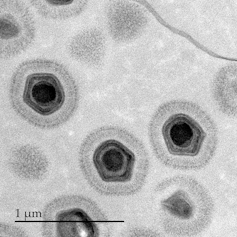
This approach was effective for isolating most viruses we knew about. Until the early 2000s, when an atypical virus was isolated by chance. Because it resembled a microbe, it was named mimivirus, for “microbe-mimicking” virus. Initially registered under the species name Acanthamoeba polyphaga mimivirus it was renamed Mimivirus bradfordmassiliense in 2024.
This initiated the discovery of a whole new group of “giant” viruses, called the Nucleocytoviricota. They are distinguished by their exceptional size, similar to that of small bacteria, and by massive DNA genomes that can reach up to 2.5 million base pairs, encoding genes from all domains of life.
Research now reveals these viruses — previously invisible to so-called traditional virology — as essential to the resilience of extreme polar environments.
Diversity across ecosystems
Giant viruses infect a wide variety of microalgae and small zooplankton. They have profoundly transformed our understanding of the nature of viruses, challenging the boundary between the living and the non-living and the extent of their dependence on the hosts they infect.
Some giant viruses carry part of their own replication machinery, which allows them to carry out most of their reproductive cycle within the host cell.
Today, the widespread availability of DNA sequencing techniques, the establishment of a specific taxonomic framework, and the development of bioinformatics tools for detecting these viruses have demonstrated the widespread distribution and great diversity of giant viruses across a vast number of ecosystems.
Research has shown that they play a major role in microbial functioning and dynamics on a global scale.
(Thomas M. Pitot), Author provided (no reuse)
Viruses as ecosystem engineers
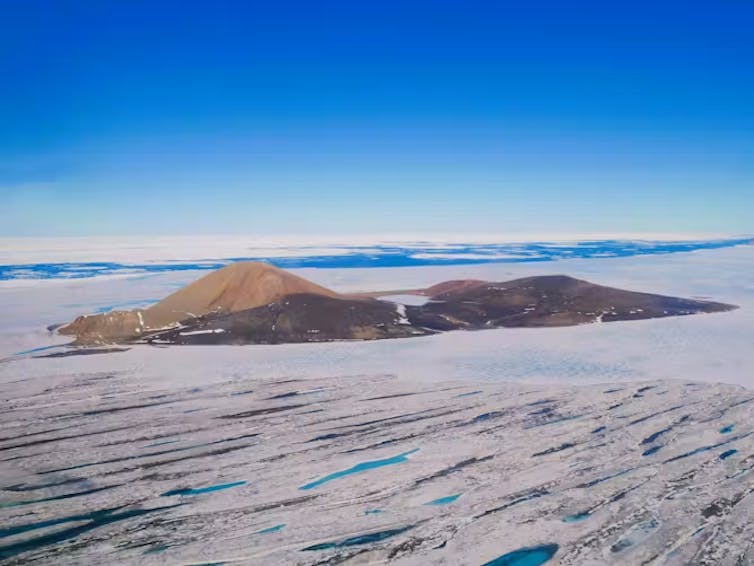
The structure of polar food webs amplifies the ecological impact of these viruses. In the aquatic or frozen habitats of the North and South Poles, in the absence of large multicellular predators, life is dominated by single-celled micro-organisms.
Protists and microalgae play central roles here, but they are also the preferred hosts of giant viruses, which sit at the top of the food pyramid.
These viruses are not simply parasites. They act as true biogeochemical engineers via two key mechanisms:
-
The viral shunt: By causing cell breakdown in their hosts, they release massive amounts of dissolved and particulate organic matter into the environment. This process feeds nutrients directly back into the microbial cycle, supporting local microbial productivity in the process.
-
Metabolic reprogramming: Through auxiliary metabolic genes, giant viruses actively modulate their host’s physiology and metabolic activity during infection. They appear capable of optimizing nutrient acquisition, manipulating lipid synthesis to maintain membrane fluidity or even influencing their host’s energy production.
Parasites in viral factories
The dominant influence of giant viruses at the poles is itself regulated by another, more discreet player: virophages (Lavidaviridae).
These small viruses can only replicate by parasitizing the “viral factories” created by giant viruses (of the Mimiviridae family) inside infected host cells. By hijacking their resources, virophages reduce the giant viruses’ ability to infect and also to produce virions (the free-floating form of the virus).
This “parasite parasitism” introduces an additional layer of complexity and has major consequences for the stability of ecosystems. For example, modelling based on the Organic Lake system in Antarctica shows that the presence of a virophage reduces microalgal mortality. Paradoxically, it allows for more frequent algal blooms by limiting the virulence of giant viruses — thereby stabilizing the food web.
(Penelope Blackburn-Desbiens), Author provided (no reuse)
Even more surprising is that certain virophages can integrate directly into a microbial host’s genome and remain dormant until the cell is infected by a giant virus. They then reactivate to hinder viral replication, functioning as a genuine antiviral defence system.
These complex interactions between hosts, giant viruses and virophages are essential to the resilience of extreme environments.
A sanctuary and climate sentinel
It is within this context that certain polar environments, such as the Last Ice Area, become unique reservoirs of viral diversity.
This is the region of the Arctic Ocean that is expected to retain its multi-year sea ice for longer than any other region in the North, in the face of current global warming. Located along the northern coasts of Greenland and the Canadian Arctic Archipelago, it is characterized by the thickest and oldest ice in the Arctic Ocean and considered a future climate refuge for ice-dependent organisms.
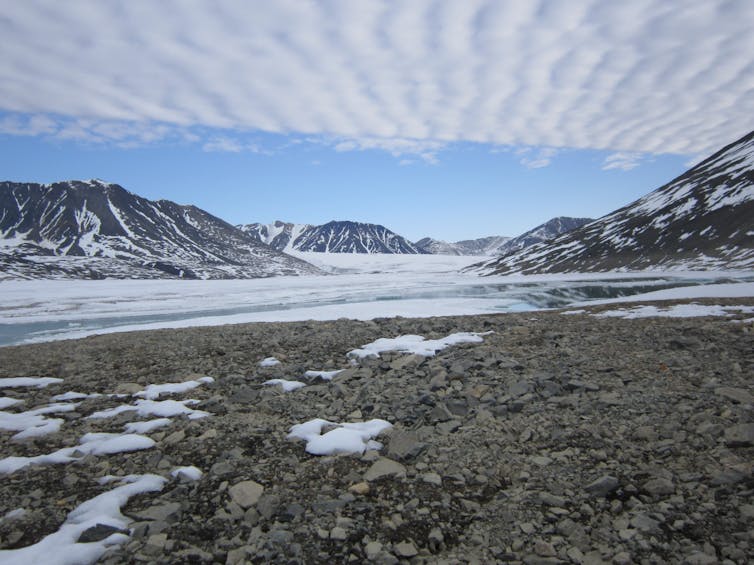
Along the margin of the last remaining ice field lies a narrow coastal strip comprising freshwater systems that are permanently covered by ice (epiplatform lakes, ice-dammed lakes, meromictic lakes), fjords, coastal bays and marginal land habitats. These systems are protected from change by the persistent cold conditions maintained by the Last Ice Area.
They have experienced centuries, even millennia, of uninterrupted cold, minimal hydrological connectivity and extreme geographical isolation. Within these systems, the viruses are spread across precise ecological niches dictated by gradients in light, oxygen and salinity, demonstrating a fine-tuned adaptation to the extreme constraints of the Arctic.
This coastal strip offers a natural laboratory for understanding how viruses and their hosts have developed and evolved under stable cold regimes. It also serves as a climate sentinel: rapid warming at the poles threatens the perennial ice covers and stratified water columns that maintain the isolation of its unique lakes, as well as the stability of the surrounding glaciers.
The breakdown of these physical barriers could trigger rapid ecological restructuring, a loss of unique microbial communities and long-term changes in the High Arctic ecosystems.