



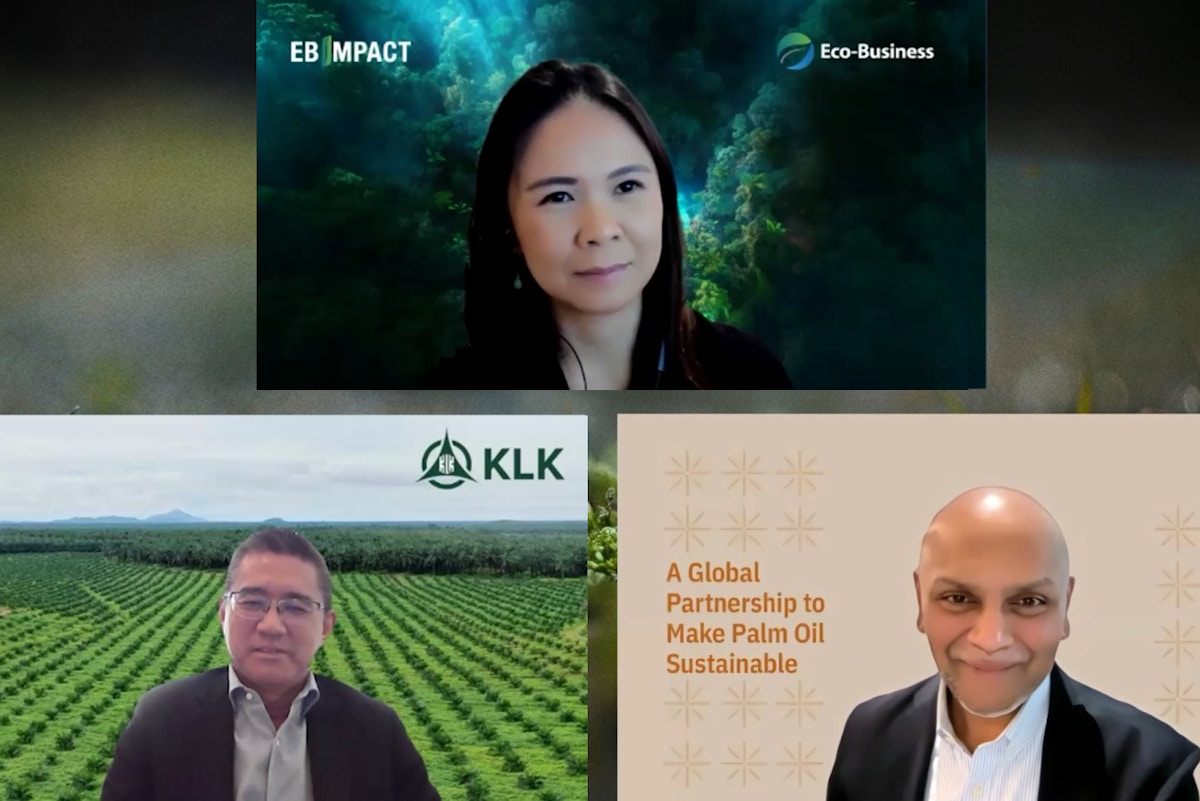
In this debut episode of Eco-Business’s new Resilience podcast series hosted by chief executive officer and founder Jessica Cheam, CEO of the Roundtable on Sustainable Palm Oil (RSPO) Joseph D’Cruz, and group chief sustainability officer of Bursa Malaysia-listed Kuala Lumpur Kepong (KLK) Group Ku Kok Peng, discuss what genuine resilience looks like across one of Southeast Asia’s most scrutinised industries.
The ongoing conflict in the Middle East has sent shockwaves through global energy and commodity markets, with fertiliser availability — a critical input for palm cultivation — emerging as a top concern. With a large share of global urea supply sourced from the Middle East, growers face both price spikes and outright shortages at a critical growing season in the agricultural calendar.
The current sustainability model, say the podcast guests, distributes costs and risks unevenly, with upstream producers and smallholders absorbing the compliance burden while downstream buyers capture the market benefits.
“Resilience means having surety that you have a partnership with your downstream, not only to be there to buy when you supply, but also to be there to help you deal with the shocks,” said RSPO’s D’Cruz. “That is where, even as a scheme, structurally, almost ideologically, we need to reframe.”
Both speakers expressed unease about regulatory directions that risk undermining the very resilience they are trying to build. Indonesia’s emerging policy signals, which include treating unplanted conservation land within concessions as idle and available for reallocation, threaten to erode the high conservation value and high carbon stock areas that RSPO members are required to set aside protect.
The EU Deforestation Regulation (EUDR), meanwhile, was questioned for adding compliance layers that fall disproportionately on smallholders least equipped to bear them.
“How have they helped these growers, including the smallholders? All that they have done so far is to demonstrate that they are very good at layering impractical bureaucratic layers after layers,” said Ku.
On leadership – perhaps the most human dimension of resilience as noted by this podcast’s moderator – both agreed that the sector needs a generational shift in thinking. D’Cruz pointed to companies built by founders who saw their enterprise as a legacy, not a quarterly earnings cycle. “The companies I would bet on in the long term are those where leadership is genuinely thinking about where this company is going to be 50, 100 years from now.”
Tune in to this conversation for insights into evolving industry regulations including the EU Deforestation Regulation (EUDR), the role of data and technology in building systemic resilience, and what leadership qualities are required to build resilience for communities in a turbulent era.
In a world increasingly defined by disruption, from climate shocks and pandemics to social fragmentation and economic uncertainty, Resilience explores the systems, communities, and individuals finding ways to adapt and thrive. Produced by Eco-Business, this podcast series dives into the intersection of climate, health, and the human spirit to uncover what it truly means to be resilient in the 21st century.
You can also listen to this podcast on Soundcloud and Spotify.