



For decades, consumers have been encouraged to take environmental action through personal lifestyle choices — bring a reusable bag, buy organic food, reduce air travel, cut plastic use, don’t eat meat.
In this episode of the Eco-Business Podcast, environmental social scientist Michael Maniates argues that this focus on individual action is not only insufficient in saving the planet — it is counterproductive.
” The myth that I’m calling out is what we see in shops, advertising, and supermarket aisles that says: ‘If you and I do these small gestures of environmental stewardship, we will be part of transformative change,’” said Maniates. “This perspective on how individuals make a difference is just flat out wrong.”
Maniates, formerly a professor of environmental studies at Yale-NUS University in Singapore, has spent decades studying green consumption and eco-lifestyles.
In his book, The Living Green Myth: The Promise and Limits of Lifestyle Environmentalism, Maniates contends that the emphasis on personal consumption has narrowed the scope of environmental action. By framing climate change as a problem of individual behaviour, attention is shifted away from the structural drivers of environmental degradation — energy systems, industrial production, and regulatory frameworks — and from the collective political action required to change them.
Green living has too often turned people into consumers, while the larger forces driving environmental destruction continue largely unchecked, Maniates said. So if buying green isn’t the answer, what is? And what does it mean to be an effective environmental citizen today?
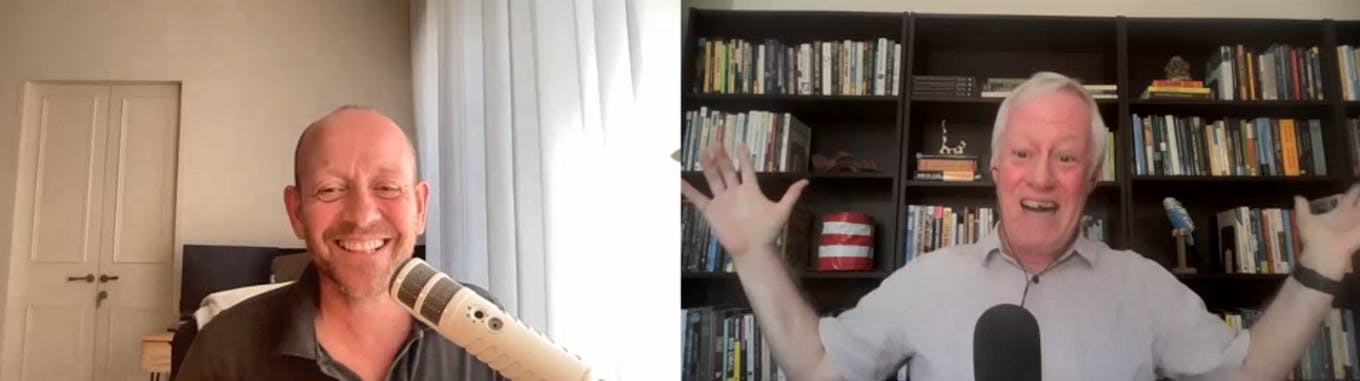
Michael Maniates (right) on the EB Podcast says living green “isn’t bad” but does not drive transformative change.
Tune in as we discuss:
- Why green living is a myth
- Does individual action not matter?
- How “we” hides culpability
- How green consumption reduces citizen activism
- Can only the masses drive change?
- Why have hope in an era of hyperconsumption?
The edited transcript:
Explain the key arguments you are making in your book, and why “green living” is a myth.
Buying green and living lean isn’t a bad thing. It can encourage mindful living, reduce exposure to toxins — for example through organic food — and even build community and credibility with others who care about environmental issues.
But it’s not well suited to driving transformative change. The “myth” I’m calling out is the idea — promoted in shops and advertising — that small acts like buying a product or changing a lightbulb can add up to systemic impact.
This way of thinking only emerged in the late 1980s and early 1990s, and it’s simply not supported by evidence. These actions are materially insignificant compared to the scale of the problem. Their impact is often offset by rising consumption, they don’t reliably spread, and they don’t lead to deeper civic engagement or lasting shifts in behaviour change.
I used to believe strongly in the power of green living, but the empirical evidence doesn’t show the spillover effects we might expect. If we’re serious about transformative change, then buying green and living lean are the wrong tools — despite what marketers suggest. The same applies to businesses: promoting the idea that consumer choices alone will drive change is ultimately self-defeating.
What evidence is there that green living choices are dwarfed by the scale of environmental destruction? And are you concerned this argument suggests individual actions don’t matter?
One useful benchmark is the ecological footprint, such as the calculator from the Global Footprint Network. Even highly committed individuals struggle to get below “two-planet living” — meaning their lifestyle would still require twice Earth’s capacity if adopted universally.
Part of the issue is that many impactful choices simply aren’t available to consumers. Another is that much of our footprint comes from shared infrastructure — roads, public systems — and from supply chains. In many cases, 90–95 per cent of a product’s environmental impact occurs before it reaches the shelf.
That said, individual action does matter – but not in the way we’ve been told. Before “green consumerism” took hold, individual action meant working collectively to shape systems and policies.
The point isn’t to dismiss green choices; it’s to recognise their limits. Overemphasising them — often with guilt and pressure attached — can crowd out more effective forms of collective action.
You use the metaphor of fighting a fire with teacups while arsonists add fuel. Who are the “arsonists”?
That’s a difficult question because environmental harm is diffuse. We often talk in terms of “we” — we’re destroying the planet, we’re creating waste — which obscures differences in power and responsibility.
This language is problematic because it hides who has the capacity to drive change and who bears the greatest responsibility. It shifts blame onto individuals and reinforces the idea that small consumer actions are enough.
A colleague calls this “consumer environmental scapegoatism” — placing responsibility on individuals while larger systemic forces remain unchallenged.
You’ve said green living can reduce citizen action. How does that work?
Social science points to a few reasons.
First, the idea that small consumer actions lead to deeper engagement doesn’t hold up. The skills needed to shop “green” are very different from those needed for civic or political action.
Second, people often feel they’ve “done their part” after making green purchases. That’s understandable, given how these actions are marketed — but it can reduce further engagement.
Third, green consumerism promotes a flawed theory of change: that you need large majorities on board to make progress. In reality, social change rarely works that way. Believing it does can lead to frustration and disengagement.
Can you give examples of green consumption that don’t change the system – such as electric vehicles (EVs)?
Technologies like EVs are improvements – they’re better than internal combustion engines. But they don’t necessarily transform the underlying system.
In many cases, what’s needed is a shift in systems altogether — towards things like dense urban design and effective public transport. Singapore already points in that direction.
At best, technologies like EVs buy time. Humanity is currently operating at about 1.8 “planets” worth of ecological demand each year — we’re running an ecological deficit. These technologies are really helping us to tread water in shark infested seasa.
Consumer choice can matter when it’s used strategically — through boycotts or coordinated action. But that’s different from the idea that everyday green purchases will automatically drive systemic change.
What about other personal actions, like flying less, eating less meat, or having fewer children?
These are complex issues. For example, while having fewer children may reduce resource use, the evidence is mixed — households without children may spend more on other carbon-intensive activities.
Similarly, if you choose not to fly, someone else may take that seat at a cheaper price. If you reduce meat consumption, market dynamics can offset the impact through pricing and supply.
These choices can reflect personal values, and I respect that. But their systemic impact is limited unless they’re paired with broader efforts — like policy changes, infrastructure investment, or shifts in production systems.
Why do your arguments matter in places like Singapore, where green consumerism was never really a trend anyway?
Even in Singapore and across Asia, we’re seeing growing interest in sustainable products — alongside rising scepticism about greenwashing.
At the same time, the belief persists that widespread adoption of green behaviours — like recycling or dietary change will solve environmental problems. That’s the green living myth.
Businesses are often encouraged to meet this demand with more sustainable products. While that has value, it can reinforce the idea that consumption alone will drive change — rather than mobilising the citizen engagement needed to shape policy and systems.
What do you mean by “citizen activism,” especially in contexts where that term can be sensitive?
I prefer to think in terms of “citizenship” or “advocacy” rather than activism in the narrow sense. It’s not just about protests or throwing paint at expensive works of art.
It’s about working with others for the common good — identifying leverage points where small, coordinated actions can have large effects. That might involve engaging with policy, supporting collective initiatives, or building expertise in a specific issue.
The key shift is from thinking like a consumer to thinking like a citizen.
How hopeful are you about the future?
I love the saying — I think it comes from David Orr, who’s one of the grand old men of American environmentalism – that hope is a verb.
Hope is something that comes to you when you’re working with others to try to make a difference. That’s where my hope comes from; collaborating with others as an educator to try to give people the tools and the insights that they need to move forward in their own way.
For me personally, I’m the father of — sorry — three children, two grown up and one who’s an 8-year-old from a second marriage. It’s only when you start having kids, the future really starts to feel like it’s a real thing. Because you’re thinking, how is it going to be for them?
I am hopeful for the future — if we’re talking about 2125 or 2150. I take a page out of the book of Kim Stanley Robinson, the Hugo Award-winning science fiction writer, who many of your listeners may know from his recent novel, the Ministry of the Future.
I was on a panel with Stan many years ago and he made the argument that it’s not too late to save the planet. We have got to have hope, but you have got to take the long view. The long view says that things are likely going to get worse before they get better.
It’s hard for me personally to argue with that, looking at the momentum of climate change, of ice loss, of biodiversity loss, of ocean acidification.
It doesn’t mean it has to be that way. What it means is that we, who are on the earth now at this particular moment of crisis and change, have this opportunity to get the ball really rolling in a good direction — to plant a flag for a slowly bending arc towards true sustainability and prosperity for the human and the non-human world.
We can make choices now that make it much easier for generations ahead to pick up the pieces and build something good. My hope comes from the deep belief that four or five generations from now, people are going to look back and say: “Man, those people in the 2020s and 2030s, they had a lot of crap raining down on them. But despite that, they began to set in motion a set of changes that makes it now possible for us to be in a world where there’s sustainability and prosperity and justice.”
And I want to be part of that story. It doesn’t mean that it’s all going to be kittens and rainbows right now. But we have an opportunity to be respected, if not revered by the generations that follow. And that is an honour and a privilege we ought not turn our back on.
But we have got to do more than be smart shoppers at the mall.