



Gordon Saft is the Publisher of Rest of World. Last week, he returned to New York from a trip to China with a delegation of leaders from across media, technology, public policy, and finance to gain a deeper understanding of the AI and robotics industries.
On my first morning in Beijing, before joining a delegation trip on China’s AI and robotics industries, I visited an exhibition by the Belgian-born conceptual artist Carsten Höller, called “Two.” Visitors enter through one of two doors, assigned at random. One half of the space is a full-color replica of the other rendered entirely in black and white. Walking through it, everything felt familiar yet slightly off all at once.
The debate over AI in the U.S. has long felt oppositional and binary: open versus closed, diffusion versus frontier, LLMs versus world models. Underneath it is a bigger framing that treats the U.S. and China as two competing models for how AI should be built and deployed, racing toward different futures. I wanted to understand if this held up on the ground, 18 months after DeepSeek’s launch reshaped open-source AI.
The institutions and politics diverge significantly, and the technology carries risks neither country can wave away. I expected the differences to be what struck me. Instead, it was the similarities.
I’d made a few similar trips to European cities over the past year, and each left me rattled by conversations about stagnation and uncertainty, a pessimism about technology and growth more entrenched than anything in America’s own debates. China was the opposite. I came back to New York surprised by how familiar the dynamism and optimism felt.
One theme surfaced repeatedly: China’s intense focus on deploying AI into the physical world, in robotics, manufacturing, electric vehicles, and embodied intelligence. Whether that’s conviction or a response to American export controls depends on who you ask. One researcher argued chips aren’t the real constraint anymore, data is. If he’s right, the export control debate is fighting yesterday’s war. Even Washington’s strongest leverage hasn’t held: Last summer, restrictions on EDA software were relaxed within weeks as part of a trade deal tied to rare earths.
The more people I talked to, the less this looked like innovation versus regulation and the more it looked like two powers staring at different maps.
Xi Jinping’s recent speeches on AI are more nuanced and technically informed than many Western observers assume, several China experts told me before the trip, and Beijing has worked to present itself as a responsible steward of AI rather than a competitor. What surprised me more was how often AI safety came up in these conversations. One analyst described responsibility for AI safety as increasingly sitting inside China’s national security establishment, treating advanced AI as strategic capability first, consumer technology second. Additionally, China’s capacity to move quickly is inseparable from a political system that places far less weight on individual liberty, due process, and constraints on state power. The surveillance cameras on every block are impossible to ignore.
The more people I talked to, the less this looked like innovation versus regulation and the more it looked like two powers staring at different maps. In the U.S., the limit is frontier capability itself, plus the looming threat of rare-earth leverage. In China, the conversation kept returning to deployment, and how quickly powerful models could be embedded into everyday life. It’s why the LLM-versus-world-model debate feels alive in China. If embodied AI is the next frontier, the scarce resource may be high-quality interaction with the physical world rather than raw compute, and China is generating exactly that.
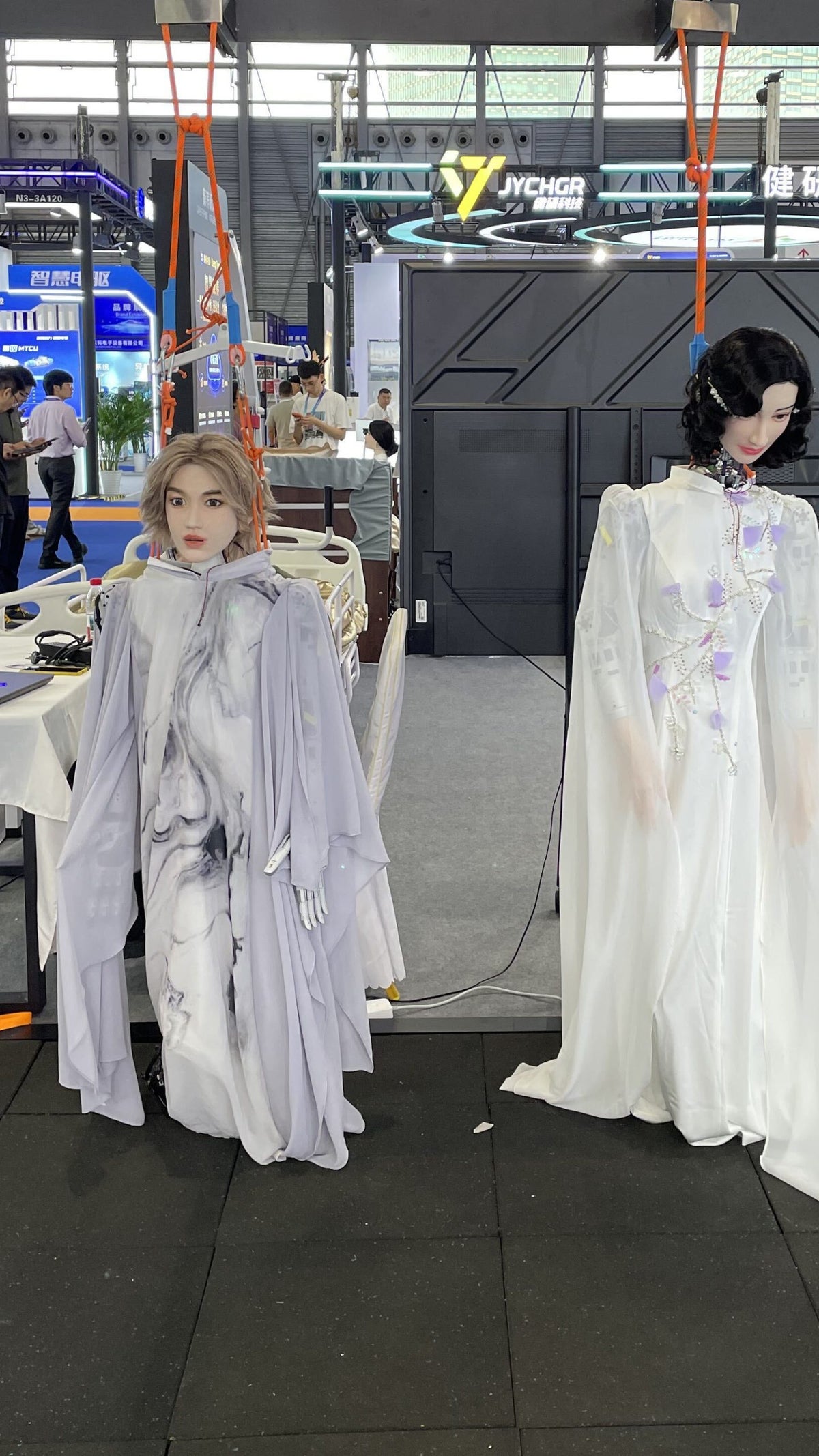
Gordon Saft/Rest of World
China’s focus on deployment appears to be intentional. Cut off from leading-edge chips, the country has leaned into ground it can still win: getting AI into factories, vehicles, and everyday life faster than anyone else. Whether that’s conviction or necessity may not matter. If embedding AI across an economy ends up mattering more than owning the best frontier model, China’s constraint may have become its strategy.
On my last night in Shanghai, I walked into the Huawei flagship store directly across from an Apple Store on Nanjing Road. Where a Genius Bar might be in an Apple Store, Huawei had filled the back with electric vehicles. I thought of the Xiaomi factory we’d visited earlier, a phone company that became one of China’s largest EV manufacturers in just a few years. We rode a trolley through a robotic assembly line like an attraction at Universal Studios, watching cars that looked like electric Porsches glide silently through production. Apple spent years trying to build a car before abandoning the effort; adapting consumer hardware manufacturing into EVs was the very thing Xiaomi had pulled off.
Höller’s exhibit stayed with me. Your sense of which side is real depends entirely on which door you entered through. Dizzyingly, China felt like that. Everywhere I turned, there was something familiar: a slightly more advanced smartphone, a robot-operated coffee shop, a sleek electric vehicle — each refracted through a different political system and a different bet on the future. The differences were expected; the similarities were the surprise.