



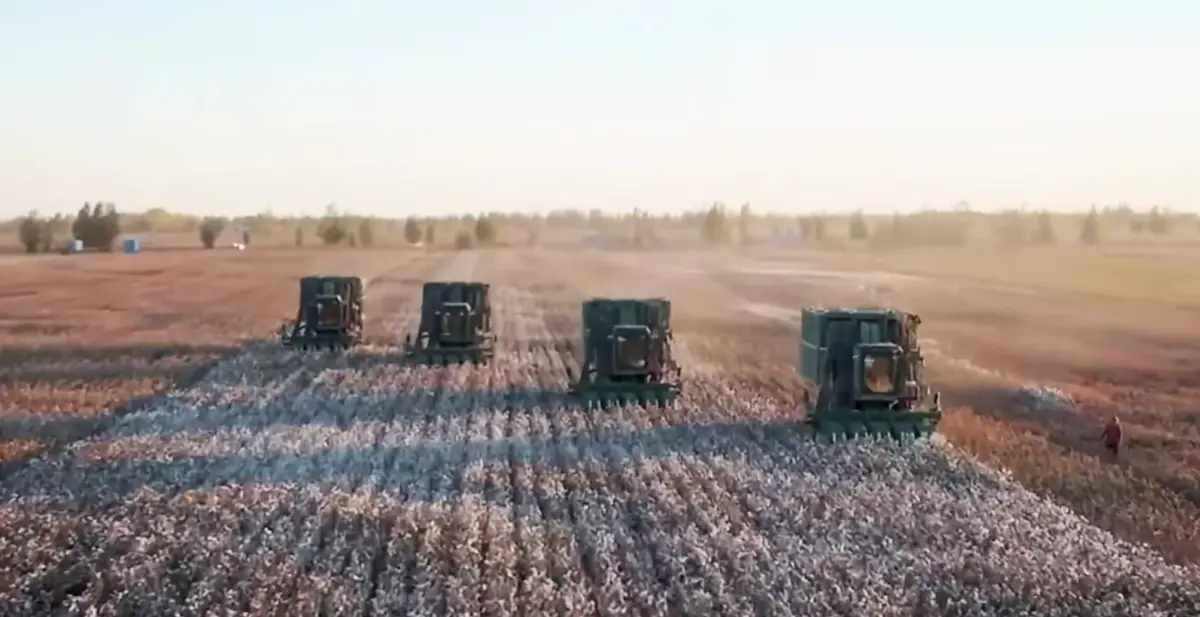
Screenshot from China Daily Online’s video, shared via the “We are China” account on Facebook, detailing the automation of cotton production in the Xinjiang region. Fair use.
This post is part of Global Voices’ August 2026 Spotlight series, “Indigenous Rights.” This series offers insight into the lives and experiences of Indigenous peoples to build connections across regions, center Indigenous experiences, and share the stories of leaders, activists, community members, and more. You can support this coverage by donating here.
A new regulation took effect in China’s Uyghur region on July 1, 2026: The Xinjiang Uyghur Autonomous Region Regulations on Promoting Cotton Quality (新疆维吾尔自治区棉花质量促进条例). While the new law makes the cotton supply chain traceable, it does not address longstanding evidence and reports of forced cotton-picking labor. The coercive land and labor transfer system that underpins the automated cotton and agricultural industry may cause irreparable harm to Uyghurs and other Indigenous peoples, as UN human rights experts warned.
The Chinese government describes the regulation with familiar language: “high-quality development,” improved cotton quality, protection of producers’ interests, and stable supply chains. But the regulation’s actual reach extends far beyond technical standards for cotton fiber. It creates a legal framework for supervising the entire production chain — from the farmer and plot of land to the processing plant, warehouse, and final point of sale.
The law covers planting, harvesting, purchasing, processing, sales and storage. It requires producers and businesses to maintain traceability records identifying the grower, the land plot, the cotton variety, and the quantity and date of purchase and processing. These records must be retained for at least five years. Every bale must carry barcode information corresponding to its type, grade, quantity, and processing history.
The regulation also gives authorities extensive supervisory power. Cotton businesses are subject to inspections, credit evaluations and a possible “exit mechanism.” Their evaluation results can affect policy support and access to finance.
Under this system, every bale of cotton is not only a commodity; it is a unit of data connected to a farmer, a piece of land, a processor, and a state-controlled regulatory structure.
For Uyghur farmers, this is especially significant. A 2020 report from Xinhua, a state-run media group, stated that around 7 million people in the Uyghur region were engaged in cotton production, about 70 percent of whom were Uyghurs and members of other Indigenous peoples, according to the government’s own figures. The report acknowledged that cotton was a main source of income, particularly in Uyghur-majority southern areas.
The new regulation makes this livelihood more visible and controllable. It does not merely provide information about the grade of cotton. It allows the state and participating enterprises to follow cotton from a specific farmer and field through every subsequent stage of the supply chain.
The “separation of three rights” land system behind the cotton law
The 2026 regulation builds on an earlier restructuring of rural land.
In 2018, the regional government issued an implementation opinion on the “separation of three rights” (“三权分置”) in rural land: collective ownership, household contracting rights, and management rights.
Under this system, the land remains collectively owned, while households formally retain contracting rights. However, management rights can be transferred to cooperatives, companies and other state-approved “new-type agricultural business entities.”
The policy explicitly described the low rate of land transfer in southern Uyghur areas — then below 15 percent of arable land — as a problem. It called for land-share cooperatives, trusteeship arrangements, managed cultivation and other forms of large-scale farming. It further instructed authorities to examine whether incoming operators fit local development and poverty-alleviation plans and could absorb local labor.
This arrangement leaves farmers with a formal connection to land while shifting practical control over cultivation, machinery, inputs, processing, and marketing toward cooperatives and companies. The same policy calls for Communist Party organizations to be established inside the agricultural entities that receive and manage transferred land.
The official language describes this as “reform.” In practice, it restructures rural life by moving Uyghur farmers away from independent cultivation and into organizations that are subject to corporate management and Party supervision.
Cotton, land transfer, and Fanghuiju
The connection between cotton, land transfer, and political control is explicit in official reporting.
A 2018 report from China Science Daily, a state-run media group, detailed a cotton project in Company 4 of Regiment 51, Third Division of the Xinjiang Production and Construction Corps. The report stated that over 95 percent of residents there were from Uyghur and other Indigenous communities. The project was coordinated with the “Visit the People, Benefit the People, and Gather the Hearts” (访民情、惠民生、聚民心) program, known in Chinese as Fanghuiju (访惠聚).
It linked research institutes, technology companies, cooperatives, and farmers in one production structure. According to the report, land transferred into the project was paid at 650 Chinese yuan per mu (approximately USD 96.7 per 666.67 square meters). Farmers were told that, after transferring their land, they could obtain additional income by working on the same land.
The project brought standardized seeds, mechanization, irrigation management, aerial crop protection, and data services under the direction of research institutes, companies, and cooperatives. Officials said mechanized management could raise the area managed by one person from 30–50 mu to 100–200 mu.
This is not a model that preserves farmers’ independent control over their own land. A farmer transfers land into a company-centered chain, loses day-to-day control over cultivation, and may return to the same field as a wage laborer.
The government celebrates this transformation as an achievement. But the official account itself records a fundamental change in the farmer’s position: From cultivator to land-transfer recipient and potential worker inside a state-directed industrial system.
Land transfer under a stability campaign
The political environment in which these land transfers take place is crucial.
A 2019 directive from the regional Grain and Material Reserves Bureau ordered Fanghuiju village work teams to regard “maintaining social stability” as their core task.
It instructed them to conduct regular household visits, implement stability measures, expand rural labor transfers, and intensify land transfer as a targeted poverty-alleviation measure.
The same directive instructed cadres to guide residents to “feel gratitude to the Party, listen to the Party, and follow the Party.” It also called for stronger village-level Party organizations.
This official document directly connects land transfer with political instruction, household-level presence, labor mobilization, and stability control. It reveals that land transfer was not being pursued as an ordinary commercial arrangement between farmers and businesses. It was an instrument within a broader campaign to reshape rural Uyghur society.
These documents alone do not establish that every individual land-transfer contract was signed under direct physical coercion. But they do establish something essential: Farmers were asked to make supposedly “voluntary” decisions inside a system that linked land, employment, poverty policy, surveillance, political education, and social stability.
Under such conditions, official claims of voluntariness are not credible on their face.
Traceability without accountability
China’s cotton industry has rapidly expanded its mechanization process. A 2025 report from Xinhua claimed that the region’s cotton planting, cultivation and harvesting system had reached a 97 percent comprehensive mechanization rate. But this is not evidence of farmers’ economic freedom. It shows the scale at which a highly centralized, standardized production system has been constructed.
Mechanization reduces the need for labor on farms while land-transfer policies channel management rights to cooperatives and companies. Fanghuiju teams simultaneously promote labor transfer, political conformity, and village-level control. As pointed out by a UN report released in January 2026, human rights experts criticized China’s “poverty alleviation through labor transfer” program, saying it coerced Uyghurs, Tibetans, and other Indigenous peoples into jobs in the Uyghur region and elsewhere.
The new cotton-quality regulation completes this structure by making the cotton supply chain traceable, inspectable, and governable through data.
This matters internationally. Cotton is one of the sectors specifically prioritized under the United States’ Uyghur Forced Labor Prevention Act, which presumes that goods made wholly or partly in the Uyghur region are prohibited from import unless importers can meet a high evidentiary standard.
China’s new barcode and traceability system should not be confused with accountability. A barcode may reveal where a bale came from, but it cannot establish whether the farmer who produced it had meaningful freedom to keep their land, reject a transfer, choose their work, or resist the political system governing their village.
For Uyghur farmers, the central question is not the quality grade of a bale of cotton. It is who controls the land, who directs labor, who owns the data, and whether Uyghurs can retain any meaningful economic independence in a system that now tracks every stage of the harvest.