



“Seeing the Earth from above is a powerful reminder of our interdependence,” Thomas Pesquet. The words of France’s tenth astronaut to head into Space are a reminder of how we are “in this together”, something that the world’s Aerospace industry players should take heed of as they gather in Paris for the first-ever International Space Summit between September 9-10th.
The event is a prime occasion for showcasing Europe’s ambitions in orbit, namely France’s National Space Strategy 2025-2040, but the summit more importantly underscores a lesson from Europe’s space history: its greatest successes have come through cooperation, not countries acting alone. As competition in space intensifies, that collective strength may matter more than ever.
A new space race is under way, and the nature not just the scale of it is changing. The sector is entering an era marked by intensifying rivalry between EU member states – but also by an unprecedented degree of industrial and technological interdependence. For Europe, it’s not about managing a contradiction; it’s about taking the only viable path forward. The continent’s space ambitions, and ultimately its strategic autonomy, now depend on a single underlying mechanism: multilateral “coopetition,” a deliberate blend of cooperation and competition between several rivals.
Four flagship European programmes – Galileo, Copernicus, Clean Sky, and IRIS² – show why collaboration, not national or corporate self-sufficiency, has become Europe’s only realistic route to sovereignty in space.
Nearly $137 billion: that is the record level of global space spending in 2025, announced at the France’s 14th Perspectives spatiales conference, which gathers institutional, industrial, and academic players from across the sector. This colossal sum is sharpening appetites everywhere. But it is also exposing a structural truth: mastering the entire space value chain is now beyond the reach of any single state, agency, or company – including the most powerful ones.
Even Europe’s largest industrial players are compelled to work with their direct competitors.
French firm Thales Alenia Space and Germany’s OHB System are jointly developing radar instruments for the European Space Agency’s (ESA) Harmony mission, which monitors changes in the Earth’s shape. More recently, Dassault Aviation and OHB System joined forces to pitch ESA a multipurpose space plane, VORTEX-S.
These are not isolated alliances of convenience. They are the visible tip of a much deeper European strategic shift: from competing for sovereignty to building, it together.
To understand this shift, we studied the actors involved between 2017 and 2026 in four landmark European programmes:
-
Galileo (Europe’s own satellite positioning system)
-
Copernicus (the EU’s satellite Earth-observation system)
-
The Clean Sky network (sustainable, climate-neutral aviation)
-
IRIS² (the EU’s forthcoming secure satellite telecommunications constellation).
Together, they form the clearest evidence yet that Europe’s future in space and arguably its future as a sovereign technological power, will be written collectively, or not at all.
A new strategic standard for European sovereignty
Coopetition rests on a paradoxical logic: actors competing for the same markets
simultaneously agree to cooperate on parts of their activity.
For decades, management sciences scholars mainly studied it as a relationship between two rival firms. The European space sector tells a different story – one of multilateral coopetition, involving states, agencies, large industrial groups, SMEs, and start-ups, all of them competitors to varying degrees, all of them needing each other.
Wikimedia
Read more:
Carbon capture explained: how EU member states are funding and rolling out the technology to clean up Europe’s fossil fuel industry
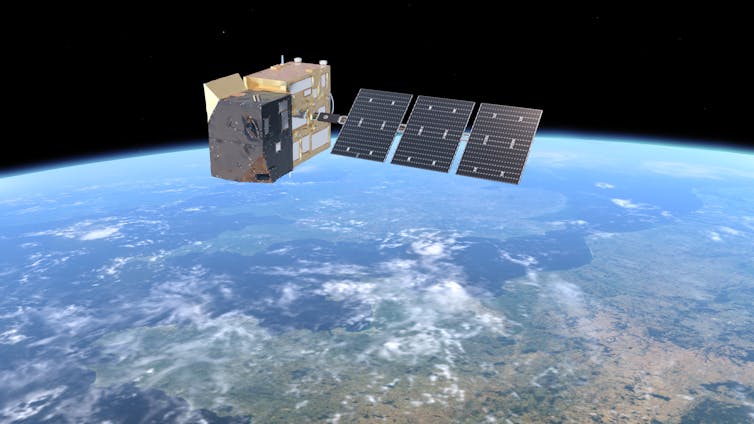
Copernicus is the clearest illustration of this. The EU Earth observation programme tracks emissions, land use, forests, oceans and ice. It is run by the European Commission along with the European Space Agency, EUMETSAT, and other partners; and operates using satellite technology to provide free, very high quality imagery. This open infrastructure lets European SMEs and start-ups build commercial services such as crop monitoring, methane-leak detection, forest surveillance – without ever having to fund their own satellite program. It is a European public investment that directly qualifies as private European innovation, at a scale no single member state could replicate alone.
IRIS², Europe’s new flagship satellite constellation programme, pushes the model further still. It brings together three competing European operators – France’s Eutelsat, Luxembourg-based SES, and Spain’s Hispasat – united under the SpaceRISE consortium specifically to guarantee Europe its own secure, sovereign communications infrastructure, independent of non-European systems.
The message is unambiguous: European digital and strategic sovereignty is being built through alliance between rivals, not in spite of it.
The European Space Agency as sovereignty’s orchestrator
Our research shows that the knowledge-sharing problem at the heart of coopetition can become so complex that a trusted third party is needed to hold the system together. In Europe’s case, that role falls on the European Space Agency.
Spech/Shutterstock
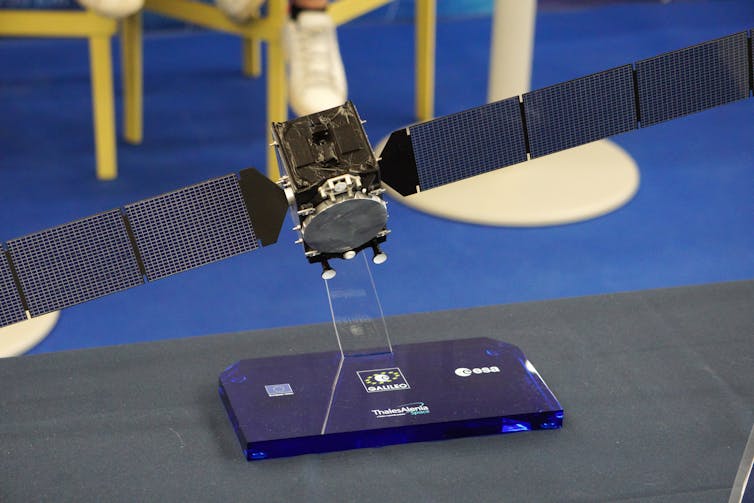
ESA occupies a unique dual position: it is both the programme owner for financing projects, and setting specifications for example, and a technical prime contractor which steers satellite development alongside industry. This dual mandate gives ESA a power of orchestration that no purely national agency or single company could exercise alone.
In Galileo, competing manufacturers were reluctant to share certain critical knowledge directly with each other.
ESA stepped into that gap: each company shared its knowledge with the agency, which filtered, aggregated, and redistributed what each partner needed. Without that European-level centralising function, Europe’s GPS simply would not exist.
What multilateral coopetition delivers for Europe
Our diverse studies point to three concrete benefits that explain why Europe keeps choosing this model for its flagship programmes.
Reaching a critical mass Multilateral coopetition lets Europe tackle technological challenges no single actor could meet, by pooling financial, technological, and human resources at continental scale. The main satellite constellation could never have been built without combining the expertise of Europe’s entire space industry – it is, quite literally, a sovereignty project that only exists because competitors cooperated.
Sharing valuable and strategic knowledge
Coupled innovation projects between competitors depend on sharing heterogeneous,
complementary knowledge. Without that sharing, the project fails outright – there is no fallback for national self-sufficiency.
Reducing the risks and costs associated with innovation development
In long horizon, high-stakes programmes like Galileo or IRIS, coopetition spreads each company’s exposure to technological and financial risk across the whole consortium – a mechanism long identified as one of coopetition’s founding drivers, and one Europe now relies on structurally.
Management is the real key to coopetition and sovereignty
None of this is a smooth ride.
Multilateral coopetition generates real tension. As the number of partners grows, power dynamics get harder to manage: coalitions form, hidden opportunism creeps in, knowledge gets misappropriated, and value sharing becomes unbalanced. These risks already exist between two competitors; multilateral coopetition amplifies them. Yet management sciences research on bilateral coopetition insights cannot be transposed to managing multilateral coopetition at the scale Europe now needs.
Our research points to a specific answer: project teams, built across competing organisations, that facilitate knowledge sharing and technical compatibility while still protecting each partner’s competitiveness. More broadly, every one of Europe’s successful programmes converges on the same hybrid management model – formal mechanisms (contracts, governance rules, IP arrangements) combined with informal ones (trust, personal relationships, shared professional norms). It is this combination, not contracts alone, that keeps cooperation and competition in balance.
Clean Sky is a striking case. This €5 billion programme aims to cut aircraft CO₂ emissions, nitrogen-oxide emissions, and noise. Eleven competitors – Airbus, Safran, Dassault, and others – sit around the same table at the Network Management Office, where technological priorities, budgets, and IP rules are all formally set out. But on the ground, contracts only go so far. Project leaders talk daily, know each other, and trust each other; over time, shared habits define what can be said openly and what stays confidential. That informal layer of trust is itself a European strategic asset – one that cannot be legislated into existence, only built over years of joint programmes.
A community of passionate European space professionals
Individuals are the ones who actually make this work.
Engineers, project managers, and program directors navigate daily between loyalty to their own organisation and the collective imperative of the programmes, managing the tensions that coopetition inevitably produces.
This is especially visible in the European space sector, which remains, at its core, a community of passionate people who often know each other, have frequently worked together before, and share – beyond their corporate or national rivalries – a common ambition to advance European space and see it succeed on the world stage. That shared identity is arguably as important to European sovereignty as any single satellite or constellation.
Multilateral coopetition: the precondition for Europe space leadership
Managing multilateral coopetition effectively is a prerequisite for European leadership in space. The states and companies that master it are the ones positioned to secure Europe’s place in the next phase of the space race.
The stakes extend well beyond industrial performance: in a world where space data increasingly underpins agriculture, defence, and climate action, mastering coopetition is mastering sovereignty.
That is the wager behind every one of Europe’s flagship programmes: Galileo for navigation, Copernicus for Earth observation, IRIS² for secure communications, Clean Sky for the aviation of tomorrow. Each one is, in its own way, proof that for Europe, there is no sovereign future in space if it’s not a collaborative effort.
A weekly e-mail in English featuring expertise from scholars and researchers. It provides an introduction to the diversity of research coming out of the continent and considers some of the key issues facing European countries. Get the newsletter!