



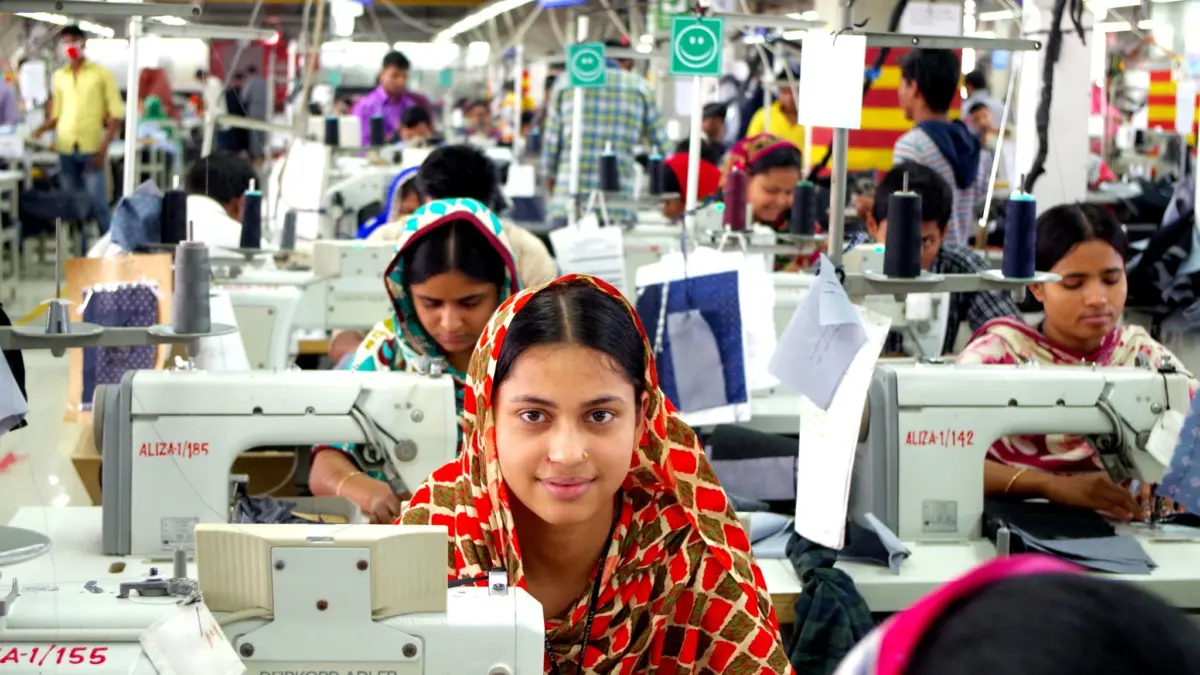
Workers at a garment factory in Gazipur, Bangladesh. Image via Flickr by Solidarity Center. CC BY 2.0.
In April 2026, Bangladesh’s Parliament amended the country’s labour law, extending maternity benefits for eligible workers from 112 to 120 days, or approximately four months. Yet for many women in the country’s garment factories, the harder question begins when that leave ends: Who cares for their babies while they return to shifts that may last 10 to 14 hours?
The pressure is not limited to garment workers. Across Bangladesh, working mothers often depend on relatives or informal care networks, while affordable, quality childcare remains limited. The International Labour Organization (ILO) has noted that Bangladesh’s traditional family-dependent care system is under pressure as patterns of work and migration change. For low-income workers with long or unpredictable hours, that gap can be especially difficult.
International brands and factories increasingly point to maternity policies, breastfeeding rooms and on-site daycare facilities as signs of progress. The question is whether those facilities are adequately staffed, accessible during long shifts and genuinely usable.
Morsheda, 33, originally from Narsingdi, has worked in the garment industry for 15 years and currently works at a factory in Gazipur. She was interviewed in person by Global Voices in Gazipur in July 2026 for this article. After four months of maternity leave, she returned to work while her five-month-old baby remained with the child’s paternal grandmother.
Before reaching the production floor, she prepares meals, cleans the house and gets her older child ready for school.
“Buyers come and talk about different policies and workers’ rights. But our duty doesn’t get any shorter. We still work at least 10 hours a day, and with overtime it becomes 13 or 14 hours,” Morsheda said. “Sometimes I worked from eight in the morning until ten at night. My body was exhausted, my breast milk leaked, but I had to clean myself and continue working.”
The factory had a breastfeeding room, but access was another matter.
“The breastfeeding room was always there. But there was no one to bring my baby to me.”
When her older child was an infant, Morsheda’s mother briefly stayed with her and brought the baby to the factory. Later, she relied on a paid caregiver who would not make repeated journeys for breastfeeding. Her five-month-old baby now stays with the child’s paternal grandmother, who brings the infant to the factory twice a day.
“I have to finish the hourly production target before I go; otherwise, the supervisor gets angry.” Morsheda said.
Her experience reflects a wider childcare problem documented in urban Bangladesh, where formal options can be limited or unaffordable and families piece together care around work. For garment workers, that can mean moving children between grandmothers, paid caregivers and older children.
Mina, 38, originally from Rangpur, has worked in the garment industry for around 20 years and currently works in Savar. Global Voices interviewed her by phone call in July 2026. When her child, now five, was an infant, she received 56 days of maternity leave.
“When my child was younger, I brought my mother from the village. She looked after my baby for around four or five months. Later, she went back to the village. Then I kept my child with another person by paying money. When I could no longer manage the cost, I kept my child at the factory daycare. But my child became sick there, and I had to take the baby to the hospital. After that, I stopped keeping my child at the daycare.”
With no reliable option left, responsibility eventually passed to her elder son.
“I knew it was affecting my elder son’s studies, but I had no other option.” Mina said.
Both women described factories where women make up more than half of the workforce but daycare space is limited. At Morsheda’s factory, where around 3,000 people work and nearly 2,000 are women, the daycare accommodates only about 12 or 13 children and has two caregivers. Both women also raised concerns about hygiene and the quality of care.
A national industry tied to global fashion
Bangladesh’s ready-made garment industry generates more than USD 36 billion in exports and employs approximately 4.5 million workers, more than 57 percent of them women. In 2024, around 40 percent of garment exports went to the European Union and another 18 percent to the United States.
Garment employment has expanded women’s access to paid work, but women still shoulder most unpaid care work at home. Bangladeshi women spend more than seven times as much time on unpaid care and domestic work as men, according to a national Time Use Survey cited by the ILO. An ILO-supported study found that 54 percent of working parents viewed inadequate childcare as a major barrier to women entering or remaining in employment, while 18 percent said they had left a job because of childcare responsibilities.
Bangladesh’s labour law requires establishments with 40 or more women workers to maintain suitable rooms for their children under six, with trained or experienced female caregivers and access for mothers. But that requirement does not answer the practical questions raised by Morsheda and Mina about capacity, staffing and whether mothers can use the facilities during production hours.
Beyond Bangladesh
The ILO estimates that the global garment industry employs around 94 million workers, nearly 60 percent of them women.
The legal protections differ. Bangladesh now provides 120 days (4 months) of maternity benefits for eligible workers and requires childcare rooms in establishments with 40 or more women. Vietnam provides six months of maternity leave; women nursing a child under 12 months are entitled to 60 minutes of paid breaks each working day, and employers are required to assist with daycare or kindergarten facilities or cover part of childcare costs. Cambodia provides 90 days of maternity leave, with half wages and benefits for workers with at least one year’s seniority. During a child’s first year, mothers are entitled to one hour of paid breastfeeding time each workday, while employers with 100 or more women must operate a nursing room and a daycare centre, or in some circumstances cover childcare costs.
Yet legal provision does not remove the problem of access. In Vietnam, ILO research found that women made up 74.8 percent of the textile and garment workforce, while 40 percent of workers in the sector worked more than 49 hours a week in 2023.
VnExpress reported that public nurseries around industrial zones were limited, private care could be expensive and many preschools closed before factory overtime ended.
In Cambodia, World Bank reporting documented similar dependence on family care. Garment worker Srun Saren left two children with her 75-year-old grandmother and expected to leave her job after a third child because adequate care was unavailable.
Another worker, Kang Somaly, left garment work after failing to find care for her four-month-old baby and seven-year-old child.
Across Bangladesh, Vietnam and Cambodia, women sustain garment production while families absorb much of the childcare that makes their employment possible.
From responsible sourcing to meaningful support
The idea that support should extend beyond maternity leave is reflected in existing labour programmes. The ILO and UNICEF’s Mothers@Work initiative for Bangladesh’s garment sector identifies seven minimum standards, including paid maternity leave, breastfeeding and childcare facilities, flexible working arrangements, health protection, medical benefits, employment protection and non-discrimination. A 2022 ILO assessment found improvements in factory maternity and breastfeeding policies, while also highlighting women leaving and re-entering employment because of childcare responsibilities.
The findings shift attention from the existence of childcare facilities to how they function in practice, including whether workers can use them during long shifts and while meeting production targets.
Neither Morsheda nor Mina identified the international brands sourcing from their factories, and their experiences cannot be attributed to any particular company. Their accounts illustrate how childcare responsibilities may remain outside formal factory systems, relying instead on grandmothers, paid caregivers and, in some cases, older children.
Bangladesh’s extension of maternity benefits to 120 days has expanded formal maternity protection for eligible workers. However, the experiences of Morsheda and Mina, together with findings from the ILO’s Mothers@Work qualitative assessment, point to continuing childcare challenges after workers return from maternity leave.