



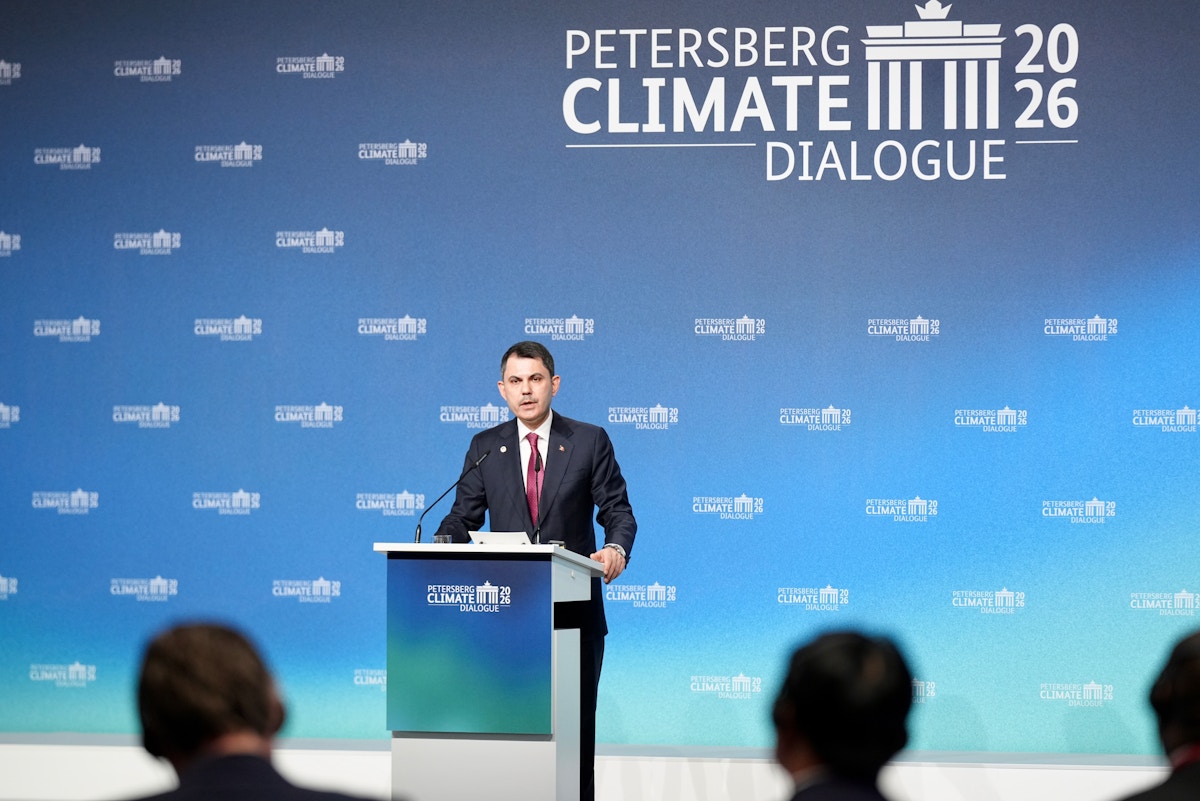
“Energy systems, which have lifted billions of people out of poverty, are experiencing a global crisis for the second time in four years. But this crisis has clearly shown us that fossil fuels do not guarantee energy supply security,” COP31 president Murat Kurum said in a speech delivered at the Petersberg Climate Dialogue in Berlin on Tuesday.
Referencing the historic pledge to triple renewable energy deployment by 2030 agreed by countries at the COP28 climate talks in 2023, Kurum said the transition to diversified, renewable energy systems must accelerate, by countries “working together to bridge the gap between global needs and available resources.”
Kurum’s remarks come against the momentum of Earth Day 2026’s theme, “Our Power, Our Planet”, calling for accelerating the transition to renewable energy by strengthening environmental policy and community action, rather than relying on political decisions. Multilateralism may refer to cooperation among states at the international level, but in practice, it depends on and increasingly integrates community and locally led action, say UN observers.
Earth Day, which is celebrated every year on 22 April, marks the anniversary of the birth of the modern environmental movement, when millions protested against the negative impacts of industrial development in the United States and around the world 55 years ago.
It is now a global annual event with more than 1 billion people in 192 countries taking part in the world’s largest civic-focused day of action.
Kurum pointed to Türkiye’s own energy transition as evidence of what sustained investment can achieve, citing how the country has tripled its renewable electricity generation over the past decade and invested more than US$10 billion in energy efficiency. Since the 2022 energy crisis, Türkiye has also permitted more energy storage capacity than any European Union member state, aiming to add at least 8 gigawatts of renewables annually through 2035 and invest a further US$20 billion in efficiency by 2030, he added.
However, Kurum acknowledged that not all countries have the same capacity to deliver such results. “We must work together to bridge the gap between global needs and available resources,” he said, underscoring the continued importance of multilateral cooperation despite rising geopolitical tensions.
“Although multilateralism has declined, it has not disappeared completely. Many countries still want shared solutions,” Kurum added, positioning COP31 as a critical forum for rebuilding trust and cooperation, despite COP29 negotiations in 2024 struggling to reaffirm or operationalise the clean energy pledge made at COP28, with last year’s conference likewise failing to agree on a fossil fuel phaseout.
As COP31 president, Kurum pledged to “defend the process and reinforce its foundations,” calling on countries to submit updated national determined contributions (NDCs) and biennial transparency reports (BTRs) without delay. He also urged developed countries to deliver on climate finance commitments, including their contributions toward the COP29 Baku Finance Goal, and to strengthen replenishments of UN climate funds.
Developing countries need an estimated US$2.3 to 2.5 trillion a year by 2030 for climate action, roughly four times current investment levels. For adaptation alone, UN assessments show finance flowing to vulnerable countries is 10 to 18 times below what is needed, with the gap is widening.
Even the new climate finance goal agreed around US$300 billion per year by 2035 is well below projected adaptation costs, which could reach US$440 to US$520 billion dollars annually by then, based on UN estimates.
