



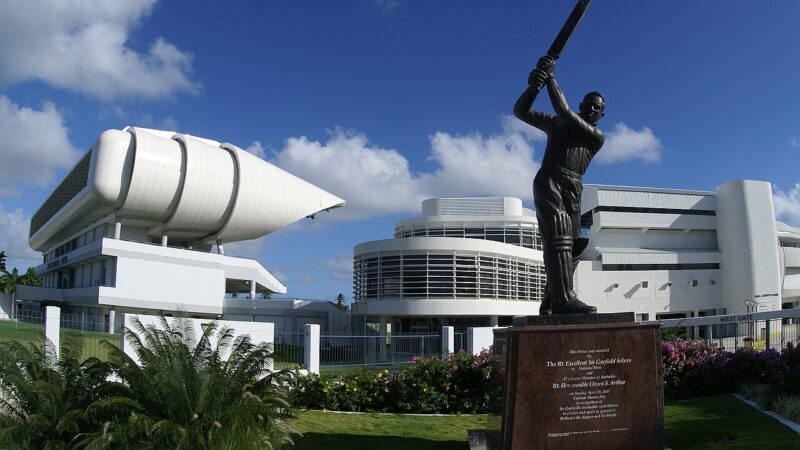
An outstanding innings has come to an end. Sir Garfield “Garry” Sobers, widely regarded as the best all-rounder the sport of cricket has ever produced, passed away on July 17, 2026, just 11 days shy of his 90th birthday.
In making the announcement about his death, Barbados’ Prime Minister Mia Mottley called the moment “a solemn hour for our nation” and declared a National Day of Mourning for “one of our greatest sons”:
It is with profound sadness that I join Barbados, the Caribbean and the cricketing world in mourning the passing of The Right Excellent Sir Garfield Sobers, our Sir Garry.
From Bay Land to Kensington and onto the world stage, he carried Barbados and the West Indies with… pic.twitter.com/Sj6lFG7gfh
— Mia Amor Mottley (@miaamormottley) July 17, 2026
Flags are being flown at half-mast across the country, and the beloved national hero will be given a state funeral.
But Sobers’ influence extended far beyond Barbados’ shores; he played for the West Indies for two decades, from 1954 to 1974, during which time he left his mark on the sport not only as a talented batsman, but also as an adept bowler and tenacious fielder — three specialists (or, as some say, five) in one remarkable player — earning him international respect as one of the greatest cricketers of all time.
The forces that shaped him
Born on July 28, 1936, to Shamont and Thelma Sobers at their home on Walcott Avenue in Bridgetown, Barbados’ capital, Sobers was the fifth of six children. He was born with six fingers on each hand. Some reports suggest that as a boy, he decided to remove the extra digits himself, using catgut and a sharp knife. One cricketing enthusiast, posting on X, claimed that “doctors removed the extra fingers before he was grown, but he played his first serious cricket match with eleven fingers.” Either way, it would prove not to be his most difficult hurdle.
Sobers was just five when, in January 1942, at the height of World War II, his father, a merchant seaman, was killed after his ship was torpedoed by a German U-boat. Cricket would offer a much-needed outlet; Gordon Bell, author of the 1978 biography “Sir Garfield Sobers,” noted that he and his brother Gerald helped their Bay Street Boys’ School team win the primary school Inter-School Cricket championship for three consecutive years.
By the time he turned 13, Sobers’ cricketing skills were attracting national attention. He was recruited to play with two clubs: Kent, which was part of the Barbados Cricket League (BCL), and Wanderers, part of the Barbados Cricket Association (BCA), where he honed his skills as a left-arm spin bowler.
At this point, Inspector Wilfred Farmer, a former Wanderers player who was captain of the police’s cricket team and later became Barbados’ Commissioner of Police, saw him in action and offered him a spot on the police squad. By 16, after working his way up to the police’s First Division team, Sobers was called to the Barbados trials for India’s 1952–53 West Indies tour, and made the team as 12th man. This was a significant accomplishment for a young man still in his first season of first class cricket — and he actually got the chance to play after fast bowler Frank King was forced to rest due to injury.
Coming into his own
Sobers made his first-class debut on January 31, 1953, where he scored seven not out in his only innings as the ninth batsman. He also made a tremendous impression as a bowler. His second appearance at this level came in March 1954 in Jamaica. Now 17 years old, Sobers took to the pitch during the West Indies’ final test match against the touring English team. His stellar performances in these two matches earned him a well-deserved selection for the West Indies team, making his third first-class appearance his test cricket debut:
#OnThisDay in 1954, at the age of 17, Sir Garfield Sobers made his debut for the West Indies, at the age of 17. The rest is history… #MagicMonday #ItsOurGame pic.twitter.com/GeaiDcaQIo
— Windies Cricket (@windiescricket) March 30, 2020
Between 1954 and 1955, Australia toured the West Indies, but Sobers was not selected for the first test, which the West Indies lost. He played in the second test match in Trinidad, however, which ended in a draw. By the third test match in Guyana, Sobers took three wickets in the Australians’ first innings. When, by the fourth test match in Barbados, West Indian captain and opening batsman Jeffrey Stollmeyer was out with an injury, prompting the question of who the opening batsman should be, Sobers got the job and struck the first three deliveries for boundaries. In the second over, he made another three fours, eventually being dismissed for 43 out of a first-wicket partnership of 52.
Australia went on to win the series, but the experience was invaluable for Sobers, who embarked upon his first overseas stint in 1956, with the West Indies tour of New Zealand. Unused to the grassy pitches, he struggled and was sent home early to play an unofficial test match against England. He performed well and was chosen for the West Indies’ 1957 tour of England.
A legendary career that shaped the game ⭐
Sir Garfield Sobers leaves behind a legacy that will endure for generations 👏 pic.twitter.com/mo9GyIsuhb
— ICC (@ICC) July 17, 2026
Over the course of the next three years, in 24 tests, Sobers scored 2,250 runs at a high average of 93.75. In 1958, he scored his maiden test century against Pakistan in Kingston and expanded it to 365. It was a record that remained unbroken for 36 years, until Trinidadian cricketer Brian Lara bested it by 10 runs. Sobers was in the stands at the Antigua Recreation Ground, making the occasion even more special:
Throwback to when Brian Lara broke Sir Garfield Sobers’ 36-year-old record for the highest score in a Test innings with his 375 against England in 1994… Sir Gary was as classy as ever ❤️ pic.twitter.com/P8k0B0z3Gy
— Sky Sports Cricket (@SkyCricket) July 17, 2026
The year after Sobers made his first century, tragedy struck his life once more. On the morning of September 7, 1959, he was driving his West Indies teammates Tom Dewdney and Collie Smith to London for a charity match when they ran into a 10-ton livestock truck. Smith, who had been asleep in the back seat, was thrown forward, injuring his spine and going into a coma. He died three days later. Sobers was found guilty of careless driving, but he maintained he was blinded by the oncoming headlights. One social media post suggested that Sobers never really got over the loss, and “those who knew him felt he played every great innings thereafter carrying a part of his friend’s dream alongside his own.”
Sobers would go on to captain the West Indies squad from 1965 to 1974. Another highlight of his career happened in Swansea in 1968, when he was playing for Nottinghamshire. Sobers made history by becoming the first to make six sixes in a single over, meaning that he hit every single ball delivered to him beyond the boundary, to score the maximum number of runs possible:
“On this week, 57 years ago — August 31, 1968 — Sir Garfield Sobers made history in Swansea by becoming the first man to smash six sixes in a single over, against Malcolm Nash in the County Championship. pic.twitter.com/YgRqO6dqe8
— John Pitchford🌹💙 (@Johnnypapa64) August 26, 2025
He continued to achieve admirable stats over the course of his growing career — 92 test matches, 8,032 runs, 26 centuries, 50 half-centuries, and much more — eventually becoming “arguably the greatest player to ever play the game,” or in the words of Prime Minister Mottley, “the standard by which greatness would forever be measured”:
Sir Garfield Sobers
The greatest cricketer, the world has ever seen – The Merrymen of Barbados – Lyrics : Emile Straker – Recorded 1973 @shamyad @cinemawaleghosh @madversity @sachinchatte #GarrySobers #RestinMemories pic.twitter.com/5emI6Aa4j0
— Pavan Jha (@p1j) July 17, 2026
This is not to say that he did not face his share of controversy. In 1969, according to Cricinfo, Sobers “broke the then unwritten rule and played cricket in Rhodesia, whose white government had in 1965 become the first country to have United Nations sanctions imposed on it.” The next year, he played for the Rest of the World side in a five-match series in England that took the place of the scheduled tour by South Africa, whose players had been banned from international cricket because of the country’s apartheid policy.
Tributes pour in
As news of Sobers’ passing spread, everyone from heads of state and media personalities to cricketers and sports fans the world over paid their respects. Although his skills and technique came in for high praise, the true measure of the man really emerged when admirer after admirer testified that Sobers was also a kind and decent human being, a true gentleman.
Noting that “his career unfolded during one of the most transformative periods in our region’s history,” Trinidad and Tobago Prime Minister Kamla Persad-Bissessar said that “Sir Garry was one of those rare individuals [who] did not simply redefine cricket; he helped shape how the Caribbean came to see itself and how the world came to see the Caribbean.”
West Indian cricketer and Sky Sports commentator Michael Holding, who called Sobers “a trailblazer,” suggested that his greatness could be measured in what his opponents thought of him. Holding also admired his humility and positive attitude, observing that he never talked about himself.
As Brendan Gallagher posted on X, “There are two categories of all rounders:
1 Sir Garfield Sobers
2 The Rest”
Cricket West Indies President Kishore Shallow spoke of Sobers’ unparalleled “mastery of batting, bowling and fielding,” but felt that “his true significance reached far beyond the boundary ropes […] Sir Garfield Sobers became more than a sporting icon. He became a symbol of Caribbean excellence, resilience, and possibility.”
Meanwhile, Jamaican Wayne Chen, referring to Sobers as “the last colossus,” felt that “Sobers’s significance, as C.L.R. James understood in ‘Beyond a Boundary,’ was never contained by the scorecard. James’s great insight was that cricket in the Caribbean could not be separated from the politics of colonialism, race and self-government; a boundary struck at Kensington Oval was also, inescapably, a statement about who belonged where in the world’s hierarchies […] Sobers became on the field what James called an example of the West Indian’s claim to ‘the freedom of the city’; full participation, on merit, in a world that had long assumed such mastery was the preserve of the coloniser. He leaves behind not just records, but a demonstration that greatness recognises no empire’s boundaries.”
Queen Elizabeth II knighted Sobers in 1975, a year after he retired, and he was conferred with the Caribbean Community’s (CARICOM) highest honour in 1998, the same year that he was named as one of Barbados’ national heroes.
Sir Garfield Sobers leaves to mourn his children, Matthew, Daniel and Genevieve, and his former wife, Prudence; his stepchildren, Stuart and Trisha (his partner Jackie White having predeceased him); his grandchildren, one of whom, Gabriel, lived with him, and his younger brother Cecil.