



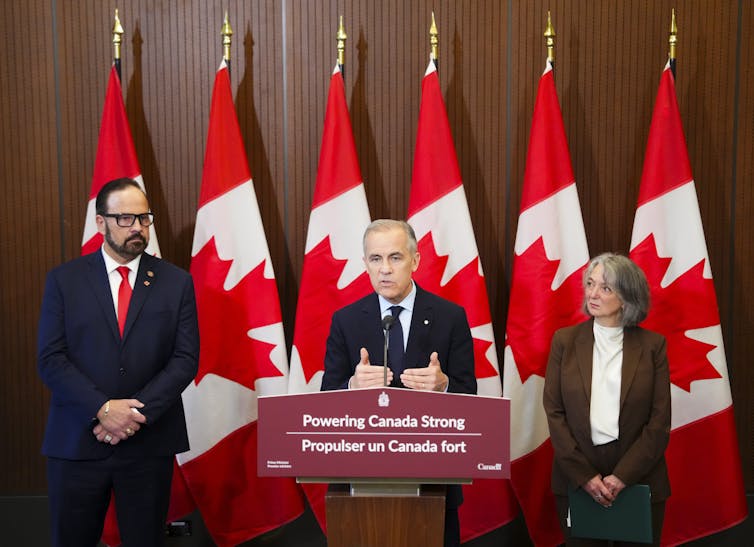
In May, Prime Minister Mark Carney announced plans to double the capacity of Canada’s electricity grid by 2050, using natural gas in the name of “powering Canada strong.” Almost all Canadian natural gas these days is derived from hydraulic fracturing — known as fracking — an industrial process involving large amounts of water laced with chemicals pumped long distances underground.
Many of the chemicals used in fracking are harmful to humans and include carcinogens such as PFAS (commonly referred to as “forever chemicals”) and endocrine disruptors.
These chemicals can leak into the environment through spills, pipes that eventually erode and crack, and evaporation into the air when stored in open wastewater ponds. The toxicity of this chemical mix is further exacerbated by naturally occurring radioactive materials and heavy metals unearthed from deep underground during the fracking process.
Another source of health harms from residential proximity to this industry is air pollution from diesel traffic, compressor stations and the venting and flaring of methane and other volatile organic gases — all of which are integral to shale gas extraction.
THE CANADIAN PRESS/Sean Kilpatrick
Residential setback regulations
Jurisdictions where fracking takes place acknowledge the potential harms from living nearby active wells through a key regulation termed a “residential setback” — defined as the minimum allowable distance between where a person lives and the construction of an active well.
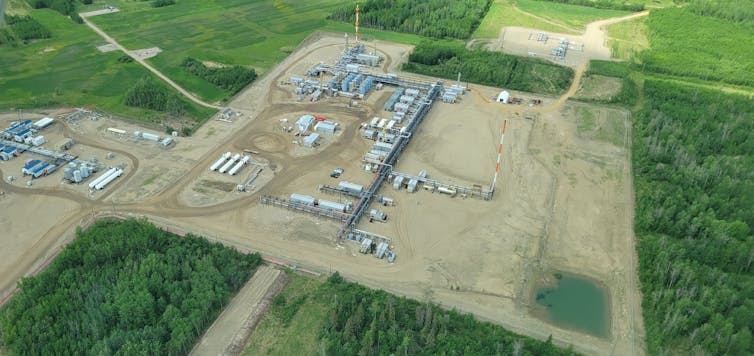
As part of an ongoing study, we recently examined setback distances in two Canadian provinces (British Columbia and Alberta) and four American states (California, Colorado, Pennsylvania and Texas) with major shale gas industries.
It turns out that B.C. and Alberta have the shortest and least protective residential setback regulations compared to their major U.S. counterparts. This distance — a mere 100 metres — is significantly shorter than California’s and Colorado’s default setback distances at 975 metres and 610 metres respectively.
California’s 975-metre regulated setback distance not only applies to private residences but also covers other “sensitive receptors,” defined as education resources, community resource centres, health-care facilities, live-in housing or any business open to the public. There is no mention in B.C.’s regulations of other “sensitive receptors” except a non-binding policy to disallow gas wells within 1,000 metres (one kilometre) of a school.
(Tim Takaro), CC BY
Impact on health
Researchers have used residential setbacks as a way to measure individuals’ exposure to fracking activity and its association with a variety of health outcomes. Several studies have demonstrated that mothers living closer to active gas wells are at greater risk of having smaller babies. This can lead to significant developmental and other health challenges later in life.
The farthest distance within which impaired fetal growth was observed in these studies was 10 kilometres — a distance 1,000 times greater than B.C. and Alberta’s currently regulated 100-metre setback distance.
Other studies report higher rates of congenital birth defects among infants born to mothers living within 10 kilometres of an active well compared to mothers living farther away.
A shorter distance to the nearest well has been linked to more self-reported symptoms in several studies. In one community-based survey in Pennsylvania, a significantly higher proportion of survey respondents living within 457 metres of a gas well reported symptoms than those living beyond that distance.
The researchers further reported that when a gas well, compressor station or impoundment pit was 457 to 1,219 metres away, 27 per cent of participants reported throat irritation. This increased to 63 per cent at 152 to 457 metres, and to 74 per cent at less than 152 metres. This pattern was similar for sinus problems and headaches.
THE CANADIAN PRESS/Darryl Dyck
California researchers found that people living less than 200 metres from oil wells had significantly poorer lung function test results compared to those living beyond that distance.
Other health harms using setbacks to measure exposure reported greater risk of gestational hypertension within one kilometre of an active well and adverse mental health among a group of American and Canadian women attempting to conceive within two kilometres of an active well.
All these studies report health harms occurring at distances far greater than B.C.’s currently regulated 100-metre setback.
Other studies, deploying exposure measures that combine residential proximity and density of wells, found a wide range of human health harms. These include higher rates of childhood leukemia and other cancers, heart and lung diseases and overall mortality within perimeter distances greater than 100 metres.
THE CANADIAN PRESS/Darryl Dyck
Vulnerable populations
Environmental exposures are also not equally distributed across and within populations. B.C.’s shale gas industry is located in the northeast area of the province. This is a rural and remote part of B.C. that’s the traditional territory of Treaty 8 First Nations who rely on the land for food, water sources, ceremonial practices and cultural identity.
One study set in northeast B.C. reported that areas with high proportions of Indigenous people experienced more air pollution compared to areas with a low proportions of Indigenous people. The study reported a similar pattern and even larger disparity in areas with high versus low socio-economic vulnerability.
Rural B.C.’s northeast is experiencing a massive expansion in the number of active wells to meet the increasing demand from B.C.s new liquefied natural gas (LNG) industry. The harms from these wells are minimally regulated at best and not subject to cumulative environmental assessments.
The evidence base for health harms associated with living close to active oil and gas wells emerged long after B.C.’s setback regulations were created in 2010. The burden of these health harms are likely to worsen with the current fracking boom.
Setback regulations remain the only lever that affords some protection to those bearing the greatest health risks from shale gas development. Provincial and federal governments have made the unfortunate decision to go “full-bore” on expanding fracking. There is an urgent need to align regulatory setbacks with environmental health evidence and best practices to protect peoples’ health.