



CORSIA, designed to keep international aviation’s net emissions flat, requires airlines to compensate any growth in carbon dioxide emissions above the sector baseline by cancelling eligible carbon credits known as CORSIA‑Eligible Emissions Units (CEEUs), each representing one tonne of carbon dioxide reduced or removed elsewhere.
Airlines from at least 130 participating countries, including Southeast Asian nations Cambodia, Indonesia, Malaysia, the Philippines, Singapore, Thailand and Vietnam, must purchase these credits to offset emissions from global routes when they rise above 85 per cent of their 2019 levels.
Southeast Asia is poised to become a major source of high‑integrity offsets if governments move quickly to authorise and scale qualifying projects, said the report backed by aerospace giant Boeing, investment platform GenZero and carbon procurement and market‑intelligence firm Abatable.
Asean member states already provide around 7 per cent of the current global supply of CEEUs, with 2.6 million credits issued from four clean cookstoves projects in Cambodia and Laos, the study found. It estimated that this volume could grow almost eightfold, to about 20.8 million units, within months if governments in the region issue Letters of Authorization (LoAs) for a further 54 carbon projects that already meet CORSIA’s technical criteria.
These include 24 projects in Vietnam, 11 in Thailand and 8 in Myanmar, all aligned with CORSIA requirements but still awaiting LoAs to become fully eligible for use under the scheme. LoAs indicate that a government has formally authorised the use of credits from specific projects in CORSIA and will not count the associated emissions reductions toward its own national climate targets.
“
Asean has the potential to play a globally significant role in strengthening CORSIA implementation and expanding access to high-quality and lower-cost units, with clear policy guidelines and timely action.
Allison Melia, vice president of sustainability, Boeing
This supply‑side opportunity comes as airlines brace for rising compliance costs. Data provider MSCI Carbon Markets has warned that a tightening market for CORSIA‑eligible credits could drive prices sharply higher, leaving global airlines facing billions of dollars in additional costs over the coming decades as they buy approved offsets to meet their obligations.
The region’s ability to bring more high‑quality credits to market could help ease the squeeze on airlines while channelling climate finance into the region, suggested the study.
“Asean has the potential to play a globally significant role in strengthening CORSIA implementation and expanding access to high-quality and lower-cost units, with clear policy guidelines and timely action. Collaboration between governments and industry will be key to building a credible and sustainable CORSIA market-based measures ecosystem,” said Allison Melia, vice president of sustainability at Boeing.
Aviation remains one of the fastest‑growing sources of greenhouse gas emissions, even as aircraft become more fuel‑efficient. Commercial flying accounts for roughly 2 to 3 per cent of global carbon dioxide emissions, but its climate impact is larger once contrails and other non‑carbon dioxide effects are included.
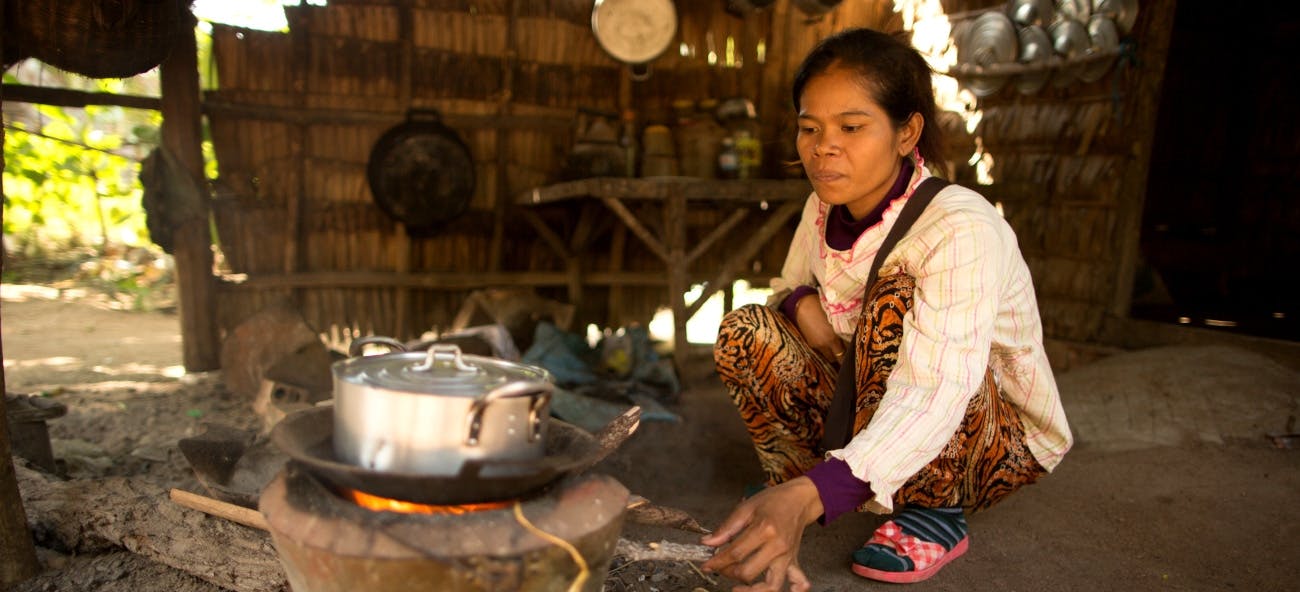
A women cooks a meal on a cookstove in Cambodia. Clean-cooking projects account for around 10 per cent of all carbon credits issued globally, but their significance is far greater within CORSIA, the offsetting scheme for international aviation. Of the 43 projects currently eligible for compliance between 2024 to 2026, 40 are clean cooking, spanning countries such as Cambodia and Laos. Image: Geres EU
Article 6 readiness and institutional capacity as risks factors for the region
However, the report makes it clear that CORSIA is not a straightforward win for Asean.
It emphasised that authorising credits for CORSIA can be challenging for governments in the bloc, not only because environment ministries worry about “overselling” credits and then struggling to meet their own nationally determined climate (NDC) targets if too many units are authorised for export and corresponding adjustments, but also because Article 6 readiness and institutional capacity remain uneven across the region.
The Article 6 implementation agreement sets out the legal rules for how the two countries can generate and trade carbon credits under the Paris Agreement.
“To engage effectively in the opportunity to authorize units for CORSIA under Article 6, while recognizing their own NDC targets, host country governments may need additional institutional capacity, frameworks, and procedures. Within Asean, member states show varying levels of engagement with Article 6 to date, which can impact where CORSIA supply will come from in the region,” it said.
The analysis noted that more than half of Asean member states have adopted an Article 6 framework, such as Singapore, Indonesia, Thailand, Vietnam and Cambodia making clearer progress on participation on the Paris Agreement carbon market framework and authorisation processes. Malaysia has an emerging Article 6 framework under development.
Laos has already hosted the special carbon credits airlines have to buy under CORSIA, but does so without a fully developed, formal Article 6 framework. The Philippines and Singapore have struck their first Article 6 carbon credit deal, but it is not yet backed by a comprehensive Article 6 rulebook for measuring and approving those cuts.
Brunei, Myanmar and Timor‑Leste likewise have more limited Article 6 engagement so far, with frameworks and procedures either nascent or still under development.