



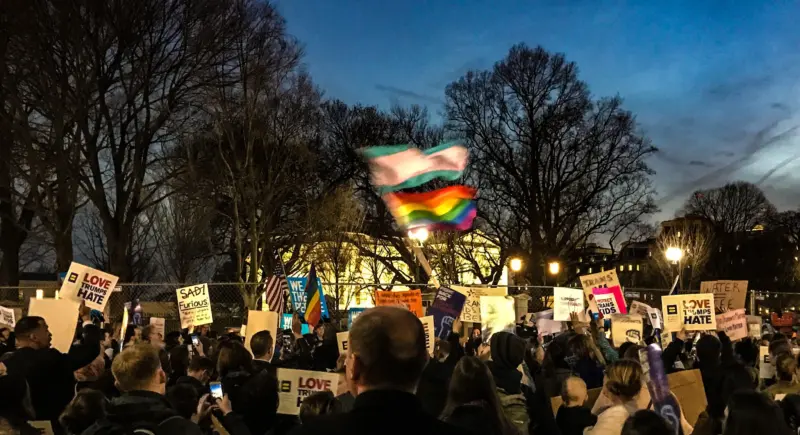
A protest in Washington DC, USA, calling on officials to protect transgender youth. Image from Flickr. License CC BY-SA 2.0.
By Brindaalakshmi K
This article specifically looks at the impact of the U.S. policy changes on a sub-group, LBQT (Lesbian, Bisexual, Queer, and Trans) people within the LGBTQ+ spectrum in South Asia, to understand the policy impact on people gender-assigned female at birth or trans-feminine people.
In January 2025, the new Trump administration in the United States issued executive orders impacting social justice and development work around the world. While the most obvious and visible impact has been funding cuts, these developments have brought about a palpable shift in the understanding of gender and related power hierarchies. Tracing the impact of recent US policy changes across the geographies of my work in South Asia and the Caribbean nation of Belize has revealed different anti-gender strategies that are being engaged to influence state mechanisms, civil society organisations, funding agencies and big tech companies.
A systematic effort seems to be underway to dismantle the support systems established to advance gender justice worldwide, reshaping the understanding of gender and gender justice. In this article, I trace some specific anti-gender tactics and their cumulative impact on the data generated on these gender issues — data which is essential for driving development decisions.
Direct attack on subversion tactics
My sources observed that the US-imposed tariffs have resulted in increased economic pressure, shifting political priorities for different nations. Countries clamouring to bridge the financial deficit created by the new tariffs have resulted in LBQT rights taking a backseat for many countries, especially those that still criminalise homosexuality. With the current anti-gender attacks on any gender-related work, organisations are being forced to reimagine the manner in which they describe their work. As a general trend, these policy changes have impacted all gender related work, with a more immediate impact on organisations that specifically work on LGBTQ+ rights.
In South Asian countries like Bangladesh, Pakistan and Sri Lanka, which criminalise homosexuality, it is illegal for organisations working on LGBTQ+ issues to fundraise for their work, leading to active erasure of these issues. Historically, these organisations have been forced to use the alternative tactic of raising funds under gender and gender-based violence as broad buckets. A source who opted to remain anonymous observed the US policy changes threaten these tactics, too. “Historically, as a movement, we have been using subversion to raise funds for our work. Now these policy changes are targeting these very tactics, giving us no way out.” Such strategies are a double-edged sword since they help raise funds in countries with criminalisation, but also result in erasure and misrepresentation of these populations.
The consequences of grouping LGBTQ+ issues under the umbrella of gender and gender diversity look different in a country like India. Despite decriminalising homosexuality in 2018, “There is a lack of awareness about LGB identities within government departments and even the police,” shared Sandi, founder and general secretary of Mobbera Foundation, India. “They use the language of LGBT while talking about programmes for inclusion, but what they really mean by that is transgender inclusion. These programmes only address transgender persons, and even within that community, they only know trans women. They don’t know about trans men either,” he added.
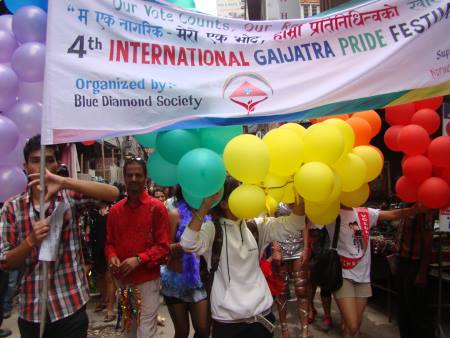
A PRIDE festival in Nepal. Image from Wikimedia Commons. License CC BY-SA 3.0.
Sources in Nepal and Belize shared that they had to change the language used in their programming and funding applications to get support. “We normally use terms like GSM (gender and sexual minorities), LBT and LBQ women as terms in our programming. They are now trying to erase these identities. Recently, we were working on a project that had LBT women in the title. The donor asked us to change the term LBT to ‘minorities’ in the project title following the recent US policy changes,” shared a gender professional working on LBQT+ issues in Nepal.
Charrice Talbert, president of Promoting Empowerment Through Awareness for Lesbian and Bisexual Women (PETAL), Belize, shared, “The idea has always been for us to package our work differently because of the churches. The churches have a problem if we mention marriage or children while talking about LGBT community.” She added, “With the US policy changes, some agencies that were funding LGBT issues are now being forced to use different language.”
Changes in the language of evidence-building efforts
There have been notable changes in the language used to record evidence on different gender issues. In 2023, the term “technology-facilitated gender-based violence” (TFGBV) was introduced. The term was coined to recognise the use and role of artificial intelligence (AI) in gender-based violence by different UN agencies. This term is increasingly used instead of online gender-based violence. UN Women says, “While many other terms — such as digital or online violence — are commonly used, ‘technology-facilitated gender-based violence’ better reflects how technology can enable harm, both online and offline.” This replacement raises questions about the validity of evidence gathered thus far on online gender-based violence.
A more drastic development has been the recent demand by Project 2025, a right-wing political initiative in the US, asking the Federal Bureau of Investigation (FBI) to frame transgender ideology as extremist and a domestic threat following the shooting of Charlie Kirk, a right-wing political activist and an ally of Donald Trump. Although an event specific to the US, this incident aligns with the disinformation campaigns against gender ideologies that have sprouted in different parts of the world. Following the US, several sources observe the shift in the stance of different governments, like the Netherlands, Sweden, and the United Kingdom, among others, on gender issues. This is significantly impacting the accountability mechanisms available in the development sector to counter the anti-gender narrative.
The shift in the development sector’s language is influencing the way development issues are defined, prioritised, and funded. Gender as a term is changing to fit the heteronormative understanding of gender and sexuality. In March 2026, United Nations member states rejected U.S. efforts to limit the understanding of gender to men and women. The shift in the language of evidence-building efforts also changes the kind of gender issues that have evidence to substantiate the need for support. This will continue the active erasure of LGBT realities and hamper efforts to advocate for their inclusion.
Justice system targeting the LBQT+ community
A Sri Lankan LGBTQ+ rights activist said, “A lot of online hate speech and anti-LGBT speech has now become normalised in Sri Lanka, with Trump’s re-election. This perpetuates a narrative shaped by disinformation.” There is a general lack of support from the Sri Lankan police when it comes to LBQT rights. There have been cases when the police have refused to file complaints by LBQT persons against perpetrators of violence, leading them to be pushed into silence when abuse happens.
In case of extortion or non-consensual sharing of intimate images, the police often target the individuals for having the video on their phone, framing it as a violation of the state’s obscenity laws. Several sources said that this stops queer individuals from approaching the police.
Women in Belize experience similar police violations, a source shared. “Women are mostly targeted for sharing nudes. It doesn’t matter if your nudes are leaked. The fact that you shot it shows your intention of sharing it, so then a case is filed against you.” Similar to Sri Lanka, queer persons in Belize find it difficult to file police complaints. “Very often, people are forced to go to the media first before the police take any action. The commissioner then takes action because he doesn’t want the police looking bad.”
According to a feminist digital security expert, digital security threats against gender and sexual minorities are very common in South Asia. She said, “Issues of trolling and extortion are common. In Sri Lanka, LGBTQ+ organisations are often specifically targeted. In India, on the other hand, transgender persons have been facing a lot of financial fraud and extortion. Indians often use the religious and ethnic identities of gender and sexual minorities for targeted online gender based violence.”
Due to the criminalisation of homosexuality in Bangladesh, many LBQ women seek partners online. In recent years, there has been a rise in cases of men pretending to be women to target LBQ women on dating apps. “Such cases were previously common among gay men. Now this has become an issue even for LBQ women.”
The culture of disinformation influencing the rights of LBQT+ people has taken a drastic turn in Pakistan. Disinformation tactics are used to target the rights of gender and sexual minorities, especially transgender people, owing to their visible presence and legal recognition. In 2018, Pakistan enacted the Transgender Persons (Protection of Rights) Act, which was considered a progressive statute in the country. Sources note a drastic overturn of several provisions in recent years because of a disinformation campaign by influencers who cited religion as a reason to push for a rollback on transgender people’s rights, using hashtags such as #SayNoToTransgenderAct and #AmendTransgender Act. As a result of this campaign, the police made wrongful arrests and booked 60 transgender people for allegedly organising an objectionable private party. In March 2026, India, in a similar move, amended the provisions of the Transgender Persons (Protection of Rights) Act 2019, reversing the fragile progress of transgender rights in the country.
Social media control
There has been a drastic increase in the anti-gender attacks online, moulded by local laws and the policies of big tech companies that have increasingly downsized their accountability to their users. Evidently, these attacks are using disinformation and online gender-based violence as tools to attack the rights of LBQT people.
In an effort to align itself with the Trump administration, Meta announced sweeping changes to its content moderation policies and initiatives across all its platforms in January 2025. This includes the Hateful Conduct policy, which controls the manner in which gender and sexual minorities may report targeted attacks on these platforms. The language used in the January update allowed for anti-LGBTQ+ hate speech and misinformation. The impact of these changes is more adverse in South Asian countries with more fundamentalist political regimes, as well as the criminalisation of homosexuality.
Big tech and social media platforms have used compliance with local laws as an excuse to censor and control content on queer and transgender issues. Platforms like TikTok have admittedly shadowbanned LGBT content for many years now, owing to their own categorisation of any content by queer and transgender content creators as sexual content.
Apart from self-censorship, this affects the type of content that is visible and available to consumers. Consumers in certain jurisdictions, such as the European Union, have legal recourse to address shadowbanning in specific cases. Criminalisation and limited rights of gender and sexual minorities make it harder to insulate queer and transgender-related content from being shadowbanned in other geographies.
Through these tactics, algorithms are manipulated to shape the narrative on gender-related topics. In addition, the lack of sufficient protection on social media platforms against anti-LGBTQ+ hate speech is leading to a shift in the perception of these issues and the general attitude of the public at large towards these marginalised communities.
What’s to become of the data for the development agenda?
With the impact of these ongoing developments, organisations working on LGBTQ+ rights are being forced to move away from using the language of human rights to protect the rights of this population group. In an attempt to continue their work, some organisations are devising newer strategies to support their agenda. “The Democratic argument is a good one. We are shifting our narrative to security and defence. We are speaking about how China and Russia are using anti-LGBT narrative to undermine democracy. Russia is funding anti-LGBT campaigns before elections to divide people,” said Alex Farrow, the CEO of Kaleidoscope Trust in the UK. With this move away from the language of human rights, Farrow also notices human rights having a lesser impact on donor countries and even the United Nations.
These concerns also raise questions about the global data-for-development agenda as a whole. The shifting focus of the global development agenda, accountability mechanisms, and the consequent changes in the language of development discourse on gender issues hardwire the erasure of the LBQTIA+ realities within different gender data sets. To begin with, global development datasets like the Global Gender Gap Index, among others, present data in binary form and do not sufficiently acknowledge the opportunity and economic cost of erasure for individuals who are not heteronormative in their gender or sexuality. This data gap is further widened and strengthened by the reshaping of public opinions on these issues using social media. The current global socio-political developments are systematically promoting the anti-gender agenda to fit individuals into the hetero-patriarchal understanding of gender and gender roles by influencing the data that is fed into automated decision-making systems.
The author was supported by the Heinrich Boell Foundation, Washington, DC’s Transatlantic Media Fellowship to conduct the research for this article.