



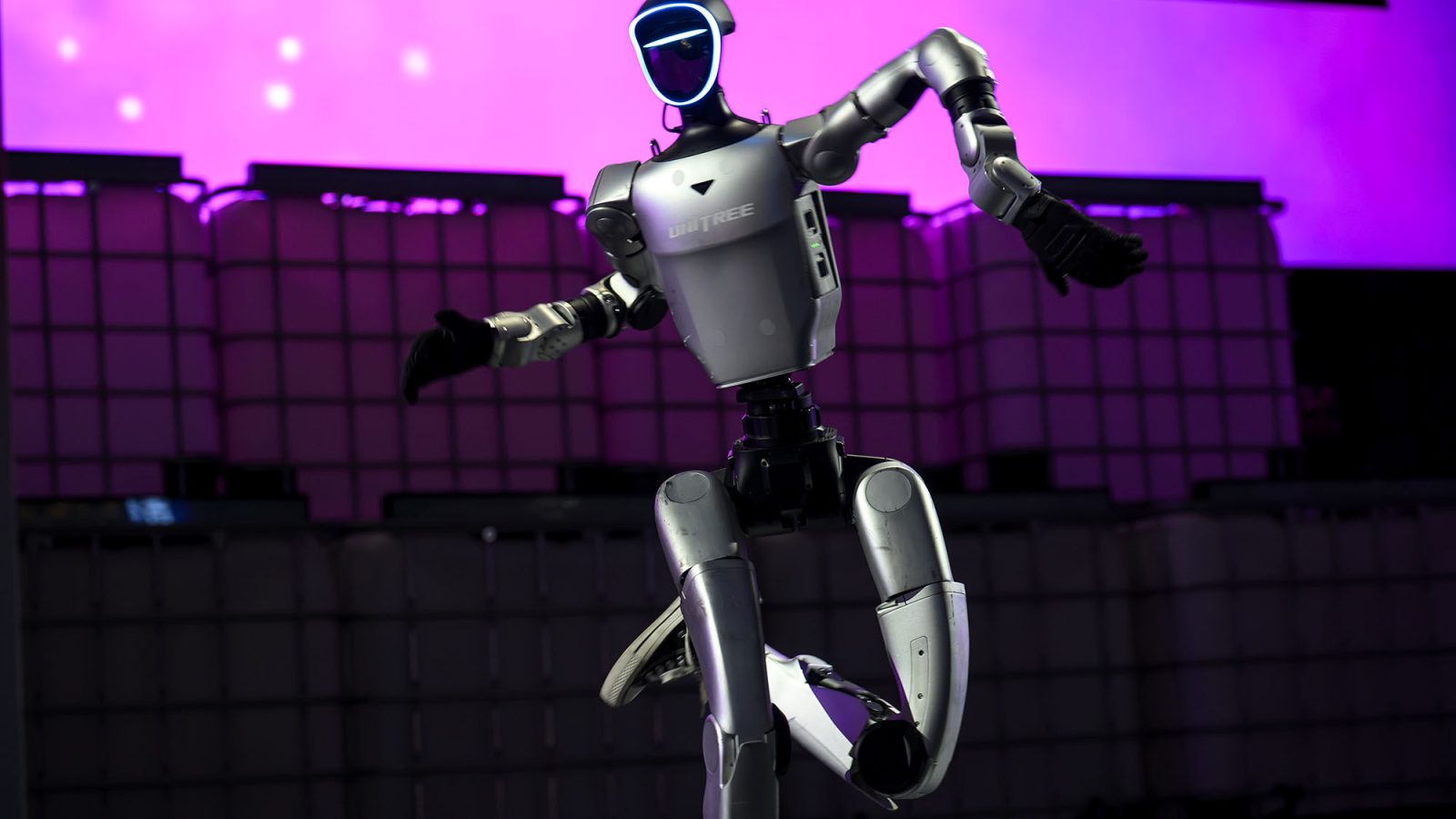
While Silicon Valley spent 2025 polishing its marketing decks for the humanoid future, China was busy shipping the robots.
Nearly 90% of all humanoid robots sold globally in 2025 were Chinese, and six of the highest-selling companies in the sector were from the East Asian country.
The humanoid robots industry is still in its infancy, but the early advantage accelerates China’s progress in research, development, and deployment, potentially locking in a commanding position — replicating the playbook that drove its electric vehicle success.
China’s early advantage is due to “a combination of policy support, public investment, mature supply chain, and advancements made in AI software and hardware,” Lian Jye Su, a tech analyst at consultancy firm Omdia, told Rest of World.
Between 13,000 and 18,000 humanoid robots were sold globally in 2025, according to data from research firms Omdia and IDC. For now, these robots, which resemble the human body in shape, are mostly sold for research, retail, or industrial use. Their deployment could shift to mass adoption by the late 2030s, according to Morgan Stanley.
By 2035, the global humanoid robots market is estimated to touch $38 billion, and reach $5 trillion by 2050.
China’s largest humanoid robot company, Unitree, sold 5,500 humanoid robots last year, making it the world’s top seller. This is the first time Unitree has published its sales figures. Shanghai-based Agibot came second with 5,168 units.
The neck-and-neck race between the two Chinese companies is reminiscent of how China built its lead in the electric-vehicle space: Early state support and industrial policy enabled dozens of new entrants, and rapid scaling ultimately propelled them to the top of global bestseller lists.
“Chinese humanoid robotics vendors are using more and more local components in their robotics design, which helps with cost efficiency, supply chain security, and driving local innovation and time to market,” Su said.
China’s lead has been years in the making. The humanoid robot industry was listed as one of the key industrial areas for technological breakthroughs in its 14th Five-Year Plan in 2021. State funding is being used for both testing infrastructure and backing individual companies.
The three non-Chinese companies that made it to Omdia’s top-selling humanoid robots chart for last year were American: Figure AI, Agility Robotics, and Tesla. These companies, however, trail their Chinese rivals by a wide margin, with each selling only around 150 robots.
Unitree and Agibot each sold more units than Tesla’s overall production target of 5,000 humanoid robots for 2025, which it did not meet.
Tesla CEO Elon Musk himself recently acknowledged China’s strength.
“China is very good at AI, very good at manufacturing, and will definitely be the toughest competition for Tesla,” Musk said at the World Economic Forum last month. “To the best of our knowledge, we don’t see any significant competitors outside of China.”
However, he said Tesla’s Optimus robots would ultimately outperform Chinese alternatives.
Tesla has been developing a general-purpose robot called Optimus for over five years. Tesla’s Optimus robots can now perform “simple tasks” inside the company’s factories, Musk said. Tesla could start selling its humanoid robots to the general public by the end of 2027, he added.
But despite China’s current dominance, the West will not necessarily become reliant on buying Chinese robots, Su said.
“Western humanoid companies can compete by focusing on superior AI, software, and autonomy rather than sheer hardware volume,” he said. “As such, we do not expect the U.S. to end up being dependent consumers of Chinese humanoid robots.”