



The findings raise questions about whether people who steward ecosystems have control over funding intended to protect them, rather than simply receiving benefits from projects designed elsewhere, the research institute said in its report, Locally-led finance for nature: estimating finance flows to local actors for conserving and restoring nature, released on Monday.
Researchers examined descriptions and titles of biodiversity-tagged official development assistance reported to the Organisation for Economic Cooperation and Development’s (OECD) Development Assistance Committee. Their broader dataset covered around 233,000 funding lines between 2011 and 2024.
Only 33.7 per cent of the finance examined included references to the local level. Explicit references to “locally led” accounted for 0.28 per cent, while “Indigenous-led” represented just 0.001 per cent. The latter phrase appeared only six times across the broader dataset.
IIED described the findings as “deeply concerning”, saying they indicated that more than 99 per cent of nature projects remained led by non-local actors, even where spending or benefits reached communities.
However, keyword searches capture donors’ descriptions, not necessarily actual funding flows or decision-making arrangements. The analysis cannot establish precisely how much money reaches local recipients.
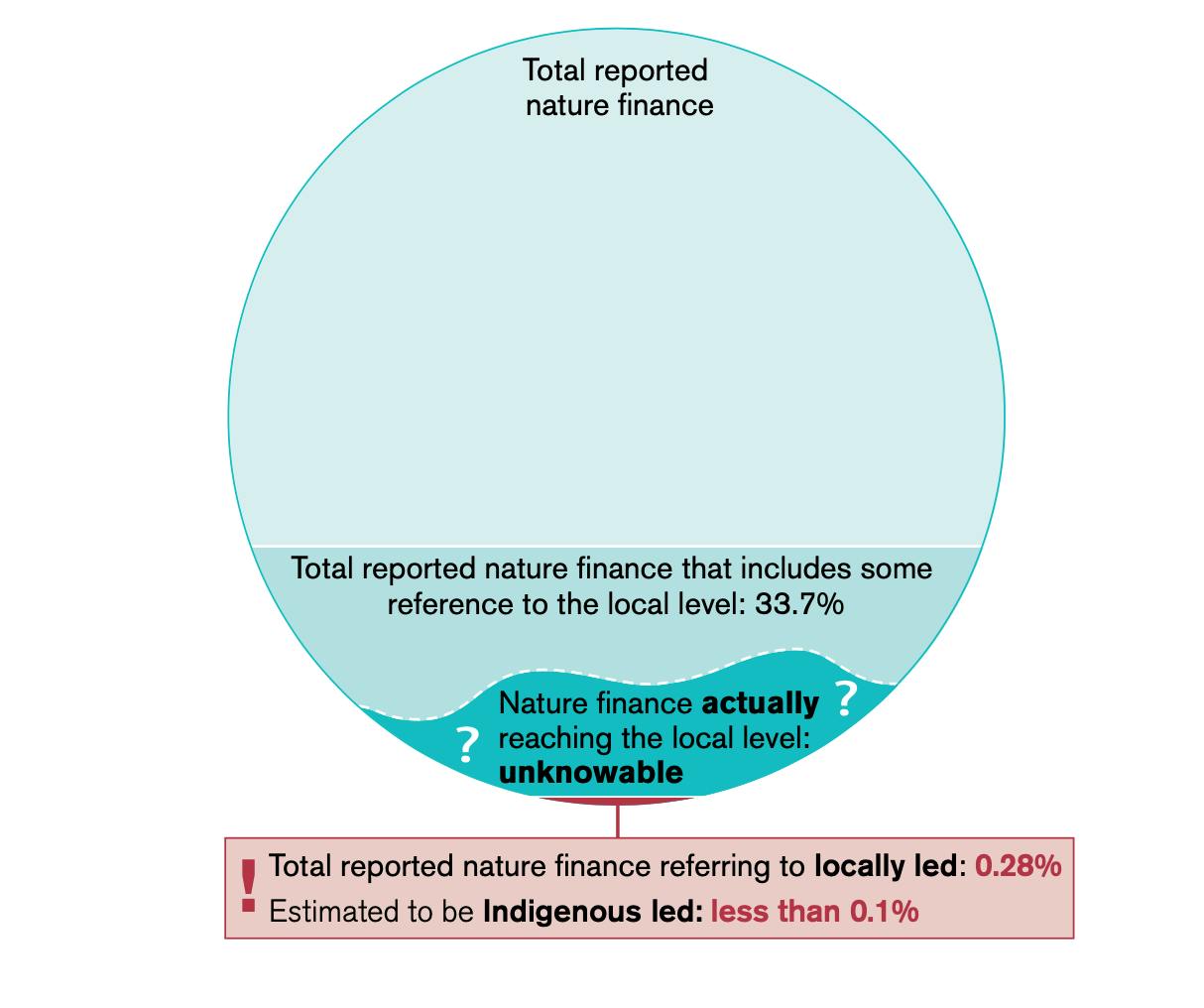
The figure shows the proportion of total reported nature finance including a mention of the local level or locally led. It illustrates how only two-thirds of overall nature finance includes any mention of local implementation or local actors and small the proportion is that is locally or Indigenous led. Image: IIED
The findings come ahead of the 17th meeting of the Conference of the Parties to the Convention on Biological Diversity or COP17, which begins on 19 October in Yerevan, Armenia, where governments will discuss biodiversity protection and finance.
At COP16, countries agreed to establish a permanent subsidiary body for Article 8(j) of the Convention on Biological Diversity (CBD), creating a dedicated space to advance Indigenous Peoples’ and local communities’ traditional knowledge and contributions to conservation. The International Indigenous Forum on Biodiversity hailed the decision as the first time a UN environmental agreement had established such a permanent body.
While these groups have an increasingly strong voice in negotiations, the CBD remains an intergovernmental treaty, leaving governments as the decision-makers.
“Our findings raise concerns over whether communities will have decision-making power regarding any new finance which is agreed or pledged at COP17,” said Nicola Sorsby, Climate and Nature researcher at IIED.
“Negotiators must make sure new announcements about funding include specific provisions that get money to where it’s needed.”
“
Evidence shows nature does better when these groups take the lead on conservation, so getting funds to the local level will provide value for money.
Nicola Sorsby, Climate and Nature researcher, IIED
“Promises about new funds are all very well but may not mean a huge amount if they are channelled in the usual way, which we know isn’t very effective at reaching Indigenous People and local communities, or responding to their needs. Evidence shows nature does better when these groups take the lead on conservation, so getting funds to the local level will provide value for money,” added Sorsby.
The stakes extend beyond access to funding. Around one million plant and animal species face extinction, many within decades unless action is taken to reduce the drivers of biodiversity loss, according to the Intergovernmental Science-Policy Platform on Biodiversity and Ecosystem Services (IPBES).
IIED said addressing this crisis requires shifting financial flows away from activities that harm nature and towards conservation, restoration and more sustainable production.
The Kunming-Montreal Global Biodiversity Framework seeks to mobilise at least US$200 billion a year for biodiversity from all sources by 2030. It also calls for harmful incentives, including subsidies, to be reduced by at least US$500 billion annually by the same deadline.
However, IIED said funding vehicles such as the Global Biodiversity Framework Fund and the Cali Fund had yet to deliver at the scale required. It also warned that the finance targets paid insufficient attention to how much money would reach Indigenous Peoples and local communities.
For nature finance to meet these communities’ needs and respect their rights, projects must be led by local actors, rather than designed externally and merely implemented alongside them, the report said.
The principles for locally led adaptation and inclusive nature action offer frameworks for funders and policymakers, but evidence of how closely nature finance follows them remains limited, IIED added.
To improve accountability, the institute called for specific indicators in OECD and biodiversity funding reporting systems to distinguish finance reaching local actors from funding that supports local leadership. It also recommended expanding OECD reporting categories to distinguish local funding recipients based in donor countries from those in recipient countries.
“In addition, funders should engage in substantive dialogue with Indigenous Peoples to assess the extent to which projects are in line with the priorities of Indigenous Peoples and to explore the development of appropriate tracking mechanisms,” the report said.
