



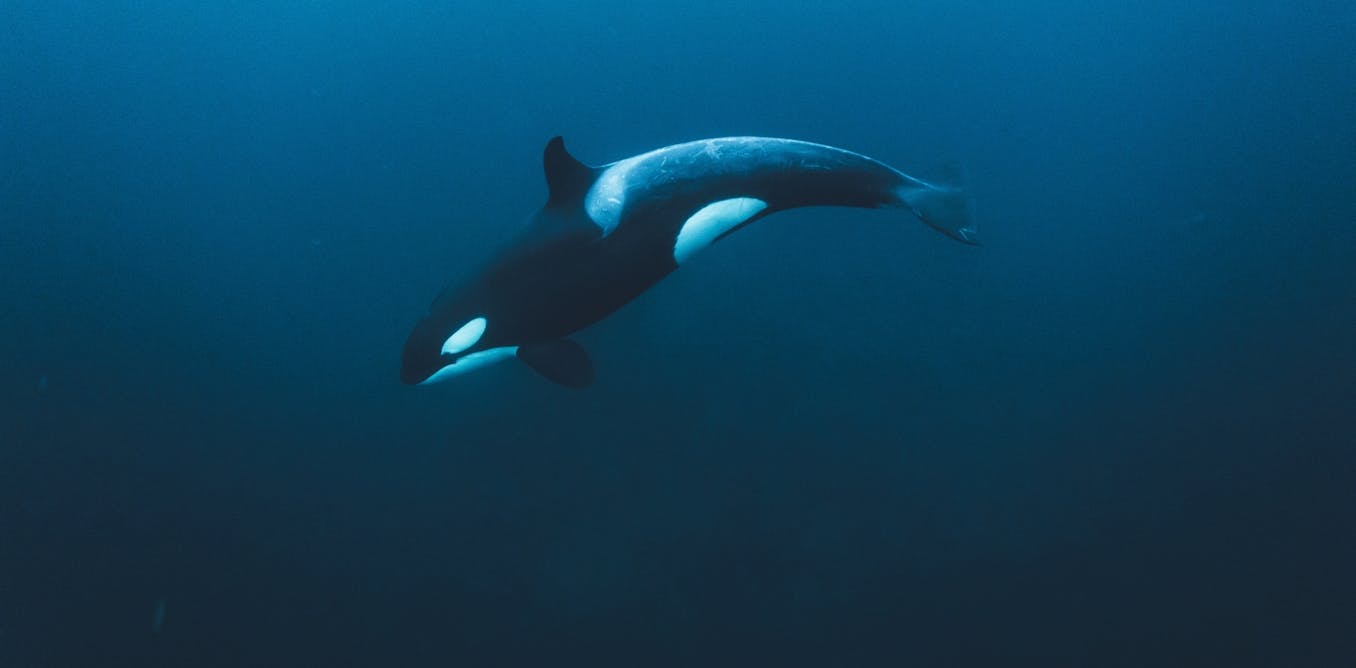
An adult orca cruises near the surface of the clear, blue water, holding a large sunfish carcass in its mouth.
Seconds later, it releases its prey, right in the path of another adult orca that’s torpedoing up from the depths. The sunfish explodes into thousands of pieces on impact. A younger member of the pod that’s watching on then moves in to feed.
Tourists in the Gulf of California captured this event on camera in July 2024. They captured a similar event nearby in September 2025.
This never-before observed behaviour, reported in a new paper published in the journal Frontiers in Ethology, is known as “ram-to-fragment” behaviour.
It’s like someone whacking a piñata, causing it to explode and release hundreds of tasty treats. And it has a lot to tell us about whale intelligence.
Feeding on the go
Orcas, also known as killer whales, are actually the largest members of the dolphin family.
Found in just about all of Earth’s oceans, this cosmopolitan species are grouped into ecotypes. This is a general term which refers to different killer whale groups based on their genetics, appearance, where they are found, behaviour, and even the language (dialects) they use to talk to each other.
Each group looks a little different, with variations of the white patch above their eyes. Different orcas around the world also have varying diets and feeding strategies depending on where they are found.
For example, some orcas in Antarctica are known to cooperatively hunt seals by swimming towards them when the seals are taking shelter on icebergs, in a behaviour known as “wave-washing”.
In South American waters, some orcas have learnt to deliberately beach themselves to feed on sea lions as they risk life and flipper in the shallows of the waters.
Then there’s orcas that eat other dolphins such as those in the Humboldt current system in the South Pacific Ocean.
In South African waters, two well-known orcas feed on white sharks. Others have specialised diets on chinook salmon.
Orcas found in Australian waters are known to take down humpback whales, deep-diving beaked whales, and even the biggest of them all, the blue whale. Then there are orcas that appear to play with potential food, including turtles.
In recent years, we have seen boat-biting orcas. However, this isn’t for food; it’s more likely a kind of play.
Co-ordinated, deliberate and smart
Orcas are highly social and known to work together. This new study, led by Kathryn A. Ayres from Beneath the Waves, a non-profit organisation promoting ocean health, is further insight into their secret lives. It clearly shows that by working together, they can be calculated and co-ordinated.
But why are they doing this?
People have observed orcas interacting with sunfish in other parts of the world.
But it’s the fact that orcas ram the sunfish so hard that it breaks up into pieces that’s the point of difference here, as this behaviour hasn’t been previously described.
There are several reasons why they may do this.
For example, they may be breaking the prey up into little bits to enable all members of the pod a chance to eat parts of the fish.
It could also be a social interaction and a form of play.
Tourists are helping scientists
This paper is clear evidence that we continue to keep learning more about whale and dolphin behaviour, especially through tourism.
Chance encounters, observed by tourism operations with citizen scientists who have access to high-quality underwater cameras, enable us to capture behaviours when we least expect it.
Recently, tourism and social media has been used to document gaping in humpback whales – a newly described behaviour despite them being one the world’s most watched whale species. Gaping refers to a behaviour where whales are observed opening their mouths unrelated to feeding; it’s observed only outside known feeding areas.
In the case of the exploded sunfish, the “stabilize-and-ram” coordination between two adults also indicates a high degree of cooperative precision. And it provides further evidence that the more we keep looking into the lives of animals other than ourselves, the more we continue to learn.