



Feature image created by Global Voices using Canva Pro elements.
This story is part of Undertones, Global Voices’ Civic Media Observatory’s newsletter and column. Subscribe to Undertones. The publication is based on conversations with Mayan language speakers from Rising Voices during the Civic Media Observatory’s Narrative Spotter Workshop.
The government and the private sector in Mexico frequently reference the identities and symbols of Mayan communities to promote tourism in the country. The Riviera Maya, the tourist corridor managed by the government of the state of Quintana Roo on the Yucatán Peninsula, is perhaps the best-known example. The Mayan archaeological sites in the region are among the key attractions that the tourism industry, both national and international, highlights when promoting its services.
The Tren Maya, the railway line connecting southeastern Mexico, is an iconic project. Still under construction, it was inaugurated by former President Andrés Manuel López Obrador (National Regeneration Movement, or MORENA) in December 2013 with the opening of its first sections. The initiative has been publicized as an effort that “celebrates the resurgence of the great Maya nation,” immersing visitors in the heart of southeastern Mexico. Connecting the states of Chiapas, Tabasco, Campeche, Yucatán, and Quintana Roo, the train, according to its official website, features a design inspired by Mayan culture, “in the colors and textures of regional art.”
The Travesía Sagrada (Sacred Journey), an annual event organized and celebrated by the tourism consortium Grupo Xcaret, which the Quintana Roo Tourism Secretariat promoted as a “unique experience that revives the ancient Mayan ritual by crossing the Caribbean Sea in canoes, in honor of the goddess Ixchel” in 2025, is another example of these references to symbols and identities when promoting tourist services.
Narrative: The Mayan culture is a marketing tool; it is a trademark
In March 2024, Grupo Xcaret shared a statement reporting on a meeting with the Great Mayan Council of Quintana Roo, in which both parties addressed the “use, protection, and development of Mayan cultural heritage” within the framework of the Federal Law for the Protection of the Cultural Heritage of Indigenous and Afro-Mexican Peoples and Communities:
… Grupo Xcaret will continue to provide suitable spaces for cultural bearers (inheritors and transmitters of traditions, knowledge, and living heritage) to share their cultural expressions with dignity, fostering a vision of prosperity and shared value. This will always be done with absolute adherence to ethics and their self-determination, and through prior, free, and informed consent in accordance with their customs and traditions, giving credit to the bearers and providing fair compensation agreed upon by both parties.
Grupo Xcaret will support projects for the research, preservation, protection, promotion, enhancement, revitalization, dissemination, and transmission of the Living Heritage that the Ceremonial Centers choose to share, including, but not limited to, Mayapaax music, the training of prayer leaders, traditional ceremonies, patron saint festivals, and the transmission of traditional medicine. This will be done while respecting the self-determination of each Ceremonial Center.
The agreement acknowledges the “lack of implementation” of the transitional rules of the Federal Law for the Protection of the Cultural Heritage of Indigenous and Afro-Mexican Peoples and Communities, while seeking consent for the Xcaret Group to continue using Mayan symbols and identities across its various facilities. One of them is Xcaret Park, a theme park that offers shows such as the Travesía Sagrada.
With this agreement — which, according to reports, involved a compensation of 15 million Mexican pesos (just over USD 857,000) — the Xcaret Group, together with the Great Mayan Council of Quintana Roo, shares a narrative that gives commercial value to Mayan symbols and identities, turning them, in their story, into a transactional element.
For more than 30 years, as mentioned in the 2024 document, Grupo Xcaret has used Mayan symbols and identities in its commercial strategies, implicitly stating that these symbols and identities constitute a trademark.
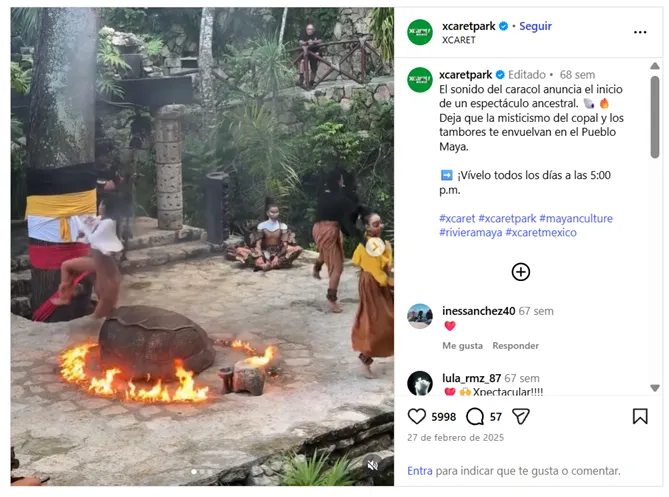
Screenshot from an Instagram post by Xcaret Park; fair use. The caption of the post reads, “The sound of the seashell announces the beginning of an ancestral spectacle. Let the mysticism of the copal and the drums immerse you in the Mayan Village.”
The context surrounding the narrative
The agreement between Grupo Xcaret and the Great Mayan Council of Quintana Roo follows the latter’s 2022 complaint to the National Copyright Institute (Indautor) against the tourism consortium for appropriating Mayan cultural heritage. The case was elevated to the Supreme Court of Justice of the Nation (SCJN), which, after an appeal referencing the 2024 agreement between the parties, ruled in March 2026 that Grupo Xcaret must remove advertising content that used elements of Mayan cultural heritage. According to the SCJN press release, “tangible and intangible cultural heritage belongs collectively to Indigenous peoples and communities, and therefore its protection is a matter of public order and social interest.”
In April 2026, the Great Mayan Council of Quintana Roo expressed its discontent with the SCJN ruling, accused the court of denying them a hearing to defend the actions of the Xcaret Group, and reaffirmed the agreement reached in 2024.
The Great Mayan Council of Quintana Roo is an Indigenous representative body, established by the state of Quintana Roo in 1998. According to an article by Hilda Landrove Torres in the online magazine Maya América, it has been surrounded by conflict and political pressure. The institution was created during the administration of Mario Ernesto Villanueva Madrid (then a member of the Institutional Revolutionary Party, or PRI), who prioritized the development of tourism in the Riviera Maya. Critics of Villanueva Madrid’s governorship argue that he orchestrated unions to his advantage, including the Great Mayan Council of Quintana Roo, to ensure the growth of the state’s tourism industry. Villanueva Madrid’s term ended in 1999, and he was imprisoned years later for alleged ties to drug trafficking, charges he maintains stem from his refusal to support the business interests of former President Ernesto Zedillo’s family (also linked to the PRI) in the Riviera Maya.
The positioning of the Great Mayan Council of Quintana Roo as being representative of the community was pushed in 2016 by the then governor-elect Carlos Joaquín González (currently Mexico’s ambassador to Canada), who represented the Party of the Democratic Revolution (PRD). According to the council’s proponents, its legitimacy emanates from its members, the Mayan generals and priests who represent each of the five ceremonial centers located in the state of Quintana Roo. The council is currently led by Simón Caamal Coh, who in April 2026 denied having received 15 million Mexican pesos as part of the agreement with Grupo Xcaret, which was made public in March 2024.
The National Institute for the Development of Indigenous Peoples (INPI) recognizes a separate group of representatives of the Mayan community in Quintana Roo, who have expressed their disagreement with the actions of the Great Mayan Council of Quintana Roo and are requesting an audit of the 15 million Mexican pesos allegedly granted by the Xcaret Group.
Mayan communities are nowadays settled across a vast geographical area encompassing Guatemala, Belize, western El Salvador, and Honduras, as well as the Mexican states of Chiapas, Tabasco, Campeche, Yucatán, and Quintana Roo. Given its status as a cultural region, this territory transcends national and state borders and therefore cannot be defined solely by them. Each Mayan community has its distinct language, worldview, and traditions.
Due to funding challenges, our Civic Media Observatory research continues on hiatus, and we are currently working at minimum capacity. Please help us maintain these narrative insights in a nutshell by donating to Global Voices, and reach out if interested in building partnerships to conduct our Civic Media Observatory research.