



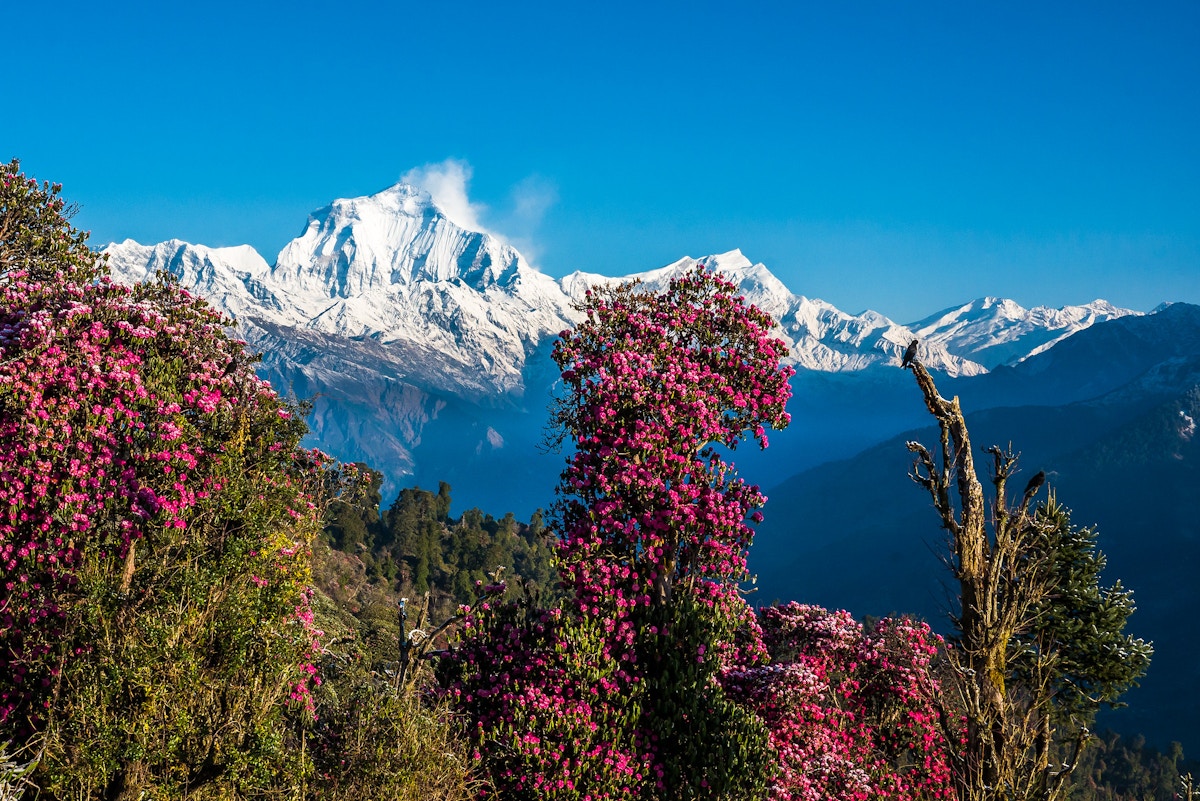
Every April, Nima Sherpa’s family used to picnic in a rhododendron (lali guras in Nepali) forest about 5 kilometres (3 miles) from her home at Basantapur Bazaar in Tehrathum in the Tinjure-Milke-Jaljale (TMJ) region, which stretched across the eastern districts of Tehrathum, Taplejung and Sankhuwasabha.
It has been five years since her family has done so as they no longer have the time. Instead of enjoying their time in the forest, they said, they are busy running their hotel in Basantapur Bazaar, which sees a big surge in tourism for only a few weeks.
This is when the hillsides get covered in crimson, pink and white blooms of at least 26 species of rhododendron, the national flower. All family members get busy welcoming guests with smiles and souvenirs. This year alone, local officials estimate that around 500,000 visitors entered the TMJ area between April 1 and 15.
One of the “souvenirs” growing in popularity among visitors is the flower-based alcohol, bottled in reused containers with handwritten labels and openly displayed in shops across. But authorities remain unaware of where the flowers are harvested, whether extraction levels are sustainable, and of the safety of the unlabeled products.
A trade hiding in plain sight
In April this year, Mongabay found bottles of rhododendron liquor displayed openly in shops catering to tourists in Basantapur Bazaar and nearby Gufa Pokhari, in Chainpur municipality, Sankhuwasabha district. Several shopkeepers told Mongabay that the sale of alcohol has become a growing seasonal business bringing in extra cash.
“
If someone breaks a branch, it takes at least five years for the plant to return to its original state. At higher altitudes, growth is even slower.
Indra Bahadur Khadka, chairperson, Chaite Community Forest
The products are typically sold in reused bottles of popular soft drinks with handwritten labels or no labels at all. Shopkeepers said most buyers are domestic tourists from cities such as Kathmandu and Dharan, although Indian visitors from West Bengal and Assam states also buy the bottles as a souvenir linked to the flowering season.
“I bought a bottle because everyone was talking about it,” said Balaram Jaisi, a tourist from Guwahati, Assam. “People think it is organic and traditional. I didn’t really think about where the flowers came from.”
Khem Dahal, a shopkeeper in Basantapur, acknowledged selling rhododendron alcohol from his store. He insisted, however, that his family uses flowers grown in private gardens rather than harvest from forests. “My family makes this alcohol from flowers grown in our garden,” Dahal said. “We do not collect them from the forest.”
Nepal’s conservation laws ban commercial harvesting of rhododendron flowers from community forests without approval. But officials say they don’t know how to apply the rules to flowers grown in private gardens.
However, local officials acknowledged there is little clarity over whether small-scale alcohol production from privately cultivated flowers falls under forest law, local excise regulation, or food safety oversight. The law also allows local people to brew alcohol up to 10 liters (2.6 gallons) for personal use if they belong to a community where the consumption of traditional alcohol is culturally accepted.
Livelihoods tied to the bloom season
For some families, rhododendron alcohol has become part of a supplemental revenue source. Denga Lama, a resident at Gufa Pokhari who produces small quantities of rhododendron alcohol at home, said visitors increasingly ask for local products linked to the flowering season. “Tourists want something unique from here,” she said. “People buy the alcohol because it reminds them of the flowers and mountains.”
Lama said the income during the short tourism season helps families as employment opportunities remain limited during the off season. “We only make a small amount,” she said. “If this is to be stopped completely, then the government should also think about other income sources for local people.”
Local residents say the commercial trade itself is relatively new. Tanga Sherpa, 70, who has lived in Basantapur for five decades, said rhododendron alcohol only became popular around three years ago, roughly coinciding with the return of tourists after Covid-19 restrictions were lifted.
“The flowering time has not changed. Everything is the same,” she said. “But in the last three years, people have started making more alcohol from the flowers.”
Conservation under pressure
The TMJ complex covers about 2,378 square kilometres (918 square miles) and its highest point touches nearly 5,500 meters,000 feet). Besides rhododendrons, the landscape is home to numerous plant species and wildlife, including red pandas, clouded leopards and snow leopards.
The region has been managed largely through community forestry systems rather than a formal protected-area model, giving significant stewardship responsibilities to local communities, including Rai, Limbu, Sherpa and Tamang groups who have long depended on the forests for fuelwood, grazing and seasonal forest products.
Yet local conservation groups say tourism pressure is already straining the ecosystem. Indra Bahadur Khadka, chairperson of the Chaite Community Forest in Tehrathum, said visitors frequently break branches and pluck flowers despite repeated warnings.
“If someone breaks a branch, it takes at least five years for the plant to return to its original state,” Khadka said. “At higher altitudes, growth is even slower.”
Community forest groups have deployed forest guards and police personnel during peak bloom season. They also fine visitors up to 5,000 Nepali rupees (US$37) for picking flowers. According to Khadka, 15 people have already been penalised this year.
But while authorities focus on tourists plucking flowers for photographs, there appears to be little oversight of commercial harvesting for alcohol production.
Botanist and biodiversity researcher Kamal Maden said rhododendron alcohol production is a serious emerging challenge, particularly if commercial demand continues to grow without harvest monitoring.
“The local administration should investigate where the flowers are coming from and whether harvesting levels are sustainable,” Maden told Mongabay.
Maden said rhododendron flowers have traditionally been used in some Himalayan communities for homemade drinks, herbal remedies and local food products, but added that commercialisation of the product in the name of tourism could have ecological impacts.
Health concerns
When Mongabay asked Division Forest Officer Megh Raj Rai about bottled rhododendron liquor, his immediate response was, “This is the first time I have heard about it.”
Rai said if this was being done on a big scale, it raises not only conservation concerns but also possible public health risks. “When I worked in Makwanpur district, we tested a similar product in a laboratory and found it harmful for human health,” he said.
Although rhododendron flowers are widely used for traditional food and medicinal purposes, the health risks of distilling them into liquor are not the same for all species.
Mongabay couldn’t independently verify the findings. But certain species, including Rhododendron decorum, have been found to contain grayanotoxins — a type of neurotoxin — linked to potentially life-threatening toxins.
Similarly, studies show that all rhododendrons don’t carry the same grayanotoxin concentrations, and hybridisation among rhododendron varieties produces new plants whose toxin levels are hard to determine. In the TMJ region, at least 26 species share the same habitat, making crossbreeding likely. In addition to this, the souvenir rhododendron liquor hasn’t been tested for toxins.
“There is still very little awareness,” said Arjun Mabuhang, mayor of Laliguras municipality in Terhathum district. “People continue using firewood and making alcohol even after awareness programs.” So far, however, local governments have not introduced specific regulations targeting commercial rhododendron harvesting or alcohol production.
Tourism growth and climate stress
The alcohol production isn’t the only issue facing TMJ’s rhododendrons.
The region is experiencing rapid tourism growth. There are plans for a 199-kilometre (123-mile) trekking route, and even a cable car line to bring in more tourists, but some conservationists like Maden said they worry that increased access may further strain the already fragile ecosystems dealing with waste, flower picking and unmanaged visitor pressure.
“There should first be a clear conservation management plan before expanding tourism infrastructure further,” said Maden. “Otherwise, we risk increasing pressure faster than local communities and forests can handle.”
Climate change is adding further stress.
According to Khadka, from Chaite Community Forest, prolonged droughts and shifting snowfall patterns are already affecting flowering cycles.
“During the blooming season there should be rain or snow, but now it comes late,” he said. “Because of the drought, the flowers bloom later.” Studies from the western Himalayas have already documented significant shifts in rhododendron blooming times linked to warming temperatures.
“People from Tehrathum, Dhankuta, Sankhuwasabha and Taplejung are earning money from lali guras, but they are not helping conserve it,” said Basantapur resident Tanga Sherpa. “If people stop coming here to enjoy nature, how will we survive?
This story was published with permission from Mongabay.com.