



There is ongoing turmoil in the native forest logging industry, as revealed in the ABC’s Four Corners program that aired last night.
The evidence presented was unambiguous: the native forest logging industry has been in financial, social, and environmental decline for decades.
Yet it continues to be financially supported by federal and state government subsidies that are detrimental to the economy, environmental integrity and the efficient spending of taxpayer dollars.
Logging is banned on public land in Victoria. However, Four Corners revealed Victorian sawmills are sourcing wood from native forests in Tasmania, at taxpayer expense.
This is not in the public interest. Instead, governments should facilitate the restoration and protection of native forests.
Is there demand for native forest wood?
Advocates for the native forest logging industry claim that Australians have an insatiable appetite for hardwood, from species like mountain ash and alpine ash.
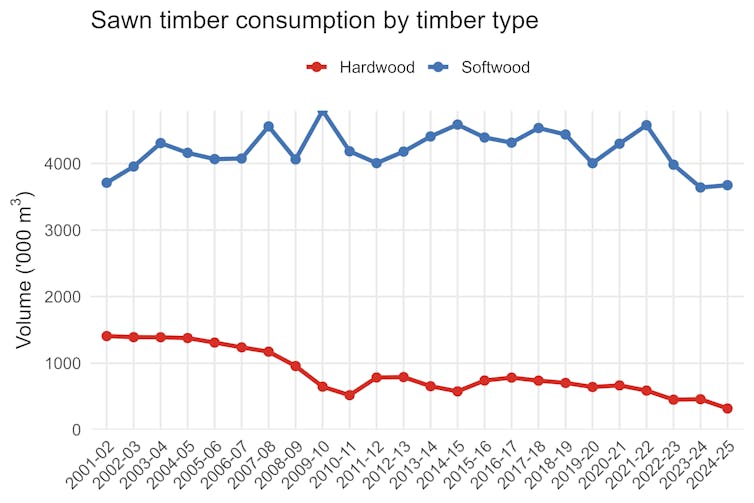
But government forestry products data tells a different story.
It shows sawn hardwood timber consumption has declined dramatically. In 2001-2002, about 1.4 million cubic metres was consumed, compared with 318,000 cubic metres consumed in 2024-25. This is close to an 80% decline.
In comparison, softwood sawn timber – cut from trees like pine – dominates the sawn timber market, producing an annual average of 4.2 million cubic metres over the same period.
In places like Victoria, over 80% of the wood removed in native forest logging was made into white copy paper. Yet demand for this product has declined – dropping 66% in the last 20 years. Australia’s consumption of white copy paper peaked at approximately 1.8 million tonnes in 2007-08, before falling sharply to around 660,000 tonnes by 2023-24.
ABARES
Will we just import more hardwood timber?
Industry representatives said on Four Corners that without native forest logging, Australia would import vast amounts of hardwood timber.
However, this is not the case. According to government data, dressed and rough hardwood sawn timber imports have fallen from a combined total of 150,000 cubic metres in 2004-05 to 47,000 cubic metres in 2024-25 – a decline of nearly 70%.
In contrast, Australia has been a net exporter of sawn hardwood timber since 2022-23, and for the years 2008–2011 and 2013–2015. This means that as a nation we have exported more hardwood timber than we have imported.
Australia is actually a net exporter by volume of most wood products, but these are of lower value, such as unprocessed logs. In 2024-25, Australia imported only 1,000 cubic metres of unprocessed hardwood and softwood logs. In contrast, it exported 1.4 million cubic metres of these logs and nearly 4.7 million tonnes of woodchips.
However, Australia imports more high value-added wood products than what it exports. For example, in 2024-2025, Australia imported 1.1 million cubic metres of engineered wood products, but exported only 319,000 cubic metres of the same kind of products. Engineered wood products include veneers and cross laminated timber.
The large amounts of exported low value wood products versus the imports of high value-added wood products in lower volumes is one of the main reasons why Australia has a trade deficit in wood products.
Chris Taylor
Why was the forest industry closed in Victoria?
Forest industry advocates have questioned why the native forest logging industry was closed in Victoria. There are several reasons. A key one is the government-owned forestry company VicForests routinely made large net losses.
For example, its annual reports show a $60 million loss in 2022-2023, and $54 million loss in 2021–22.
In addition, forests in Victoria were heavily overlogged. Our research has found the vast majority of mountain ash and alpine ash forest across the Central Highlands of Victoria has been either severely disturbed and fragmented by clearfell logging or high severity fire (and often both).
The Victorian native forest logging industry also had large numbers of regulatory breaches for its industrial operations and ongoing impacts on biodiversity.
Has Victoria really stopped native forest logging?
The Four Corners program showed footage of wood being trucked from Tasmanian forests across Bass Strait to be processed in Victorian mills in the towns of Heyfield and Powelltown.
Following the Victorian government’s announcement it would stop native forest logging on public land, it committed $1.5 billion of taxpayer funds to support the transition away from native forest logging in Victoria.
The Heyfield mill is 49% owned by the Victoria government. Hence, although the Victorian government says it has stopped logging, taxpayer funds are being used to cut forests in Tasmania and process them through the Heyfield and the Powelltown mills. Transition funds have been allowed to flow into native forest logging rather than out of it.
Victorian Premier Jacinta Allan rejected the suggestion Victoria was shifting logging pressure to Tasmania, saying the government was backing workers and regional communities. “We’ll always look at ways to back workers, particularly in these small rural communities where companies like this one, they’re a big and important source of income and support for that area”, she told the ABC.
An end to native logging
As researchers working on forests, we have collected and read reports from roughly one inquiry or review into the native forest logging industry in Australia almost every year since the end of World War II.
No matter how much public money, suggestions for change and reform or recommendations for value-adding, the industry simply cannot survive without massive subsidies and handouts from government. It has been like this for decades.
The taxpayer should not be expected to keep propping an industry that loses so much money. It is time to terminate contracts, cease handouts, and fully close the native forest logging industry in Australia. Instead, we should transition to a well managed plantation-only forestry sector – as New Zealand did in 2002.