



SINGAPORE: Singapore’s coastal landowners now have a clearer idea of what is expected of them as the country prepares for the long-term threat posed by rising sea levels.
The national water agency, Public Utilities Board (PUB), has launched a new code of practice on coastal protection (CPCOP) that sets out how coastal property owners must protect their land from future sea-level rise. The guidelines will become mandatory from 2028 and will support legislation passed earlier this year that requires landowners to take responsibility for coastal protection.
According to a report by Channel NewsAsia (CNA) published on June 17, landowners with more than 30 years remaining on their lease must plan for a projected sea-level rise of up to 2.15 m. Those with fewer than 30 years left on their lease must prepare for at least a 0.7-m increase.
Climate risks are no longer a future problem; they are now a planning and infrastructure issue, a reality facing many coastal cities worldwide.
Coastal protection becomes a shared responsibility
Speaking at the Singapore International Water Week conference, Minister for Sustainability and the Environment Grace Fu said the new legal framework gives clear direction on who is responsible for safeguarding Singapore’s coastline.
Under the law passed in March, public and private coastal landowners must build, operate and maintain coastal protection measures as part of a continuous line of defence.
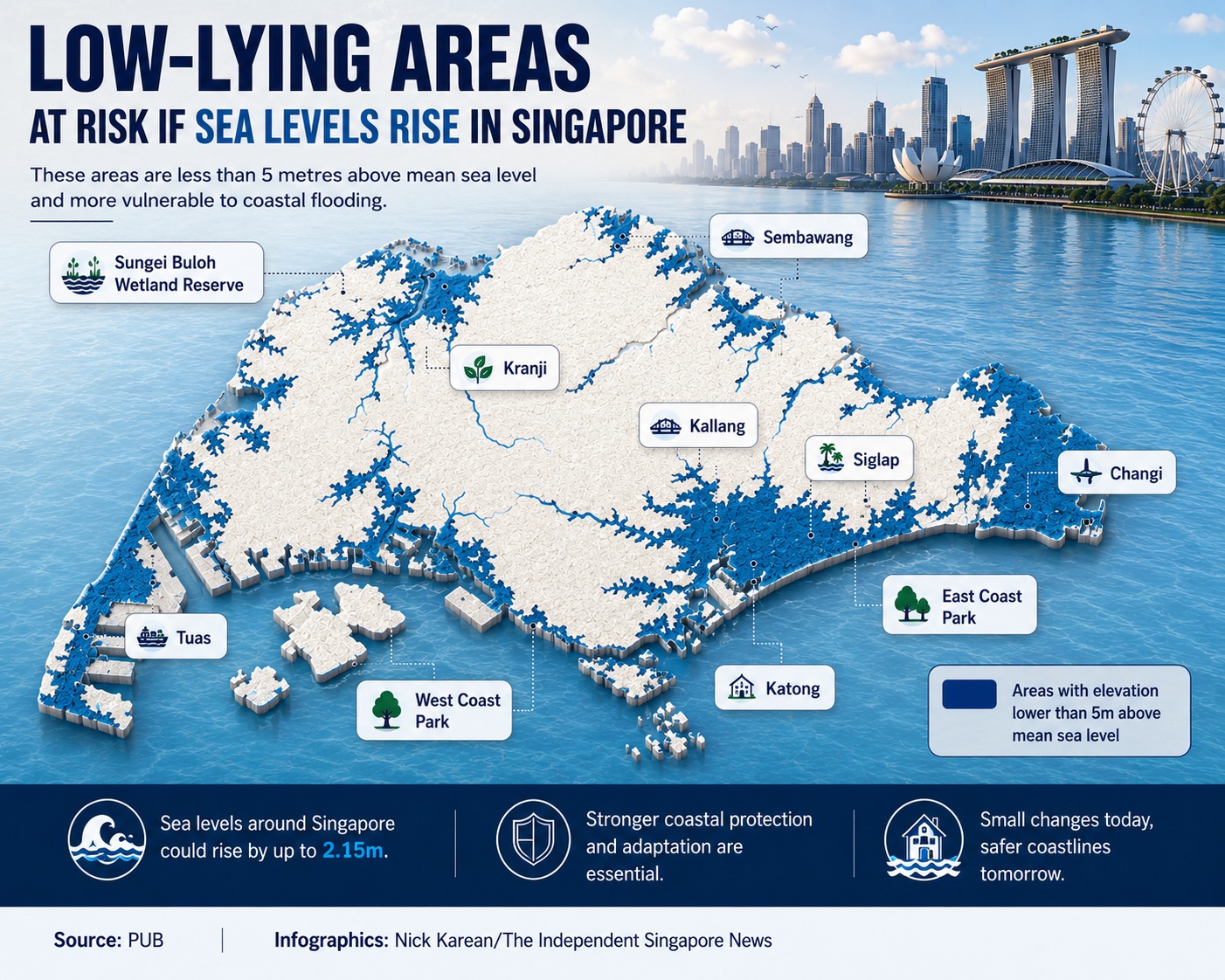
About 70% of Singapore’s coastline is government-owned and will largely be managed by the state. The remaining sections are owned mainly by shipyards, ports, and businesses involved in the oil, gas, and manufacturing sectors.
Private landowners will be eligible for capital grants and technical support from PUB to help meet the new requirements.
Building seawalls to form a continuous watertight barrier
The code doesn’t focus only on construction. It also outlines standards for inspections, maintenance and long-term performance.
Landowners will have to ensure their protective structures remain effective throughout their lifespan and submit annual declarations to PUB confirming maintenance obligations have been met.
The guidelines also address how neighbouring coastal protection systems should connect to form a continuous, watertight barrier.
Where conventional structures such as seawalls or embankments are unsuitable because of operational needs, landowners may apply to use deployable barriers. These include swing gates, flip-up barriers and sliding gates. However, PUB said stricter approval requirements will apply because such systems carry greater operational risks.
Testing new solutions for a changing climate
Alongside the new rulebook, PUB is investing in future protection methods. The agency has awarded S$14 million to five pilot projects that will test coastal protection technologies from 2027.
The trials will run for three years before authorities assess whether the solutions can be adopted.
One project involves Japanese construction firm Kajima Corporation working with local partners and researchers to trial an eco-friendly seawall. The design will use prefabricated components, lower-carbon materials, smart sensors, and self-healing technology to reduce maintenance needs and emissions.
Coastline protection is no longer solely a government task
Singapore has long relied on forward planning to tackle major infrastructure challenges. Coastal protection is becoming one of the biggest concerns.
The latest rules signal that defending the coastline is no longer solely a government task. Businesses and private landowners with coastal assets are now expected to help protect the country’s shoreline.
As climate risks become harder to ignore, the bigger challenge may not be whether coastal protection is needed, but how quickly stakeholders can work together to stay ahead of the rising tide.