



When vaccination rates drop — as is the case with adult influenza vaccinations in Canada and child measles vaccinations in British Columbia — the explanation is often that people are “hesitant.”
The unvaccinated are frequently described as influenced by misinformation, cultural beliefs or religion. The solution, then, is assumed to be health education or clearer messaging, suggesting that the main barrier to vaccination lies within individual attitudes, fears or choices.
There is some truth to this. As ample research demonstrates, beliefs do matter and misinformation does influence vaccine decision-making. But focusing only on individual behaviour and beliefs risks overlooking the context in which decisions are made. Across multiple Canadian studies, barriers to vaccination consistently extend beyond personal choice. They are embedded in policies, institutions and everyday experiences with the health system.
In other words, vaccine uptake is not just a behavioural issue. It is also a structural one.

THE CANADIAN PRESS/ Geoff Robins
When access isn’t truly accessible
One of the most consistent findings in Canadian research is that access to vaccines is uneven. Vaccination clinics may be located far from rural or lower-income communities, or operate only during standard working hours — despite the fact that 60 per cent of Canadians work shifts or non-traditional hours.
For others, logistical barriers create challenges. Parents may struggle to find childcare. During the initial COVID vaccination campaign, for example, adults were able to take paid time off work to get themselves vaccinated, but not to get their children vaccinated.
Immunity and Society is a new series from The Conversation Canada that presents new vaccine discoveries and immune-based innovations that are changing how we understand and protect human health. Through a partnership with the Bridge Research Consortium, these articles — written by experts in Canada at the forefront of immunology, biomanufacturing, social science and humanities — explore the latest developments and their impacts.
Transportation may be limited. For some people, this may mean unreliable public transit, transportation costs or difficulty travelling with children, older family members or those with mobility challenges. In Northern Ontario, for example, one survey found that about one in four residents in rural and northern communities had cancelled a medical appointment because of the distance required to travel for care.
Administrative requirements can also exclude people. Identification rules, for example, can create barriers for undocumented individuals or those experiencing housing instability.
These challenges are rarely captured in public conversations about hesitancy. But they play a major role in shaping who gets vaccinated.
Trust is built through systems, not slogans
Public health strategies often emphasize improved communication based on the assumption that better information will lead to higher vaccine uptake. But trust is not just about receiving facts. It is about experience.
For many communities in Canada, particularly Indigenous, Black and racialized immigrant populations, interactions with health systems have not always been positive, and in numerous cases have been outright negative.
Experiences of discrimination, exclusion or neglect shape how public health messages are received. During the COVID-19 pandemic, frequent policy changes and inconsistent messaging further undermined confidence. In some cases, even health-care providers struggled to keep up with evolving guidance.
In this context, hesitancy is not simply a lack of knowledge. It can reflect a lack of trust — rooted in real experiences.
THE CANADIAN PRESS/Chris Young
Top-down approaches can create gaps
Another important factor is how vaccination programs are designed and delivered. Many public health strategies, particularly during public health emergencies, rely on top-down approaches, with limited input from the communities they aim to reach. This can result in services that do not reflect people’s needs, whether in terms of language, culture or accessibility.
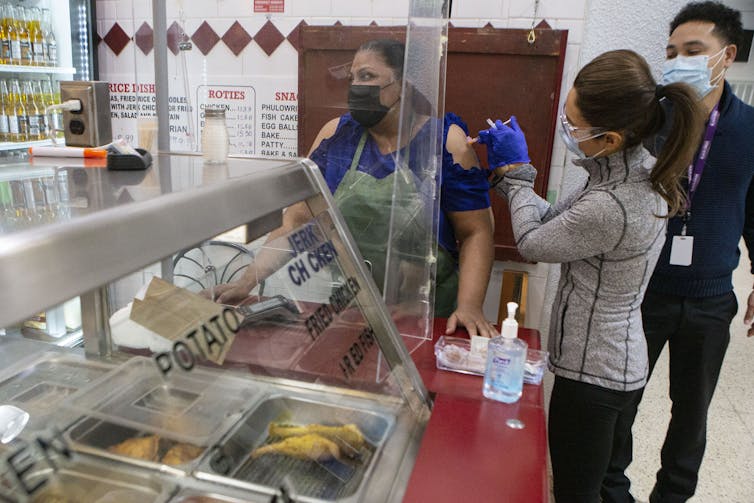
Community organizations often step in to connect specific communities with public health providers. They may offer translated information, help people book appointments, organize mobile or pop-up clinics, provide transportation support, or work with trusted community and faith leaders to deliver culturally appropriate outreach.
During the COVID-19 pandemic, some public health units partnered with faith-based and ethnocultural organizations to host vaccination clinics in places of worship and community centres, helping improve trust and accessibility among racialized communities.
However, these efforts are often short-term and underfunded. Despite their effectiveness, they are not always integrated into formal health systems.
This highlights a broader issue: the people closest to the problem are not always included in the solution.
What a structural approach looks like
If vaccine access is shaped by structural factors, then solutions must go beyond changing individual behaviour. Research points to several key shifts:
- Designing services that fit people’s lives — including flexible hours and accessible locations
- Removing unnecessary administrative barriers
- Investing in community-led approaches and partnerships
- Improving consistency and transparency in communication
- Involving communities in decision-making processes
These changes focus on the conditions that enable sound vaccine decision-making.
Changing how we think about vaccination
Reframing vaccine hesitancy as a structural issue does not mean ignoring individual choice. Instead, it recognizes that choices are made within a context. When access is difficult, trust is low and systems feel unresponsive, lower uptake should not be surprising.
Balancing the conversation, from a strong focus on vaccine acceptability, to include the structures that support vaccine accessibility, can help advance vaccine decision-making that is more equitable.