



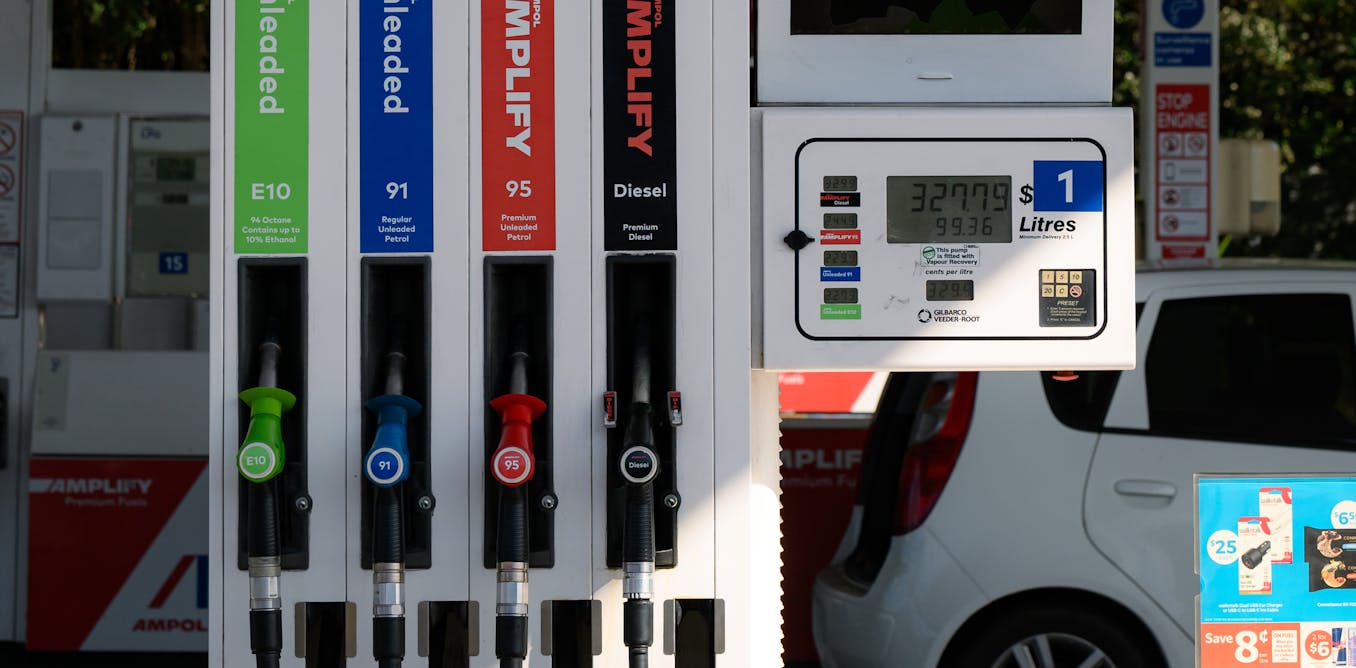
The federal government’s cut to the fuel excise is due to expire at the end of June, meaning the cost of filling up a 65-litre petrol vehicle could rise by about A$19 from July 1.
This week, Prime Minister Anthony Albanese left the door open to extending the temporary cut for petrol or for diesel. The cut was put in place to offset the surge in fuel costs following the start of the Iran war in late February.
While the cut provides some inflation relief for drivers, it is a blunt way of achieving fairness. The three-month cut has cost the government some $2.55 billion in lost revenue.
A more radical reform package that would be budget-neutral would replace the fuel excise with a road user charging system.
Cost-of-living relief
Before the reduction, the fuel excise was 52.6 cents per litre of petrol and diesel for passenger vehicles, and 32c a litre for heavy vehicle road users. Fuel for off-road uses, including agriculture and mining, were exempt.
In 2024–25, the fuel excise raised $24.6 billion in revenue. The tax is not directly allocated to governments to fund spending on roads, maintenance and other road services. But it serves as a user charge for drivers for the costs to society of government-funded roads and road maintenance.
When it announced the halving of the fuel excise, the government said it wanted to relieve the financial stress caused by the spike in oil prices. The price of petrol was cut by 26.3c a litre and the heavy vehicle road user charge was suspended.
However, this reduction has resulted in a number of problems that could be largely reversed by returning to the original rates from July 1.
Read more:
Halving the fuel excise is smart politics, but flawed policy
Better options for income support
The loss of government revenue means a larger federal budget deficit, at the same time as providing a boost to consumer spending.
These two forces work against the Reserve Bank of Australia’s mission to dampen demand in the economy to bring down inflation, with a series of interest rate hikes this year.
It’s understandable the industries most affected by higher petrol costs – such as road transport and construction – welcomed the fuel tax relief, and want to see it extended.
Travel, groceries (particularly fruit and vegetables) and new home construction all cost more when fuel prices rise. This is an inflation risk the Reserve Bank has been watching closely for months.
However, from a fairness perspective, there are better policy options to help lower-income households deal with high fuel prices. More direct and effective policies would be to increase unemployment benefits, disability and aged benefits, or reduce the lowest income tax rates.
Cutting the excise rate for petrol and diesel provides a benefit to wealthy and poor drivers alike. It is a blunt way to reduce higher living costs for those on lower incomes. And households without petrol motor vehicles or those that take relatively short trips gain very little from the lower petrol prices.
A subsidy for fossil fuels
More broadly, cutting the excise on petroleum products has a number of negative effects on the allocation of scarce resources in the economy.
The reduction is, in effect, a subsidy for polluting vehicles that run on fossil fuels, generating greenhouse gases and ultimately contributing to climate change. The subsidy reduces the incentive to switch from fossil fuel to electric vehicles.
And by making fuel cheaper, the subsidy also encourages increased road usage by households and businesses rather than, for instance, encouraging public transit use.
A chance for radical reform
While it might not have the political appetite to do so, the government could consider a more radical reform package than returning to the old rates of fuel excise.
Sales of electric vehicles (EVs) have surged this year as consumers switched from petrol vehicles, with EV and hybrid sales jumping to 46% of all vehicles sold in May.
But these cars still use government-provided roads and services, and do not pay the fuel excise.
A road user charge with similar treatment for petrol and electric vehicles could largely replace the fuel excise, and would apply to all drivers.
This type of charge, which has been debated since the 1970s, is used in other advanced economies to reduce congestion and influence travel behaviour.
There could be a couple of categories for vehicles of different weights, as SUVs and other heavy vehicles cause more damage to roads.
And a nationwide road pricing policy could reduce reliance on the current patchwork of declining fuel excise revenues, road tolls and vehicle registration fees.