



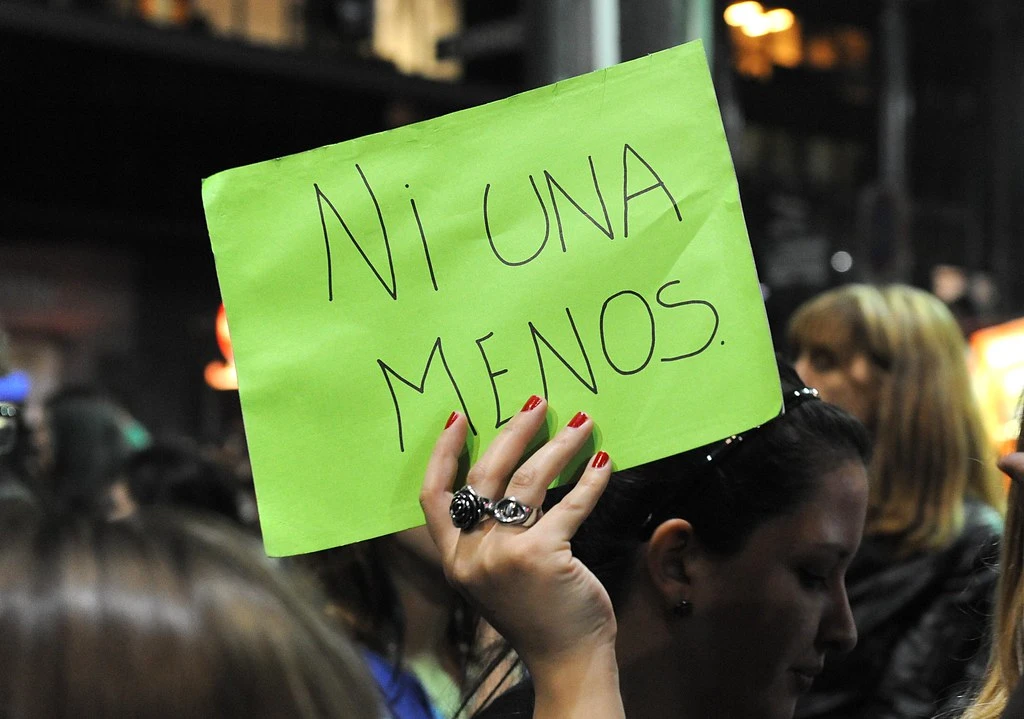
Photo of International Women’s Day protest in Argentina by TV Prensa Pública Uruguay, 2015. (CC BY 2.0)
By Daniela Poblete Ibáñez
This article by Revista Emancipa was first published on May 7, 2026. An edited version is being republished on Global Voices under a content partnership agreement.
This post is part of Global Voices’ June 2026 Spotlight series, “Gender Diversity.” This series offers insight into gender diversity and how it is being threatened, protected, and preserved around the world. You can support this coverage by donating here.
There are phrases born from the deepest pain that end up changing history. In 1995, Mexican poet Susana Chávez Castillo wrote “Not One Woman Less, Not One More Death” as she walked the streets of Ciudad Juárez denouncing the systematic murder of women, which the state preferred to call “unfortunate incidents.” In 2011, she herself was murdered — raped and mutilated like so many of the women she had defended.
Chávez Castillo did not live to see how her words would have a lasting impact on the world. Four years after her femicide, her slogan crossed the continent.
On May 10, 2015, in Santa Fe, Argentina, Chiara Páez — 14 years old and two months pregnant — was beaten to death by her boyfriend and buried in the backyard of his family home. The entire town had been searching for her. Her father said something that no public policy should ever forget: “Chiara was the straw that broke the camel’s back. The violence did not begin that day. It has been going on for many years.”
A month after the crime, 300,000 people filled the Plaza of the Two Congresses in Buenos Aires and gathered in 80 other Argentine cities for a massive demonstration against gender-based violence, under a single slogan. Within weeks, Ni Una Menos (Not One Woman Less) was being heard in Mexico, Chile, Peru, Uruguay, Bolivia, Colombia, and Paraguay.
Latin America recognized in that slogan something it already knew but which no one had named so clearly: that women are killed for being women, and that it has a name — femicide.
The movement put femicide on the state agenda across the region. That same year, Argentina’s Supreme Court created the National Femicide Registry. For the first time, the state counted women murdered at the hands of their perpetrators. In Chile, Colombia, and across the continent, organizations demanded the same: data, legal recognition, and institutional accountability. Some states responded; most only partially. Today, eleven years later, the struggle continues.
According to ECLAC, at least 4,855 women were victims of femicide in Latin America during 2024, equivalent to 13 gender-based murders every day. The cumulative total over the last five years exceeds 19,254 femicides across the region. These figures come from official records reported by governments to ECLAC’s Gender Equality Observatory, but they are complemented (and often surpassed) by data collected by civil society organizations, which monitor media reports, document cases, and fill the gaps that states either fail to record or choose not to see.
According to the Supreme Court Registry, Argentina ended 2025 with 200 femicides — one victim every 44 hours — but the National Ombudsman’s Observatory counted 247 when including trans femicides, related femicides, and femicide-related suicides. These are 247 gender-motivated crimes, happening while President Javier Milei’s government dismantled the Ministry of Women and cut 90 percent of funding for victim-support programs.
Official data from SernamEG notes that Chile recorded 40 completed femicides and 283 attempted femicides in 2025, committed predominantly by intimate partners, within the home. These figures are very similar to those of 2024, but the stagnation does not reflect less violence; rather, it reveals the state’s inability to transform the structures that produce it.
Colombia is experiencing a crisis documented by its own civil society. According to the Colombian Femicide Observatory, between January and June 2025 there were 342 recorded cases, a 6.5 percent increase compared to the same period the previous year. Ninety-eight percent of cases remain without a sentence.
Paraguay ended 2025 with 37 femicides according to the Public Prosecutor’s Office, leaving 69 children motherless. Eighty-five percent of these crimes were committed by current or former partners. In the same year, 37,825 cases of domestic violence were recorded (an average of 104 victims per day), but civil society organizations consider these figures to be underreported due to weaknesses in the protection system.
The picture remains largely unchanged after 11 years. While institutional discourse multiplies through symbolic declarations, concrete action backed by real budgets and political will remains insufficient across most of Latin America.
Not only do the ultraconservative, authoritarian governments gaining ground in the region and around the world fail to protect women, they actively work to dismantle the institutional frameworks of protection and rights that took decades to build. Gender ministries are being dissolved, budgets cut, and victim-support programs paralyzed.
Alongside this comes a discursive offensive that normalizes hatred: women are labeled as hysterical, feminism is denounced as an “ideology,” and diverse identities are portrayed as “threats to the nation.” Far from being merely symbolic, these sentiments are being expressed through labor precarity, exclusion from public life, and the criminalization of abortion as a means of controlling women’s bodies.
Ni Una Menos never promised to end femicide. It promised that women would not remain silent; that every time one of their own was murdered, they would speak her name. That the struggle of Susana Chávez Castillo in Ciudad Juárez, of the Mothers of Plaza de Mayo, and of the grassroots women who organized communities across Latin America would not be in vain.
But that promise also demands more than a slogan. It demands that indignation become organization, and that organization become power. It demands that when governments retreat, citizens move forward. Eleven years after the first cry, this remains necessary — not because the movement has failed to make progress, but because patriarchy has not surrendered. And neither have women.
