



Since the launch of ChatGPT at the end of 2022, AI has quickly changed how we work, how we learn, how we love, how we heal. It has also made a handful of companies such as Nvidia, Anthropic and OpenAI very powerful, and put the U.S. and China far ahead of every other country. What does this mean for everyone else? Is there a way to ensure a more equitable future?
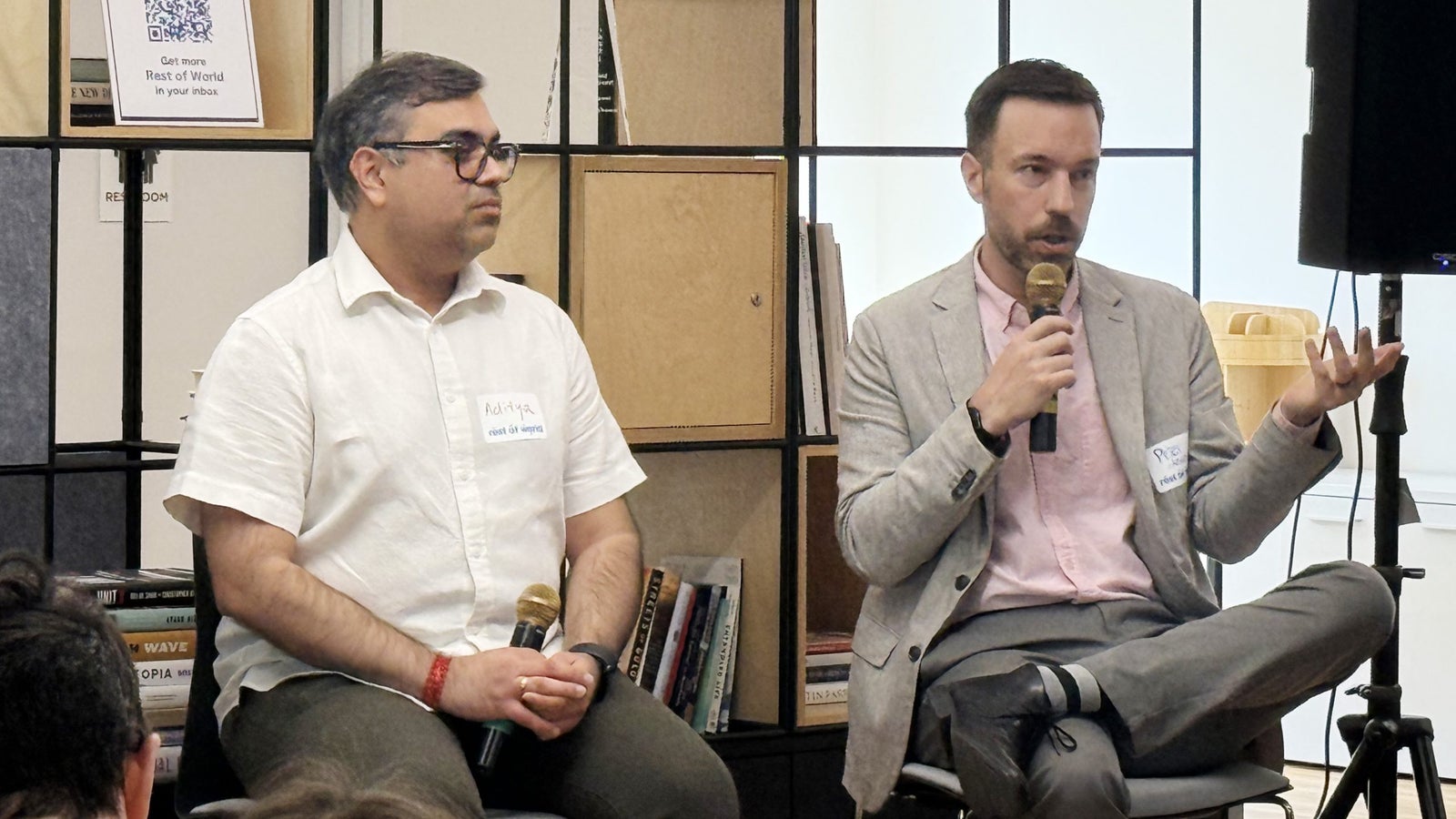
Last week, Rest of World hosted an event titled “The Great AI Divide,” as part of the New York Tech Week. We asked three experts to weigh in on these questions: Sam Winter-Levy, a fellow at the Carnegie Endowment for International Peace; Aditya Vashistha, an assistant professor at Cornell University, where he leads the Cornell Global AI Initiative; and Peter Micek, general counsel and United Nations policy manager at digital rights group Access Now.
Here is a summary of the conversation, edited for brevity and clarity. You can also watch it here.

Rest of World
Sam, is the AI race all but over for everyone? What happens when countries are subject to the whims of Washington and Beijing?
It’s fair to say that AI is primarily a two-horse race. The U.S. and China control 90% of global computing power, attract between 70% and 80% of global investment in AI, and have huge concentrations of talented AI researchers. That creates a world in which other countries are dependent on the U.S. and China for access to AI systems. And both the U.S. and China have shown a willingness to use that access for leverage. That puts most of the Global South in an uncomfortable position. And the middle powers remain exposed to the disruptions that AI could cause, even if they don’t necessarily capture the benefit. So they’re still exposed to job-related disruption, the social effects of AI systems. That’s the pessimistic story about how the rest of the world could be left behind.
The middle powers remain exposed to the disruptions that AI could cause, even if they don’t necessarily capture the benefit.”Sam Winter-Levy, fellow, Carnegie Endowment for International Peace
Three trends make this pessimistic story particularly likely right now. The first is that a lot of the frontier developers in the U.S. are switching to a more managed-access approach to their technology. Anthropic’s Mythos model is a good example of this. They’re rolling the model out to small groups of companies that they select, at least initially. That puts other countries in an uncomfortable position where U.S. companies pick who gets access to these systems. Second, we’re now in a world where there are quite severe compute constraints. Demand for these models is outstripping the compute that the companies have. Again, companies are rationing who can use those systems. And finally, we’re starting to see the U.S. government and the Chinese government playing a more assertive role in who can have access to these systems. So those trends together could lead to a situation where a small handful of very wealthy companies, very wealthy countries have control over who has access to this technology.
Aditya, you design, build, and evaluate AI for marginalized communities. What are the risks of having only American and Chinese AI systems?
AI technologies today are designed by and for WEIRD societies — Western, educated, industrialized, rich, and democratic — which represent only 14% or 15% of the world’s population. What about the 85% and how they are represented in the AI systems? Back when ChatGPT was launched, and you would ask, “What does a Muslim man look like?” there was a homogenized view of that — someone who is wearing a headscarf and has a white beard — while a Hindu man would be someone who’s wearing saffron. There were all sorts of problematic issues for any kind of marginalized population, like people with disabilities. Many of these AI models could not even show what these looked like.
There have been many advancements, more safety integrated into these models. But these models continue to have many of these biases — religious, linguistic, identity, and so on. These biases are not what they were a couple of years ago, but they are still deeply rooted in these models. So as we think about AI futures for the rest of the world, we need to think about whose values, whose voices, whose languages, and whose cultures are represented in these models. The layers which we have now work for only a minority of the world’s population, and many of the benchmarks for safety do not even account for ableism, when we have 1 billion people in the world with disability. So some of these biases are not just towards people living in the Global South, but about marginalized voices. If you look at preference data sets, many of these do not exist for the majority of countries in the Global South. Many are in English, and not in other languages. If we do not take into account these biases, these languages and cultures, then we are continuing to design our AI technologies to work efficiently only for a sliver of the population.
90% The amount of compute that the U.S. and China control together.
Peter, the first U.N. General Assembly resolution on AI was about the need for safe, secure and trustworthy AI systems, and the application of human rights to AI. There was also a resolution on international cooperation in AI capacity-building. Where do we stand on these now?
The first two resolutions on AI were led by the U.S. and China, respectively. And unlike most resolutions, they each went it alone. There was some good language in the Biden era U.S.-led resolution, applying human rights to the entire life cycle of AI. It talked through development, model building, to feedback and implementation, and ensuring that the entire bevy of human rights — the last 60–70 years of progress — is affirmed and does apply to the AI space. That’s a really positive assertion, along with the assertion that certain applications of AI are impossible to reconcile with the human rights framework, and that leaves a lot of questions as to what those applications are. In the last year or two, we have seen the application of AI to military contexts as well as humanitarian, and that’s putting machine learning systems in direct control over life or death decisions. The idea that a human ultimately pushes the button, but depends on libraries of targets and scaling and selection that the machine gives — even with a human in a loop, that’s simply not enough.
Sam, in his speech at Davos, Mark Carney said, “Great powers have begun using economic integration as weapons, tariffs as leverage, financial infrastructure as coercion, supply chains as vulnerabilities to be exploited.” He called for countries in between to combine to create a third path. Is there a way to do that for AI?
We have seen the application of AI to military contexts as well as humanitarian, and that’s putting machine learning systems in direct control over life or death decisions.”Peter Micek, general counsel, Access Now
The problem with the Carney vision is that … the correct analysis of the geopolitical situation runs up against this technological moment where these two countries, the U.S. and China, really are dominant. So for middle powers, there are a few options. One, you form some sort of middle-power coalition, you run French models or Canadian models on data centers in Australia, and you pool resources to try and catch up.
A second approach is trying to build your own sovereign models. The UAE, India talk about this a lot. I think it’s very difficult because of the scale and the amount of money needed. They’re still using U.S. chips designed by Nvidia in data centers that are serviced by U.S. companies, so it doesn’t get rid of all these vulnerabilities. The third approach is to essentially bandwagon, or sidle up to one of the great powers, whether it’s the U.S. or China, and build a very close relationship to make sure to have access to the technology. But that does expose you to the U.S. or China. If they don’t like your policies or something, they have a lot of leverage over you.
The best option is some version of the third approach, where you get access to U.S. technology or Chinese technology, and you are well aware of the vulnerabilities. You need to bargain very hard with the great powers over getting durable guarantees. It would mean finding sources of leverage — whether that’s in the AI supply chain, in the semiconductor supply chain — and using that as leverage to say, we’ll give you access to our raw materials, our critical minerals, our robotics capabilities, our chip design capabilities. And in exchange, we want guarantees that you’re going to keep giving us access to the best models.
-
-
Rest of World
Sam, what leverage do middle powers have? India has been a massive source of data and talent for American companies, for example.
To be competitive in AI, you need access to tons of researchers, you need access to energy, you need access to chips, and access to data. So countries that have those things and can offer them to the U.S. — not as a gift, but in exchange for things in return — have a relatively strong hand to play. The Netherlands, Taiwan, Japan, and South Korea play key roles in the chip supply chain. That gives them quite a lot of leverage. India obviously has huge amounts of data, even Ukraine has huge amounts of data from the battlefield that American companies are desperate for. Talent becomes harder to use as leverage. Energy is another thing that a lot of countries can use as leverage. The key thing they need to do is figure out what they have that the U.S. or China really need, and use that as leverage — whether it’s upstream in the supply chain or downstream in actual deployments — to bargain harder for access to the frontier models.
Peter, RightsCon this year was cancelled because of pressure from China on the Zambian government. Is it far-fetched to imagine China or the U.S. dictating terms to a country that it sells AI systems to?
We have direct experience with being used as a ping-pong ball between great powers, and experiencing the pressure that one of them can bring on one of these smaller states. We were supposed to be in Zambia last month for the conference with around 2,600 folks in person, thousands more online — it’s the world’s biggest conference on the future of the internet, going deep into human rights and into labor and the environment. Unfortunately, about five-six days before the conference was supposed to start, we were told that the Chinese government had got wind that there would be Taiwanese participants, and that more time was needed for security clearances and other diplomatic overtures. Ultimately, we learned that they needed full moderation of online and offline panels, for mention of LGBTQ issues, denial of access for Taiwanese participants, and adherence to the One China policy. Zambian authorities gave in to this pressure, but it is not the only example that we’ve seen. The U.S. is also exerting pressure on civil society right now in the digital rights space, canceling visas, sanctioning individuals, researchers, and activists.
Aditya, at the India AI summit in February, there were high expectations that it could offer a third way to challenge how AI power is distributed. Did that happen?
As we think about AI futures for the rest of the world, we need to think about whose values, whose voices, whose languages, and whose cultures are represented in these models.”Aditya Vashistha, assistant professor, Cornell University
It’s too soon to say. What the summit accomplished was getting a lot of people in the room — government officials, heads of state, CEOs and CTOs of big tech companies, small tech companies, nonprofits, civil society organizations — to talk about the Global South. It is something we should have been doing for a very, very long time, and this was the big achievement of the summit. Just having all these people in the room talking about AI safety, security, fairness, governance, and other challenges which come with designing, building and evaluating AI technologies, forming partnerships and collaborations was a great success.
Sam, for countries that don’t want to align with the U.S. or China, what’s the outlook?
There’s one conversation that’s taking place in Silicon Valley, in Washington, and in some capitals around the world, where there is this belief that you need access to frontier models. You need access to the best large language models that are coming out of Anthropic, OpenAI, and that these models are going to be absolutely critical to national security, and the economy. There’s also this conversation in the middle powers, where there’s a little bit more optimism that you can use small language models. That you can focus on use cases, your own open-source, and you don’t need access to the very best models, you don’t need access to a huge infrastructure, or investments. We don’t know exactly which of those technological paradigms is right. For a lot of critical national security use cases, critical economic use cases, some cybersecurity, if you have a model that is okay but not great, and you’re going up against a state that has access to the best models, you’re just going to be totally outcompeted. In parts of finance, scientific R&D, if you’re not able to do research as well as the other countries, you are going to lose a lot of advantages. But it might be the case that good enough open-source models that aren’t quite at the front end will work for most use cases. And if that’s true, then the world is much less bleak for a lot of middle powers.
Access to the best models and entrepreneurial culture will unlock huge possibilities for populations around the world to create businesses, to build products that they would not have been able to in the past. With just a handful of people in India or the Philippines, you could build things that in the past you needed vastly more resources to do. So there will be a hugely democratizing effect if you have access to systems in a safe and responsible way, and you can get tremendous economic benefits. But that’s contingent on having access. And that access is not guaranteed.