



SINGAPORE: Amid a wave of reactions about Minister Indranee Rajah’s recent comments as chair of the Government’s workgroup to boost the national birth rate, one individual has said that the politician should not act as a spokesperson giving advice to citizens, given the fact that she does not have children herself.
The criticism erupted after Ms Indranee gave an update on the new Marriage and Parenthood Reset Workgroup that was convened to address Singapore’s record low total fertility rate (TFR) of 0.87.
The 63-year-old told CNA last week that the breaks women take to have and care for children should be seen as career “detours” and not sacrifices or setbacks. She added that the workgroup aims to normalise these career “detours” among employees and employers.
Singaporeans responding to her remarks were critical and asked the Minister why she hadn’t taken a detour herself. Ms Indranee is unmarried and does not have children.
Some questioned why Prime Minister Lawrence Wong, who also does not have children, would tap on Ms Indranee to head a committee on marriage and parenthood. Others said “talk is easy” and urged the Minister to avoid lecturing working mothers, as she hasn’t had the experiences they have had.
Amid the criticism, one Singaporean urged the Minister to reconsider her communication approach and rely on mothers to better connect with citizens on this issue.
In a lengthy post analysing the reactions to Ms Indranee’s recent remarks, Facebook user Ding Neng argued that successful messaging often depends not just on the content of the advice being given, but on whether the person delivering it is seen as relatable or credible by the target audience.
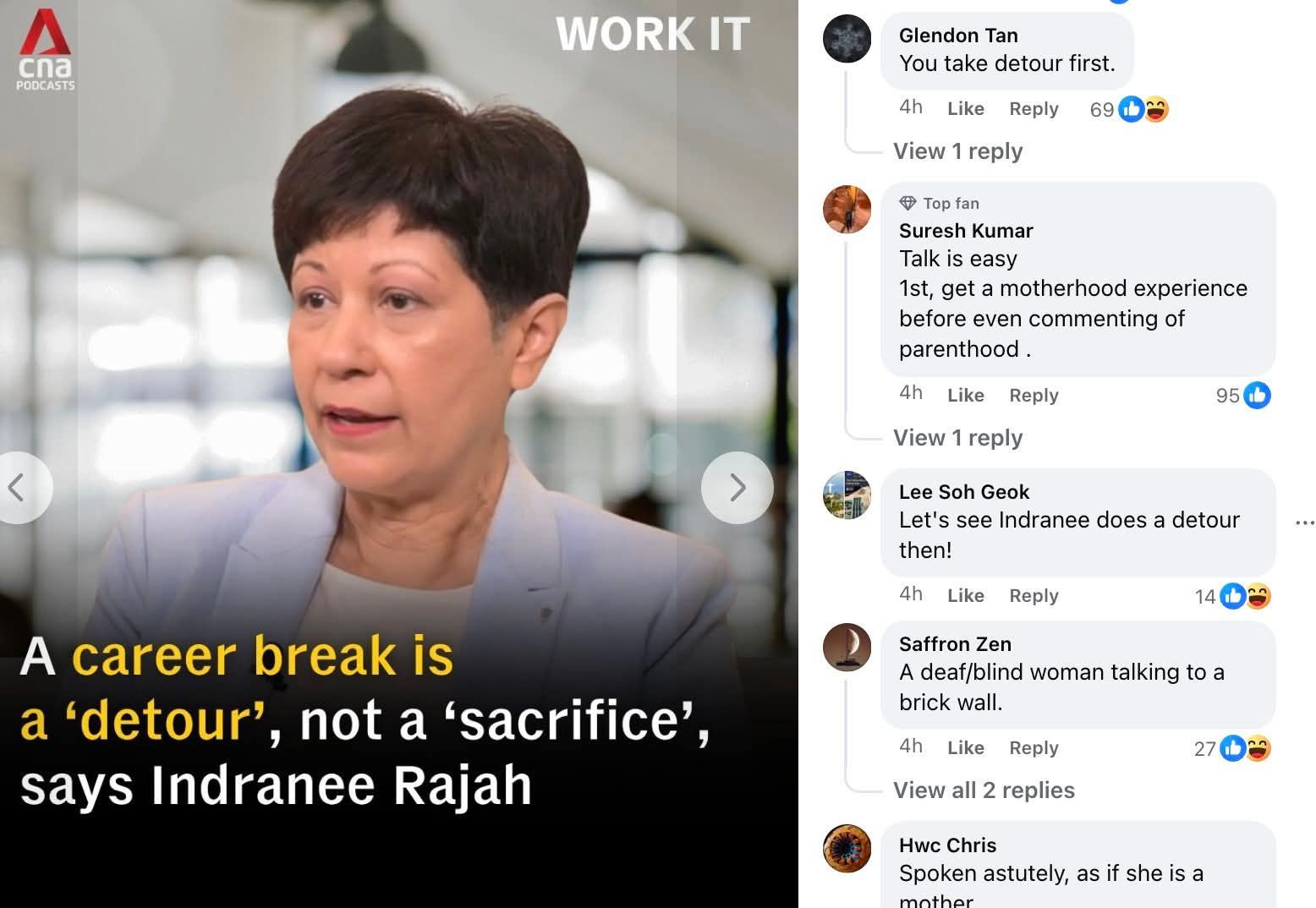
Photo: Ding Neng FB
He suggested that “testimonials” from people with lived experience tend to resonate more strongly with the public, especially when audiences can identify with them.
Using examples from MLM seminars and investment pitches, he wrote that people are often persuaded when they hear success stories from individuals they perceive as similar to themselves.
He added that the same principle applies in other contexts, saying people are unlikely to respond positively to health or fitness advice from someone who does not appear to embody the results they are promoting.
Against this backdrop, Mr Ding questioned the Government’s decision to have Minister Indranee lead messaging around childbirth and parenthood, pointing out that she does not have children herself.
“But then, we are now seeing how the government is getting Singaporeans to have kids, [led] by a minister who [hasn’t] done it before,” he wrote.
According to Mr Ding, the issue is not necessarily with the quality or sincerity of the ideas being proposed.
“I can say Minister Indranee has lots of good ideas and proposals to encourage Singaporeans to have kids,” he said, adding that she also has “a team of MPs under her team contributing to ideas too.”
However, he argued that the public response shows many Singaporeans are struggling to connect with the messenger.
“Whatever advice she gives, no matter how well-intended, got lots of push back simply because people are saying directly/indirectly ‘if so good, then why haven’t you done it yourself’,” he wrote.
He urged the Minister, “Don’t be the spokesperson to give advice already. People are hearing, but not listening – same as how a person overweight and more unhealthy than you giving you advice how to work out and eat clean.”
Rather than having politicians front the campaign directly, Mr Ding suggested the Government rely more heavily on the experiences of ordinary parents and employers who have successfully navigated the challenges of raising children in Singapore.
Among his suggestions were inviting mothers who stepped away from their careers and later re-entered the workforce to share their experiences publicly, as well as showcasing families living on median incomes who are able to raise children while maintaining a reasonable quality of life.
He also proposed highlighting companies that actively support working mothers through flexible workplace policies, with employees themselves sharing why those measures have been effective.
“The message is the same, but because it’s shared by people who have done it, people are open to listen,” he wrote.
He concluded his post by saying, “People don’t follow ideas; they follow people who have proven those ideas work.”
Netizens responding to his post agreed with his take and urged the Government to rethink how it communicates its pro-family messaging.
One commenter said, “She’s capable, but she’s definitely the wrong person to chair this. She is not married and has no kids, which is already a NO-NO and can’t get credibility liao.
“Also, by having her chair this initiative, it’s giving a negative impression to the public that the government is not serious about this initiative. Of all people, why her?”
Another netizen added, “Reality is: there are trade-offs. To deny that is to be not honest with the population. I thought PAP was always straightforward with the populace?
“Anyway, there are good reasons why people cannot accept Indranee leading the workgroup. The issue is highly emotional and sensitive, and only those who have gone through it themselves have much credibility to lead the workgroup. It is not about solving just any technical issue.”