



As we transition into spring, wildfires are on the minds of many Canadians. In fact, wildfires have already started in some parts of the country.
Over the last decade, the land burned in Canada and many other parts of the world has increased, resulting in more socially and economically disastrous wildfires. Predictions indicate the Canadian situation could worsen over the next few decades as the climate warms and soils and forests get drier.
While the impacts on humans, forests and the animals that live in them are the most observable effects, wildfires also have devastating impacts on aquatic life, especially fish. Many of these occur during and shortly after the fire is out, but others can continue for years, and potentially, decades.
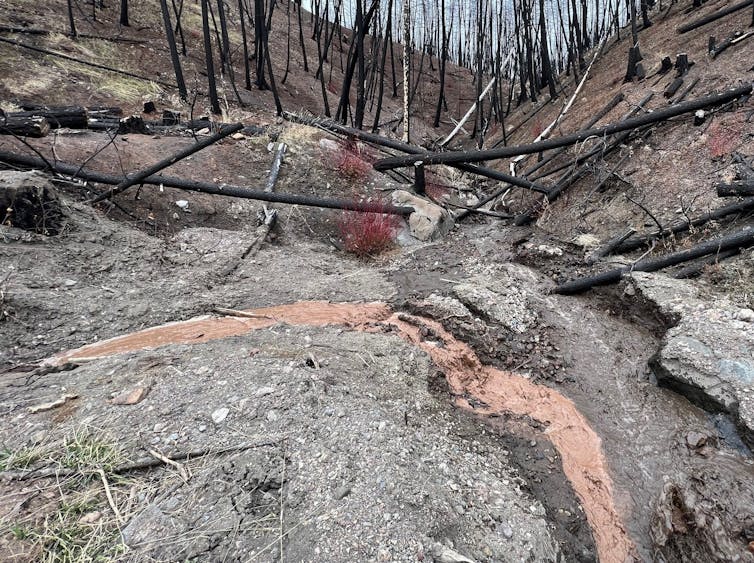
We recently published research conducted in British Columbia into how wildfires are affecting water resources and fish habitat. We used a rainfall simulator to instigate surface runoff and soil erosion at various sites impacted by the 2023 North Lucas Lake wildfire. We showed that erosion is much worse on severely burned and steep slopes.
More water in rivers
One of the immediate impacts on fish after a wildfire comes from the increase in water draining from the burned land and entering rivers. Without thick forest cover to store and use rainfall, more water runs off over the soil towards rivers.
In some situations, soil can become water-repellent, as gases from the burning vegetation enter and condense below the topsoil, forming a barrier and limiting the amount of rainfall that can infiltrate.
(Philip Owens/UNBC), CC BY
The lack of vegetation also means that more heat from the sun reaches the snowpack, which causes snowmelt to occur faster and earlier. This adds to the amount of water entering rivers and also changes the annual timing of spring melt.
The increased supply of runoff entering rivers increases the volume and velocity of water, which can be problematic for fish, including young salmon that, in spring, may be emerging from spawning gravels. These shifts in timing can result in less flow in late summer and fall, a time when adult salmon return to spawn in their natal streams.
Read more:
Warming winters are reshaping Canada’s snowpack
More sediment and debris
Roots normally hold the soil together. However, when forests are burned, the soil loses that support system. Our research shows that the lack of vegetation on hill slopes and the increase in runoff also cause more soil erosion.
This eroded sediment gets washed into rivers, increasing the turbidity, or cloudiness, of the water. That can pose serious problems for fish that rely on sight to hunt. Particles in the water column can scratch exposed membranes and tissues, such as gills, eyes and skin, leading to physical damage and impaired function. In extreme cases, it can clog tissues and organs.
Some of the sediment gets deposited on the channel bed. This can smother important food sources, such as insect larvae, snails and worms, and fill in spaces in the gravels where salmon, sturgeon and other species would typically lay their eggs.
The blockage of these spaces in the channel bed prevents water from flowing through the gravels, which should deliver dissolved oxygen and remove harmful carbon dioxide from the gravels. This essentially leads to suffocation.
And there are often debris flows and landslides after wildfires in hilly and mountainous areas, sometimes many years later. This adds further sediment and debris, and in extreme cases can dam rivers, blocking fish stock passage, as happened at the Chilcotin River in British Columbia in 2024.
Another issue is the impact on water temperatures in rivers. Trees provide shade, but when they are gone, sunlight heats the water. Water temperatures are key to the health and survival of many fish and other species, with higher temperatures being a key stressor.
Read more:
Heat-resistant corals could help reefs adapt to climate change
Harmful chemicals
(Smriti Batoye/Quesnel River Research Centre), CC BY-NC-ND
Wildfires can cause chemicals to be flushed into rivers. Nutrients like nitrogen and phosphorus, while not necessarily toxic, can cause changes in aquatic ecology and fish size in high concentrations due to wildfires.
They also contribute to harmful algal blooms in rivers and lakes. Evidence suggests that nutrients contained in wildfire ash is being deposited on lakes.
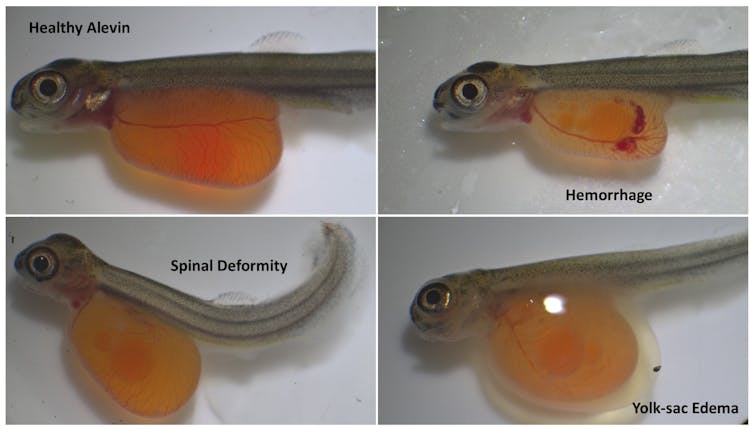
There are also often spikes in metals and organic contaminants in rivers and lakes after a fire. While these are natural byproducts of a fire, our research shows that they concentrate in soils and sediments following wildfires. We have determined that these chemicals can change fish behaviour, cause deformities or, at extreme levels, be toxic to fish.
Studies have also shown that fire retardants — chemicals used to control and extinguish fires — can be toxic to rainbow trout.
Protecting fish
It’s not a hopeless situation. Communities, organizations and Indigenous Peoples are developing innovative ways to help protect and remediate rivers and lakes following wildfires.
In British Columbia, the BC Salmon Restoration and Innovation Fund has funded projects to support salmon, including the Pacific Salmon Foundation’s Wildfire Playbook. This resource compiles best practices and offers guidance to integrate salmon into wildfire recovery planning.
The Skeetchestn Indian Band is partnering with the Pacific Salmon Foundation and others using collaborative, multidisciplinary monitoring and research to understand how the Deadman River watershed is recovering following a catastrophic wildfire in 2021, and to help guide restoration priorities.
Elsewhere, others have investigated how beavers and artificially constructed beaver dams can protect aquatic ecosystems after wildfire.
Wildfires will continue to be part of our future. Knowing their impact on rivers and lakes will help communities make informed decisions around protecting fish and other aquatic life, and ultimately, sustain resilient watersheds.
Smriti Batoye, a postdoctoral fellow at UNBC’s Quesnel River Research Centre, co-authored this article.