



The relationships human societies have with animals aren’t fixed, but vary according to era, culture, territory and customs.
Whaling, which has been practised since the ninth century and was industrialized in the 19th century, offers a good example. Long considered normal, commercial whaling has been banned since a 1986 global moratorium, and, although three countries still practise it, is now widely regarded as ethically unacceptable.
This shift — from exploitation to protection — shows how fluid our relationship with animals is, and how much it can change.
But even though eras come and go, cultures evolve and habits change, two ideas persist: the notion that humans transcend the animal kingdom and are not part of it, and the notion that there are “categories” of animals — pets, farmed animals and “wild” animals.
As a PhD student in law at the University of Ottawa, I’m interested in the legal relationships we have with other animals.
Animal law: Property and persons
Biologically, humans are animals. This is a continuum, with no clear boundary separating us from other species. Yet in moral and legal terms, we still draw a line between humans and non-human animals.
In virtually all legal systems, animals are considered “property,” meaning they’re subject to ownership. They can be bought, owned, sold and “used.”
Human beings, on the other hand, have legal personality, fundamental rights and the capacity to take legal action to assert those rights.
This hasn’t always been the case: certain human relationships were also largely based on ownership, in a manner similar to the way we treat animals today — slavery in particular.
The legal status of animals in Québec
In the province of Québec, the law has evolved considerably. For the past 10 years, the province’s Civil Code has recognized that animals are sentient beings with biological needs, even though provisions relating to property continue to apply to them.
Sentience refers to a living being’s capacity to experience emotions and subjective sensations such as pain, pleasure and well-being. Biological needs refer to an animal’s essential requirements — physical, physiological and behavioural — linked to its species, age, breed and state of health.
Read more:
The way primates parent their young shows how strict labels like parenting styles miss the mark
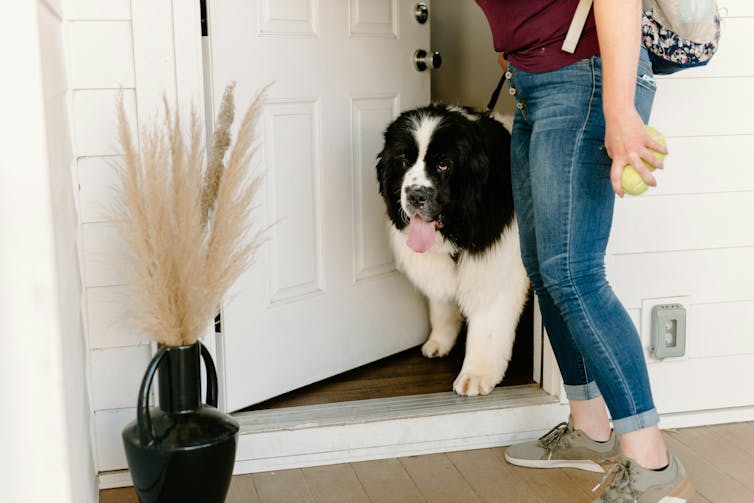
A cat sharpening its claws or climbing to view its surroundings, a dog chewing on objects and exploring by sniffing: these behaviours are fundamental to the animal.
Yet despite this legal progress, Québec law continues to classify animals according to the use we make of them — on the farm, in the laboratory or at home. That results in unequal protections. Specifically, the law provides better protection for domestic pets than for animals used in agriculture or for scientific research.
(Unsplash)
Defining ‘speciesism’
The word “speciesism,” coined by the British writer and psychologist Richard D. Ryder in 1970, draws a parallel with known forms of arbitrary discrimination, such as racism and sexism.
Speciesism is an arbitrary discrimination based on species, which consists of assigning different values or rights to beings solely on the basis of being members of a species.
Extending this line of thought, the Australian philosopher Peter Singer argues that the interests of all sentient beings — human or otherwise — deserve equal consideration, and that our dietary, scientific and economic practices must be reassessed accordingly.
As French historian Philippe Le Doze explains in an article published in The Conversation France, speciesism is not just a cognitive bias or ordinary anthropocentrism. Rather, it’s the foundation of a social project in which boundaries are erected and the exploitation of certain animals is legitimized.
Unequal protection
The contradictions in current law become strikingly apparent when one compares the treatment of different categories of animals, including those within the same species.
Since 2024, several cosmetic surgeries have been banned for pets in Québec, including caudectomy, the partial or total removal of an animal’s tail.
Dobermans and boxers now keep their tails intact. But piglets intended for consumption may still undergo tail docking before the age of seven days without anesthesia, although painkillers must be administered following the procedure.
In both situations, tail docking harms the animal’s welfare, but in only one case is the practice illegal.
The case of hens is equally revealing. In urban areas, local regulations generally require that each hen be provided with approximately 1.29 square metres of space, combining indoor space and an outdoor run.
In commercial production, under certain conditions, it is currently permitted to keep hens in cages that providing only 432 square centimetres of space per hen — barely more than a sheet of paper.
That means that the minimum space required for a free-range hen is approximately 30 times greater than that provided for a hen in intensive farming, even though the animal’s natural needs are the same in both cases.
This different approach undermines the recognition of animals’ sentience and biological imperatives, despite these being enshrined in Québec law.
As American lawyer and philosopher Ani B. Satz points out:
“When animals with similar abilities are treated differently, the use of animal capacities as a relevant baseline for legal protection is undermined.”
Read more:
What can whale films tell us about Marineland’s threatened belugas and dolphins?
How to bring about real change
For several legal scholars and philosophers, including American Gary Francione, the central problem lies in the objectification of animals and the maintenance of their status as property. As long as they continue to be legally treated as property, the protections they enjoy will remain limited and subordinate to human interests.
Real change, therefore, would require granting legal personhood and rights to animals.
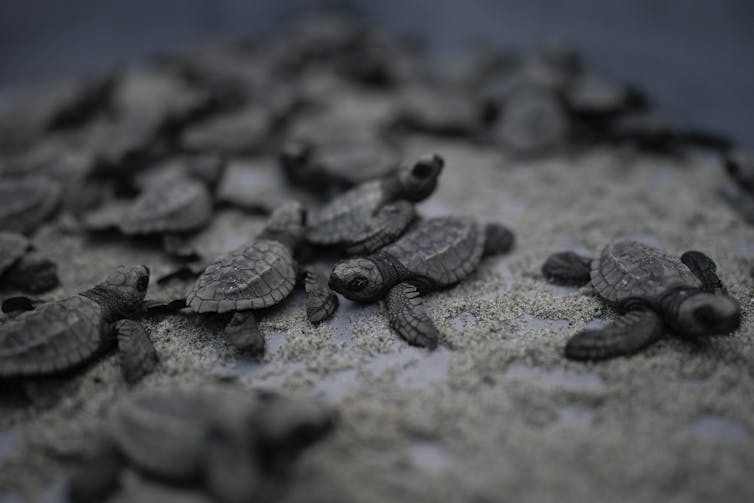
This movement is gradually taking shape on a global scale. In 2023, Panama passed a law granting specific rights to sea turtles, including the right to live in a healthy environment, to migrate and to thrive.
(AP Photo/Matias Delacroix)
In 2025, the municipality of Satipo, in Peru, recognized stingless bees, or meliponines, as rights-holders with the right to exist, maintain healthy populations and regenerate their habitat.
These initiatives are interesting, but have some limitations: they mainly concern specific species, in local contexts, and are often part of what is still an anthropocentric approach, where animals are protected because they are ecologically useful or emblematic rather than for their own sake.
Nevertheless, they reflect a broader movement: the law is beginning to recognize that animals are not merely resources, but beings whose interests deserve genuine consideration.
If “the past is guarantor of the future,” our legal and moral relationship with non-human animals will continue to evolve. The question is no longer whether this change will take place, but when, and by what means societies will agree to rethink hierarchies and grant other sentient beings a place within their moral and legal community.