



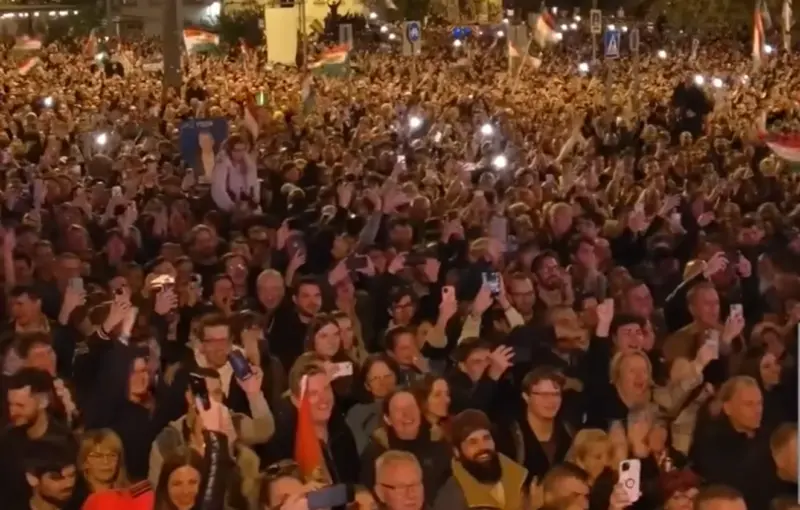
In Hungary, people celebrated the historical win of the opposition party. Screenshot of YouTube video from the 444.hu YouTube Channel. Fair use.
On April 12, 2026, Hungary held one of its most important elections in nearly four decades, widely broadcast for its relevance not just on a domestic scale, but globally. Prior to the polls, Prime Minister Viktor Orbán had enjoyed the endorsement of U.S. President Donald Trump; he was also on friendly terms with Russian leader Vladimir Putin, and both countries were a topic of conversation in Hungary during the campaign. US Vice President J.D. Vance visited Budapest a few days before the elections, and rumours were circulating about the alleged involvement of Russian counterintelligence in the elections.
The choice Hungarians needed to make was between the incumbent FIDESZ party, which had led the country for the past 16 years, and the TISZA party, which emerged two years ago. In the eyes of voters, though, that choice boiled down to either Russia or the European Union (EU). Orbán had criticised the EU for years and formed a close relationship with Moscow, as per the voice recording that emerged of Foreign Minister Péter Szijjártó. TISZA leader Péter Magyar, on the other hand, painted a pro-EU picture to citizens, promising to chage back all the autocratic changes to institutions in Hungary which were done by Orban and his party previously, including the judiciary and media’s dependence on the ruling party.
Election turnout, meanwhile, was at an all-time high of 79.5 percent. The polls closed at 7 p.m. local time; by around 9 p.m., Magyar posted that Orbán had called him and congratulated him on his win. From that moment, the only question was by what margin of victory. It soon became evident that the voter turnout would not be the only historic thing about this election; TISZA ended up collecting a two-thirds majority — a strong sign that Hungarians want to belong in Europe and work with the EU. The result has left Russia without a strong foothold in Europe.
At about 11 p.m. on election night, Péter Magyar delivered a lengthy speech in which promised to end the divide he says FIDESZ installed in Hungary. He also asked longstanding political players dependent on or closely connected to Orbán to step down so that a new era could begin. Among these, he identified the President of the Curia, President of the Constitutional Court, Prosecutor General, President of the State Audit Office, President of the Hungarian Competition Authority, President of the Media Authority, President of the National Office for the Judiciary, and the President of Hungary Tamás Sulyok, whom he encouraged to convene the inaugural session of the new National Assembly as soon as possible. Magyar also promised to establish a National Asset Recovery Office to investigate the status of lost EU funds as well as overall corruption in the country.
The path the country seems to be charting for itself may come with its challenges, but the strengthening of the Hungarian Forint once the election results were confirmed offers hope. Magyar was very explicit about this in his speech, in which he highlighted that his government will not be perfect, but will give Hungary its best shot.
In terms of public sentiment, approximately 30 percent of voters appear to be disappointed — and in disbelief — at the convincing TISZA win. The majority of the population, however, couldn’t be happier with the result: after Magyar’s speech, the capital, Budapest, turned into a massive party. Strangers were hugging and dancing with one another, and many cried as the news broke: the change they had been hoping to come to fruition finally manifested.