



Imagine your favourite sunny beach. Anywhere will do. You look out and see the ocean stretching to the horizon. To a glaciologist, that view is not just water; it’s melted ice.
Our new study shows that the best case sea-level rise scenarios may now be out of reach.
Around 20,000 years ago, during the most recent ice age, the Earth was about 5°C cooler than today. Vast ice sheets, comparable in scale to Greenland and Antarctica, covered Canada, northern Europe, and other regions. Those ice sheets formed as water evaporated from the oceans, fell as snow, and accumulated year after year on land.
Locked away as ice, that water was removed from the ocean, lowering sea level by around 130m and reshaping the planet’s coastlines. You could have walked from Britain to mainland Europe or from Siberia to North America as much of today’s continental shelf was dry land.
Between 20,000 and 10,000 years ago, global temperatures increased and those ice sheets melted. Sea level rose, flooding coastal plains and river valleys, and leading to modern coastlines. The lesson from Earth’s recent history is simple: When global temperature changes, sea level changes, and coastlines change with it.
The triple threat
Sea level rise has three main causes. First, as the ocean warms, seawater expands, increasing its volume. Second, hundreds of thousands of mountain glaciers worldwide are melting, adding water to the sea. Third, the great ice sheets of Greenland and Antarctica are losing mass. All three matter, but they do not contribute equally, and their importance is changing.
Since around 1850, the burning of fossil fuels has raised greenhouse gas concentrations to levels not seen for more than three million years. As a result, global temperatures have increased by nearly 1.5°C and global mean sea level has risen by more than 20cm. Just under half of this rise came from thermal expansion of warming oceans. A similar amount comes from the melting of about 300,000 glaciers worldwide, but with a rising contribution from the great ice sheets.
What is striking is how fast this change has happened. Around half of the total sea level rise since 1850 has occurred in just the past 30 years. During this time, Greenland and Antarctica have begun to contribute more to sea-level rise than all other glaciers combined, and together now exceed the contribution from ocean warming. Mass loss from Antarctica alone is around six times greater than it was three decades ago.
Vadim_N/Shutterstock
This shift matters because glaciers and ice sheets are not equal. If every small glacier on Earth were to melt completely, global sea level would rise by only about 24cm. If the polar ice sheets were to melt, sea level would rise by more than 65m, almost 300 times more.
Ice sheets usually respond slowly to warming air and ocean temperatures. But some regions are far more vulnerable than others. In these hotspots, retreat can trigger dynamic processes that accelerate ice loss, destabilising neighbouring regions and speeding up sea level rise.
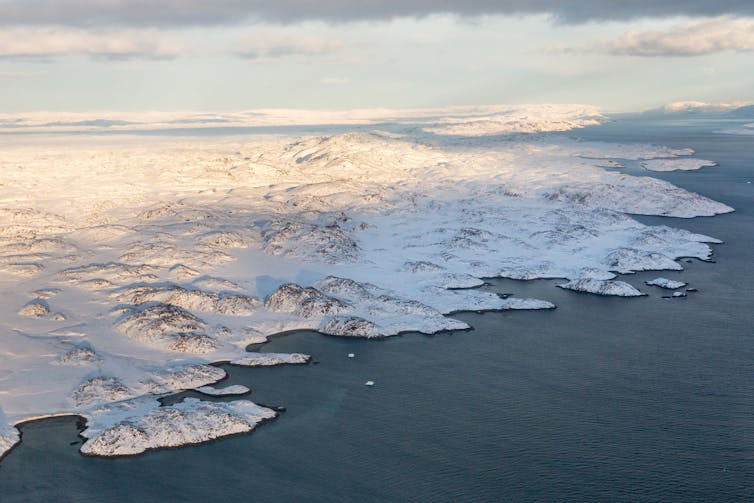
Researchers like us are starting to see just this, particularly in the Amundsen Sea sector of West Antarctica and the margins of the Greenland ice sheet. Mass loss from these ice sheets commits the planet to metres of sea level rise – and once retreat begins it may be impossible to stop.
The reality gap
The pace of change still depends on us, but the starting point keeps shifting. Observations show that current sea level rise is already tracking along the mid-to-high projections provided by the UN’s climate science advisory group, the Intergovernmental Panel on Climate Change (IPCC), placing the lowest, most manageable outcomes out of reach. Sea levels rising by more than 0.5m by 2100 are now increasingly likely, with consequences that include large-scale displacement and the abandonment of many coastal regions at immense and avoidable cost.
This does not mean the outcome is fixed. The world stops warming almost immediately after reaching net zero. Rapid decarbonisation would slow ice loss, buying time for coastal cities, communities, ports, wetlands and beaches to adapt.
Yet a clear gap remains between where the scientific consensus says emissions need to go to avoid rapid rise, and where current government commitments, known as nationally determined contributions are taking us. Many estimates say that we are currently on a path toward roughly 3°C of warming. For context, the threshold for the irreversible loss of the Greenland ice sheet is estimated to be as low as 1.7°C to 2.3°C. We are flirting with a temperature that would commit the planet to several metres of long-term rise from Greenland.
Now return to that beach. The shoreline is not fixed. It is a product of past warming and it is already being reshaped by the warming we have caused. The question is no longer whether sea level rise can be kept low, but how high it will go, how quickly it will rise, and how much damage we are prepared to accept.
The longer action is delayed, the fewer good options remain, and the more of that familiar coastline is lost to the tide.