



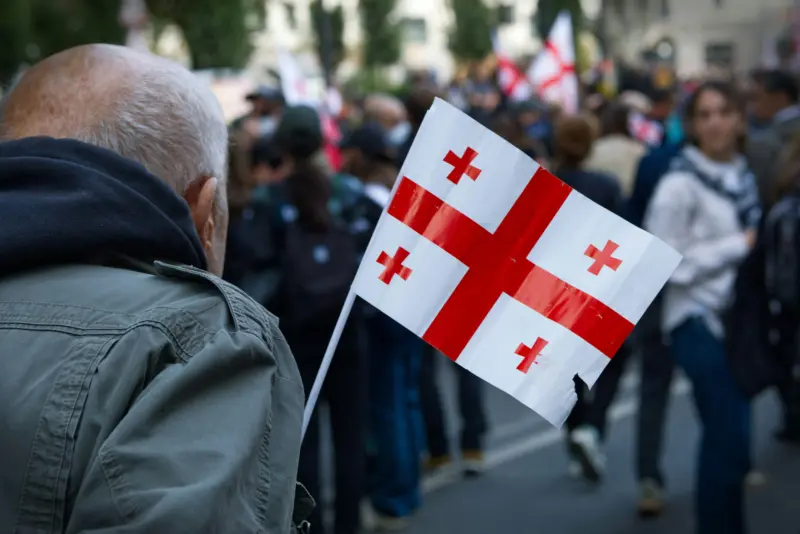
Photo by Sheldon Kennedy on Unsplash
This article was originally published on Algorithm Watch on June 27, 2026. This edited version is republished on Global Voices under a Creative Commons Attribution 4.0 International license (CC BY 4.0).
Over the past two years, the Georgian government has built a comprehensive face recognition enforcement system, procured by a Moscow-based company with ties to the Federal Security Service (FSB), and its impact on demonstrators is troubling.
In mid-March 2025, Nino, a Georgian in her 40s, received a call from the Tbilisi City Court, which summoned her to a hearing for blocking a road in the Georgian capital city two and a half months earlier. The call took her by surprise. Nino had protested against the alleged rigging of the last elections as well as the suspension of EU integration talks. She had known for a long time that the protest site surrounding the Georgian Parliament was covered with surveillance cameras, but had not considered them to be so effective at identifying her.
At the hearing, Nino saw footage of herself at the protest; she was accused of initiating a blockade of the road. The system had identified her through face recognition software and processed her as an unlawful protester — the imposed fine amounted to GEL 5,000 (around EUR 1,620 or USD 1,878). Five months later, Nino’s bank accounts were frozen. She was forced to set up a crowdfunding campaign to pay off the fine.
Like many others in Tbilisi, Nino could not afford the risk of receiving any more fines and largely stopped protesting. Her case resonated with many other Georgians who, since 2025, have stopped attending demonstrations against the ruling Georgian Dream party, in power since 2012 and dominated behind the scenes by its founder Bidzina Ivanishvili, a billionaire whose fortune was built in post-Soviet Russia.
The recent surveillance mechanisms, involving face recognition software and an extensive network of AI-enabled cameras, helped authorities achieve what physical force alone could not: breaking the protest movement.
From EU candidacy to authoritarian repression
In 2023, Georgia was granted the status of EU candidate, a milestone that for many citizens meant far more than a diplomatic formality. Following the allegedly rigged parliamentary elections of October 26, 2024, many Georgians took to the streets and protested for 580 days in a row. The European Parliament called for a re-run of the vote.
In response, Prime Minister Irakli Kobakhidze announced that his government was suspending the EU accession process until 2028. The halt is widely considered unconstitutional, as the Georgian Constitution requires all public bodies to facilitate the accession, which 86 percent of Georgians supported.
Demonstrators have been progressively stripped of their rights. In 2023 assembly required no permit and freedom of expression was guaranteed; by 2024, covering one’s face was considered an administrative offense, and the penalty for blocking a road rose from GEL 500 (EUR 165 or USD 192) to GEL 5,000 (EUR 1,654 or USD 1,920).
In 2025, both acts became criminal offenses, and even gathering required state registration. By 2026, calling the government illegitimate or criticizing it online using terms deemed offensive also became a criminal act, leaving Transparency International to conclude that “the laws amended by Georgian Dream have effectively abolished the freedom of assembly guaranteed by the Constitution of Georgia.”
Face recognition: the crackdown’s technological backbone
By December 2024, protests had spread across dozens of cities in Georgia, with many local outlets describing them as the largest demonstrations since the country’s independence in 1990.
The government responded forcibly, with the police used water cannons and rubber bullets on demonstrators. Beatings were documented: the Public Defender’s Office recorded 282 cases of physical abuse, and at least 486 people were detained in November and December 2024 alone. Still, the crowds kept returning, spending Christmas and New Year’s Eve on the street. Thematic protests led by teachers, musicians, athletes, and doctors arose, spreading to 37 of Georgia’s 55 cities and more than 40 cities abroad.
Then, once the authorities were able to accurately identify demonstrators, the fines began to arrive. By March 2025, at least GEL 2 million (around EUR 640,000 or USD 767,893) worth of penalties had been imposed on protesters. At first, people did not know how they could have been spotted so easily. The answer, however, had been in place for years.
Under the wing of Russian surveillance machines
Georgia’s surveillance infrastructure is called Polyface; its Ministry of Internal Affairs has been procuring the facial recognition system from Papillon AO, a Moscow-based company that has been sanctioned by several countries. Its products are used primarily by Russian law enforcement and autocracies close to Russia, including Tajikistan, Turkmenistan, Kazakhstan, and Belarus.
Russia, now providing surveillance technology to Georgia, invaded the country in August 2008 in a five-day war, after which it recognized — unlike the international community — the breakaway regions of South Ossetia and Abkhazia as independent states. Russian troops have remained there ever since. Nearly two decades later, Moscow still controls roughly 20 percent of Georgian territory.
According to a 2018 upgrade contract, ministry operators would have been trained directly by Russian personnel. Papillon AO, like any other Russian company operating in Georgia, is obliged by Russian law to cooperate with Russian security services if compelled.
Meanwhile, procurement documents show that Georgia’s Ministry of Internal Affairs has been expanding its facial recognition capabilities. Several demonstrators interviewed for this article saw themselves in the footage for the first time during the hearings and admitted to being shocked about how precisely they were captured by the system.
One protester, Elene, recounted that Levani, a friend of hers, “was barely at the edge of the frame, but the camera was zoomed in to the point where every expression, every smile, was visible. It was unimaginable.”
Through the lens of the system
Polyface 3.7.0, the latest upgrade purchased by the Ministry of Internal Affairs, was delivered in early June 2025. Polyface is built on a deep learning recognition algorithm developed by 3DiVi, a Russian AI company based in Novosibirsk and backed by a Russian state venture fund. It records high-definition images of large crowds, even in poor lighting, and can identify faces that are under masks or partially occluded.
The tender documents show that the ministry explicitly requested licenses for an unlimited number of operators; the change suggests a rising demand within the ministry to monitor larger demonstrations.
To match faces to identities, the system uses the Unified Information Bank, which provides access to civil registry photographs. The software can also run searches against pre-loaded images from social media and other external sources – a feature the ministry requested in 2024, indicating cross-platform surveillance as an intended use.
This investigation has identified three ways in which the software may be used. Automated identification allows Polyface to scan a live camera feed, select each searchable face in the crowd, and capture an image that can identify the person. It then moves on to the next face. This process runs continuously, without a human.
In contrast, operator-directed search allows a staff member to take manual control of a camera, point it at a specific person, zoom in, and run an image of the face against the database in real time. Finally, watchlist alerts function by loading a list of people of interest (e.g. activists, protest organizers, previously fined demonstrators, etc.) into the system in advance. When a camera spots people from this list, Polyface flags them.
Uncertainty as a pressure of its own
Early on, activists set up funds: people donated money, the funds paid the penalties, and the protest could keep going. “At first,” says Elene, “being fined felt almost like a badge – people would fundraise for you, there was solidarity.” Then, the government seized the funds’ accounts, leaving demonstrators on their own.
Because the fines would arrive weeks or months later, demonstrators understood that attending a protest was no longer a one-time act; it had become a searchable data record.
“The software doesn’t only identify who someone is – it can reconstruct a full protest history: when a person arrived, how long they stayed, how many times they came back,” explains Georgian cybersecurity expert Giorgi Lubaretsi. “Once identified at one protest, the system can locate them across every other recorded event.”
Chilling effect gathers momentum
Demonstrators described how they stopped chanting, using whistles, carrying posters, taking pictures, or even wearing distinctive clothes out of fear of identification. “I became paranoid,” recalls 22-year-old Tamuna, a student and frequent protester. “I would start covering my face the moment I left home, and I wore neutral clothes, but I still felt I could be identified.”
Face masks worn by demonstrators for protection made the protest itself feel unrecognizable. “When everyone started wearing masks,” says Nino, “I started feeling anxious at Rustaveli. You can’t see faces, you lose contact, you can’t recognize people. It’s very stressful.”
The chilling effect reduced both the scale of demonstrations and people’s willingness to show up. “The scale changed enormously,” Nino confirms. “When the funds were seized too, and there was no more hope of help, far fewer people came out.”
For Tamuna, the fear kicked in gradually: “I changed my route to protests. I started covering my face; then, they criminalized face covering, too. I wanted to avoid the penalties – I had to. Fear was one of the main reasons why I stopped going.”
The moral distance between those who still risk attending the protests and those who can no longer afford to is increasing. Luka, a winemaker, still goes to protests regularly and is angry at people like Nino who have stopped. “Honestly, I’m surprised by people who stopped going because of fines. If they hadn’t been scared back when masks were allowed [to avoid cameras], standing on pavements was allowed and there were a thousand ways out, we’d be standing stronger now.”
The democratic facade
Face recognition systems are not unique to authoritarian states; what differs is the political will.
Eto Buziashvili, a researcher at the Atlantic Council’s Digital Forensic Research Lab in Washington, United States, explains: “Papillon Systems is a core part of the Russian security infrastructure. Integrating this kind of biometric technology into the national infrastructure represents a substantial risk to Georgia’s national security. Integrity attacks could involve software being programmed to ‘ignore’ particular individuals, for example, to ignore a foreign intelligence officer of a hostile country, while creating a detailed map of the power structure within the host country.”
Buziashvili recalls Russia’s invasion of Georgia in 2008, when Georgian internet traffic was re-routed through Russian servers and used as a main tactic to isolate the Georgian government. “When an adversary gains access to face recognition archives, they can use the database for intelligence profiling. There is a tragic precedent: during the Taliban’s takeover of Afghanistan, they inherited US-built biometric systems and used them to identify and target Afghans who had worked with the United States.”
Standing on a pavement without state registration is now a criminal offense, punishable by jail. The cost of attending a protest in Georgia is now freedom. What’s at stake is the most basic question of Georgia’s post-Soviet existence: which direction does the country want to take? What the cameras record, in the end, is not disorder. It is the constitutional right to demand that Georgia keeps the European future its citizens have voted for.
Five hundred and eighty days in, hundreds, if not thousands, still gather at Rustaveli every evening, each of them being watched.