



The gutting of the United States Agency for International Development (USAID) in 2025 has had catastrophic consequences,
including in South Sudan where amid ongoing war, an estimated 33 million people require humanitarian assistance.
The federal government in Canada has similarly slashed foreign aid in response to the economic fallout of U.S. President Donald Trump’s trade war.
International aid groups have met such policy decisions with regret.
This regret is understandable. At the same time, many Western powers avoid acknowledging that the broad liberal international consensus that emerged after the Second World War — and shaped modern development — was built on global inequality.
THE CANADIAN PRESS/Sean Kilpatrick
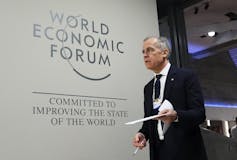
In Prime Minister Mark Carney’s 2026 speech to the World Economic Forum, he only tentatively alluded to disparities and inequalities when he acknowledged “the story of the international rules-based order was partially false … ”
In Books for Development: Canada In the Late Twentieth-Century World I argue that this “partially false” story helped to elaborate Canada’s late 20th-century image as both benevolent and innocent regarding internal colonialism.
Language of ‘development’
What social scientist Wolfgang Sachs has called the “age of development” emerged in the decade following the Second World War.
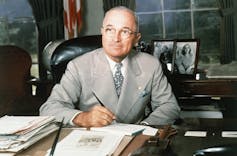
Scholars point to U.S. President Harry Truman’s 1949 inaugural address as a key moment in this post-Second World War history.
(AP Photo)
The speech referred to a U.S. obligation to make its scientific and industrial progress available for the “improvement and growth of underdeveloped areas.”
The classification of the world’s population into “developed” and “underdeveloped” came to shape the post-war order and its international institutions, such as the United Nations.
Critiques of developmentalism began to emerge in the 1960s from what was then called the “Third World.” In the context of the Structural Adjustment Programs after the economic crises of the late 1970s, post-development theorists such as Sachs and Gilbert Rist amplified this kind of criticism.
They argued that developmentalism was premised on related and false claims — that global inequalities were without cause and “underdeveloped” nations could catch up to their “developed” counterparts.
‘Developmentalism’ and books
In Books for Development, I examine how the book became a dominant symbol of the age of development through the efforts of the new international institutions, and the United Nations Education Scientific and Cultural Organization (UNESCO), in particular.
(McGill-Queen’s University Press)
This had implications both in Canadian foreign policy and in relationships with Indigenous Peoples in Canada.
In the context of post-Second World War development, books, though typically framed as “good,” nonetheless often played a harmful role.
In the post-war decades, UNESCO focused on literacy initiatives and improving global access to books, partly through its research on conditions in global publishing.
As Robert Escarpit reported in a 1982 study for UNESCO, “decolonization often stimulated book production less in the new nations than in the old colonizing countries.” The latter, he notes, now “had to meet the new demands from their former colonies for literacy campaigns or educational development.”
At their worst, book development programs undercut domestic publishing initiatives in newly independent nations in Africa, the Caribbean and elsewhere.
Canada’s role
Canada played a significant role in post-war development linked to the book.
The deep involvement of educationalist and liberal internationalist J.R. Kidd at UNESCO is a key element of this history.
As historian Kevin O’Sullivan has shown, Canadians drew on a longstanding book-centric Protestant missionary and service tradition to become leaders in the late 20th-century non-governmental organization (NGO) movement.
(International Council for Adult Education fonds/ Library and Archives Canada), Author provided (no reuse)
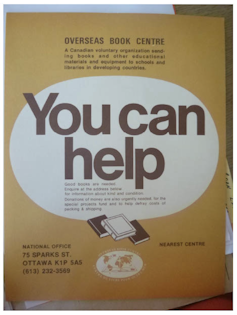
In addition to Kidd’s roles at UNESCO, he was also one of the founders of Canada’s first NGO, the Overseas Book Centre. Founded in 1959, this book donation program sent Canadian books to Global South nations.
Book donation schemes like those undertaken by the Overseas Book Centre undermined local book publishing initiatives in recipient nations. The organization’s self-assessments later confirmed this problem, and led to a reorientation of its efforts (and a renaming, in 1982, as the Canadian Organization for Development in Education).
Serving Canada’s interests
Kidd’s book- and literacy-related work often used UNESCO’s new international stage to argue for what he called Canada’s “special mission” in international development.
Canada was presented as a model and potential friend for newly decolonizing nations because of its recent experience as a colony of Britain (a status that changed with Confederation).
While historians of Canada’s post-war myth-making have pointed to the disingenuousness of claims that Canada was a “friend of the Third World,” these claims also served to make internal colonialism illegible on the international stage.
Adult literacy
Beginning in the later 1960s, Canada’s international development efforts began to shape NGO and government relations with Indigenous Peoples.
Developmentalist-influenced initiatives linked to books, literacy and education were focused on Indigenous communities. They were part of a longer history of consolidating settler liberal rule via education, exemplified most notoriously in Canada’s Residential School system.
Read more:
Why Canadians need two dramatic educational shifts to honour reconciliation
For instance, Canada’s longest running adult literacy program, Frontier College, began addressing its efforts to Indigenous Peoples at the end of the 1960s, when it began to ship magazines to schools run by the Department of Indian Affairs and Northern Development. The goal was to aid the department’s policy of integrating Indigenous Peoples into what it called “the Canadian way of life.”
‘The Fourth World’
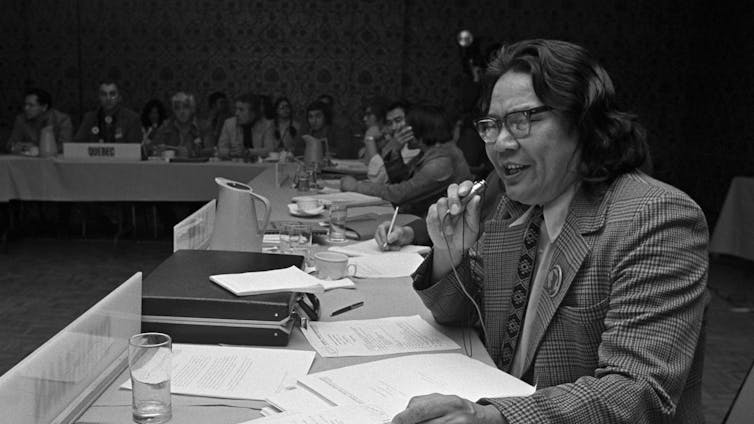
Indigenous leaders, activists and writers such as as George Manuel (Secwépemc) responded to such initiatives by adapting Third World anti-imperialist revisions of developmentalist thought to their own settler colonial situation.
The Canadian Press/Chuck Mitchell
Manuel’s 1974 book, The Fourth World: An Indian Reality, co-authored with Michael Posluns, was published during Manuel’s tenure (1970-1976) as leader of the National Indian Brotherhood. The book positions economic development at the core of any possible political sovereignty:
“Self-government … without an economic base simply creates the economic colonialism we are witnessing throughout much of Asia and Africa today.”
For Manuel, this “economic base” would come from the land. As he observed, usurping the basis of traditional Indigenous economies — land — was the primary obstacle to contemporary economic development.
Structural conditions of injustice
The Fourth World extends this thinking to the National Indian Brotherhood’s 1972 policy paper, Indian Control of Indian Education. Change at the level of education, Manuel argued, would not be sufficient (even if it meant Nations could control hiring, curriculum and so on). He saw education as fundamentally tied to the question of economic development, which he understood to be contingent on a land base.
Like the broader development framework, the approach applied to Indigenous Nations after 1965 failed to name the structural conditions of injustice. It perpetuated the status quo and, viewed more negatively, it cloaked the very political and economic conditions that created it.
Read more:
Who benefits from ‘nation-building’ projects like Ksi Lisims?
Canada’s relationships with other nations, including Indigenous Nations, cannot be premised on what Carney called a “partially false” story.