



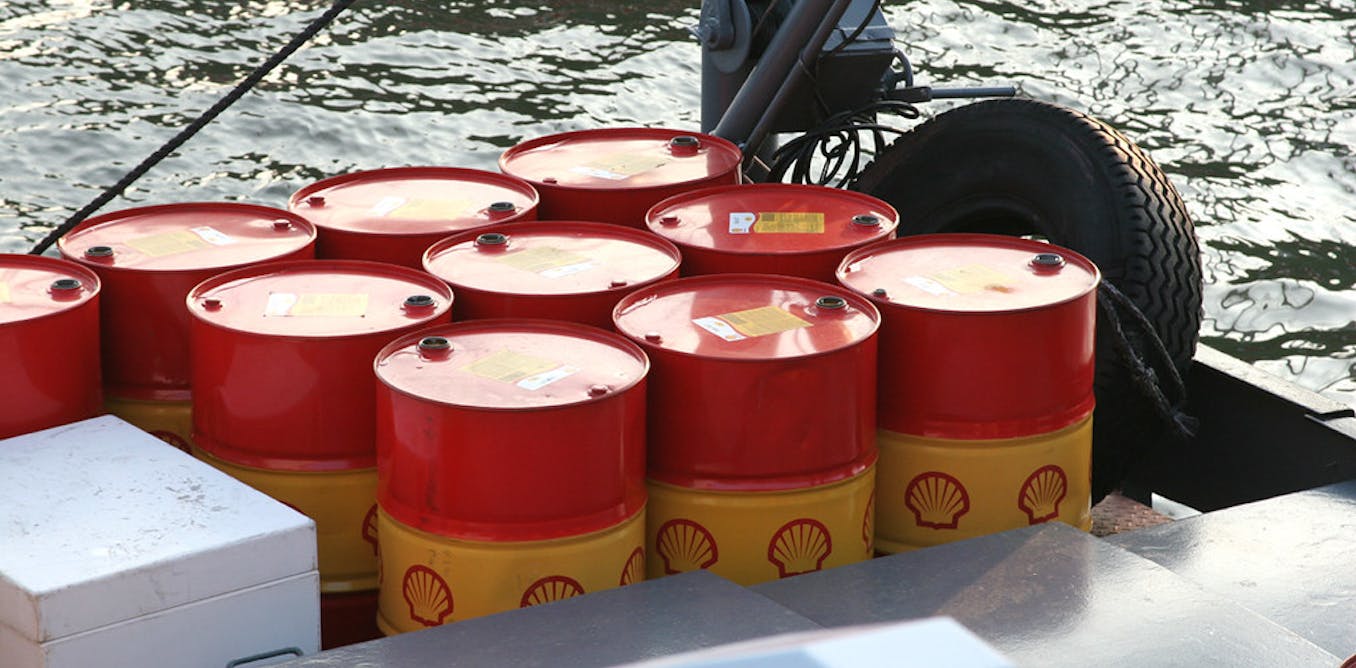
Ghana introduced a new payment arrangement for petroleum imports in 2023, using gold instead of scarce US dollars. The policy was designed to ease pressure on the cedi by reducing the need for upfront dollar purchases to settle fuel import bills.
In an import-dependent economy, rising demand for US dollars usually weakens the domestic currency. Importers must exchange local currency for dollars. As the local currency loses value, the local cost of imports rises, driving inflation.
Ghana’s petroleum-for-gold strategy delivered short-term benefits. It reduced immediate demand for foreign exchange, supported relative stability in the cedi and contributed to moderating fuel price pressures and inflation.
The country is still vulnerable to global oil price shocks, however. That has become evident with the latest surge in oil prices triggered by instability in the Middle East. For oil-importing economies such as Ghana, geopolitical risks like this translate directly into higher fuel import costs and greater pressure on foreign-exchange reserves.
I am a scholar who has served as a technical adviser to Ghana’s Ministry of Energy and major oil firms. This article argues that Ghana’s current stabilisation measures are helping to manage short-term pressure, but they have not removed the country’s exposure to oil shocks. That matters because temporary relief should not be mistaken for structural reform.
The structural gaps are limited refining capacity, weak storage infrastructure and an underdeveloped downstream petroleum sector.
As long as these constraints remain, oil shocks will continue to transmit quickly into the exchange rate, inflation and the broader economy.
What’s working
Ghana is one of Africa’s largest gold producers, with output exceeding 120 tonnes annually.
The creation of the Ghana Gold Board, under the Ghana Gold Board Act, 2025 Act 1140, improves the state’s ability to mobilise gold through official channels. This is not a solution to Ghana’s energy problem. But it is a more credible stabilisation strategy than relying on politically driven fuel price interventions and implicit subsidies. Those strategies, seen in earlier periods, contributed to fiscal losses and market distortions.
Inflation has eased significantly over the past year, falling from peak levels in 2023 to around 3%-4% in early 2026. Fuel prices have moderated, with pump prices declining by over 20% year-on-year in Febuary 2026. This indicates that short term pressures are being managed.
But relief is not reform. Policies such as gold-for-oil cannot eliminate Ghana’s dependence on imported refined fuels.
The gaps
Ghana’s vulnerability to global oil shocks stems from the structure of its energy system. Despite producing crude from offshore fields such as Jubilee, TEN and Sankofa-Gye Nyame, the country remains heavily dependent on imported refined fuels priced and settled in US dollars. That mismatch ties the domestic economy directly to global oil markets.
In practice, this dependence is substantial. Domestic refining meets only a small share of demand, with roughly 72% of refined petroleum products supplied through imports in recent years. In other words, most of the fuel actually consumed in the economy is sourced from international markets rather than processed locally, reinforcing the country’s reliance on foreign currency.
These imports are concentrated in a few critical products that underpin everyday economic activity. Diesel accounts for the largest share, used extensively in transport, logistics, construction and backup power generation. Petrol (gasoline) supports road transport, while liquefied petroleum gas (LPG) is widely used for household cooking and some commercial purposes. In effect, Ghana’s import bill is not abstract. It underwrites the economy’s core energy needs, from moving goods and people to powering businesses and households.
This dependency on imports is driven by three factors.
- Limited refining capacity. Ghana’s ability to process crude oil domestically is constrained by the limited and unreliable operation of its main refining asset, the Tema Oil Refinery. Although installed capacity exists, it has operated intermittently for years due to financial constraints, maintenance challenges and operational inefficiencies.
But expanding domestic refining capacity on its own won’t insulate Ghana from price dynamics. Domestic fuel prices remain linked to international benchmarks, meaning global oil shocks would continue to pass through to inflation.
Where refining could make a difference is on the financing side. It would lower demand for US dollars.
-
Weak storage infrastructure. Ghana has limited strategic storage capacity for petroleum products, reducing its ability to build reserves and manage supply over time. The country must rely on frequent imports to meet demand, increasing exposure to external supply and financing shocks.
-
An underdeveloped downstream petroleum sector. Beyond refining and storage, inefficiencies in the movement and sale of petroleum products constrain how effectively supply is managed within the domestic market. Distribution remains fragmented across importers, bulk distributors and retail outlets, with limited coordination and logistical bottlenecks in transportation and depot infrastructure. Regulatory rigidities in pricing and market participation further reduce flexibility. As a result, even when supply is available, it is not always efficiently allocated, and global price shocks are transmitted quickly and with limited buffering through the domestic economy.
What needs to be done
Four priorities now stand out.
First, recent gains must be consolidated through continued macroeconomic discipline and a firm avoidance of policy reversals.
Second, foreign-exchange buffers should be strengthened to better absorb future oil-price shocks and contain exchange-rate pressures.
Third, gold and foreign exchange strategies need to be integrated so that gold mobilisation directly reinforces external liquidity.
Finally, dependence on downstream imports must be reduced through credible investment in refining, storage and broader energy infrastructure.
The real test of Ghana’s fuel strategy is not whether it can withstand a single episode of oil-market volatility, but whether today’s stabilisation measures can be converted into a more resilient energy system.