



The hardest disease to care for when I was training as a pediatrician in the late 1970s was cystic fibrosis, a disease in which abnormally thick mucus secretions block the lungs’ airways and make it progressively harder to breathe.
Back then, there was no treatment for the disease itself. All we had was physical therapy to clear mucus from the lungs, and drugs to dilate the airways and aid breathing. We used high doses of antibiotics to treat chronic pneumonia – drugs that also generated dangerous antibiotic-resistant infections that not only made the disease progressively harder to treat but also posed a threat to other people. At the same time, we also had to manage co-occurring conditions, including diabetes, malnutrition and heart failure.
Worse, these efforts did not work. In 1979 the median age of death from cystic fibrosis was 15. While all young deaths are tragic, caring for children with a progressive, inevitably fatal disease that denied emerging adolescents the promise of adulthood was especially heartbreaking.
Cystic fibrosis treatment changed dramatically after 2012, when the biotech company Vertex Pharmaceuticals launched the drug Kalydeco (ivacaftor), followed by additional cystic fibrosis drugs Orkambi (lumacaftor/ivacaftor) in 2015, Symdeko (tezacaftor/ivacaftor) in 2018, Trikafta (elexacaftor/tezacaftor/ivacaftor) in 2019 and Alyftrek (vanzacaftor/tezacaftor/deutivacaftor) in 2024.

Fernando Salazar/The Wichita Eagle via AP Photo
Now, the median survival age for a child with cystic fibrosis born today in the United States is 66 years. Mary Vought, the former wife of the director of the Office of Management and Budget, Russell Vought, stated that their daughter, who was diagnosed with cystic fibrosis, “can live likely a full life because of this miracle drug,” and that “it is very, very, very hopeful.”
Cystic fibrosis treatments are not miracles; they required decades of research funded by a combination of public and private investments. The largest contributor to this work was the National Institutes of Health, which funded much of the pivotal research required to understand the genetics and biology of the disease. Only with this knowledge was it possible to begin searching for drugs to treat cystic fibrosis.
Ironically, the federal funding that was so critical to developing these drugs is now threatened by policies that were initially proposed by the Office of Management and Budget. Those policies, which would increase political control over federal research grants, limit peer review and curtail research on certain topics, were temporarily blocked by Congress. But several federal agencies are still pursing portions of this agenda, including the NIH.
NIH laid the foundation for treatment
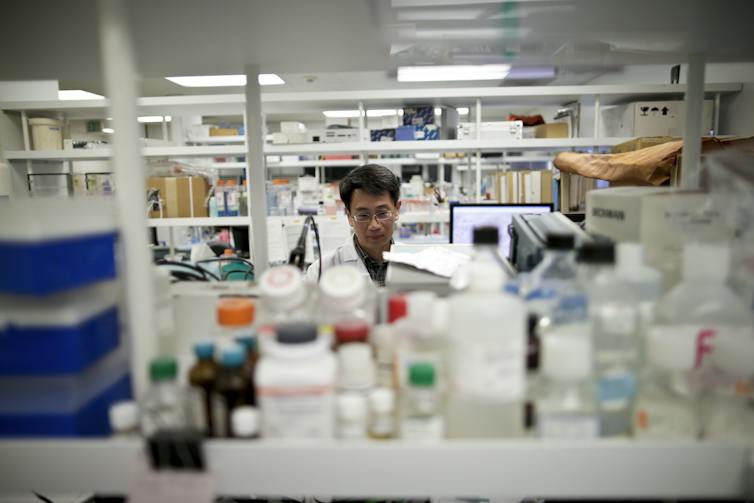
My colleagues and I examined the role that federal funding from the National Institutes of Health has played in developing cystic fibrosis treatments. We found that NIH funding supported more than 6,200 published research papers on the biology of cystic fibrosis in the 27 years before Kalydeco was approved in 2012.
Some of these publications describe celebrated milestones in understanding the biology of CFTR – the gene that causes cystic fibrosis – or the disease process. Others describe the studies necessary to replicate, refute or refine these advances and ensure the necessary scientific rigor to successfully discover and develop new drugs.
Gregory Bull/AP Photo
Overall, we identified US$3.2 billion in NIH funding for basic research on cystic fibrosis from 1985 to 2012 and approximately $940 million in funding for applied research on potential drugs. This funding complemented at least $200 million in investments from the Cystic Fibrosis Foundation for the discovery or development of these drugs as well as undisclosed spending by Vertex to develop and commercialize these products.
The Cystic Fibrosis Foundation acknowledged the essential role of the NIH in a 2025 letter to Russell Vought and other Trump administration leaders, writing that “ensuring that the National Institutes of Health (NIH) is fully functional is critical for furthering our knowledge of the biology of CF and advancing CF therapeutic development.”
What will it take to produce future miracles?
Developing groundbreaking drugs requires a long-term, sustained commitment from the public, from the government and from industry.
FDA-approved drugs are typically based on 20 to 30 years of basic research in the lab and eight to nine years of human testing in the clinic. This work is supported, at least in part, by an average of $1.4 billion in NIH funding and as much as a reported $1.4 billion in industry funding per drug.
Russell Vought and his family have benefited from the commitment that scientists, advocates, legislators and industry leaders have placed into developing treatments that now offer patients with cystic fibrosis a normal life. A similar commitment can help find cures for patients who don’t respond to available drugs and to provide cures for cardiovascular disease, cancer, dementia and other conditions.
This commitment to research is currently under threat from Trump administration proposals that would reduce NIH funding, research, training and global research collaboration. Protecting or expanding federal funding for basic research instead can help lead to innovative therapies for countless patients.
