



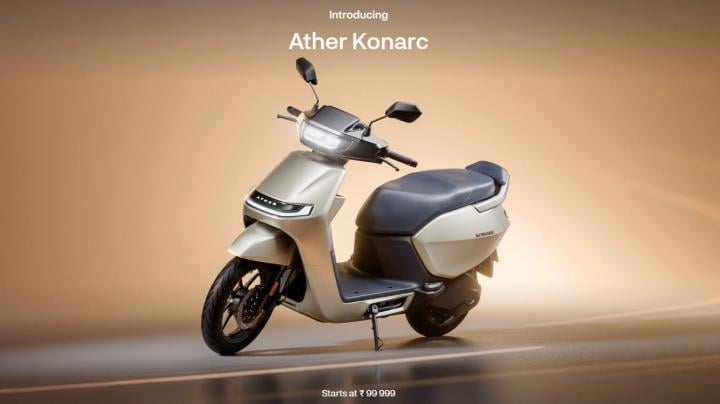
Ather Energy’s new Konarc electric scooter offers up to 200 km range, launching at an accessible price of ₹99,999, targeting mass-market consumers.
Ather Energy has officially launched its new electric scooter, the Ather Konarc, aimed at the mass-market segment in India. The unveiling took place during the company’s Community Day event on August 29, 2026. The base model is priced at ₹99,999 ex-showroom, making it notably more affordable compared to the existing Ather 450 and Rizta models.
The Konarc represents Ather’s first production model built on its innovative EL electric vehicle platform. This new platform is designed to enhance scalability and manufacturing efficiency, reflecting the needs of more mainstream scooter buyers.
At launch, Ather has introduced various range configurations for the Konarc:
- 100 km version priced at ₹99,999
- 125 km version priced at ₹1,21,999
- 161 km version priced at ₹1,44,999
- A long-range version promising up to 200 km, with its price yet to be disclosed.
The 100 km and 125 km models are set to hit the market in September 2026, while the 161 km model has already been announced at ₹1,44,999. The 200 km variant is expected to be available by Q3 2027. It is crucial for potential buyers to note that the ₹99,999 price is linked to the entry-level model, which offers a claimed range of 100 km.
Ather’s EL platform marks a significant transition for the company, allowing it to design a flexible scooter architecture that can accommodate various product lines, battery options, and price levels. This new approach serves to broaden Ather’s product appeal, shifting focus from premium offerings to higher-volume segments.
The Konarc features a steel chassis and metal body panels, a shift from previous models. Durability testing prior to launch included extensive trials, simulating various conditions equivalent to approximately 100,000 kilometres of real-world use.
In contrast to the striking design of the Ather 450 series, the Konarc adopts a more traditional scooter aesthetic, incorporating elements like a handlebar-mounted LED headlamp, and a horizontal LED daytime running light positioned on the front apron. Its design is aimed at everyday commuting with a spacious seat and floorboard.
The model’s claimed 200 km range is set to capture consumer interest, particularly in a market where range significantly influences purchasing decisions. Ather has chosen a gradual rollout strategy for the Konarc line, focusing initially on the 100 km and 125 km variants before introducing higher range configurations.
Ather’s current offerings primarily cater to the more premium end of the market. For context, their existing 450 range boasts certified ranges of about 165 km, suggesting that the 200 km Konarc could become the brand’s longest-range option in the mainstream segment.
In addition to the Konarc model, Ather has plans for the Konarc Z series, which will feature 125 km and 161 km versions launching in Q2 2027. This indicates that the EL platform will support a comprehensive product line rather than merely substituting existing models.
This strategy closely mirrors practices of established two-wheeler manufacturers who develop scalable architectures to optimise production costs across multiple models. The Konarc is projected to be accessible and positioned as a high-volume commuter vehicle.
Ather Energy’s pricing structure highlights a clear differentiation within their lineup. The Konarc launches at a competitive price point to attract a broader audience, potentially appealing to buyers who have previously found Ather products financially out of reach.
In a market characterised by increasing competition, the Konarc competes with models such as the TVS iQube, Bajaj Chetak, Ola S1 X, and various other affordable electric scooters priced around ₹1 lakh. The pricing strategy seems deliberate to vie for customers who may lean towards traditional petrol scooters or other economical electric alternatives.
As the electric two-wheeler market matures in India, consumers are becoming more discerning. They now demand offerings that can match the conventional petrol scooters in areas such as pricing, reliability, comfort, and overall service accessibility. Ather Energy’s Chief Executive Officer and co-founder, Tarun Mehta, has addressed the growing importance of factors like resale value, service time, and charging convenience as critical for electric vehicle acceptance. The Konarc appears to have been strategically developed to meet these evolving needs, launching at a pivotal time in the electric two-wheeler industry.