



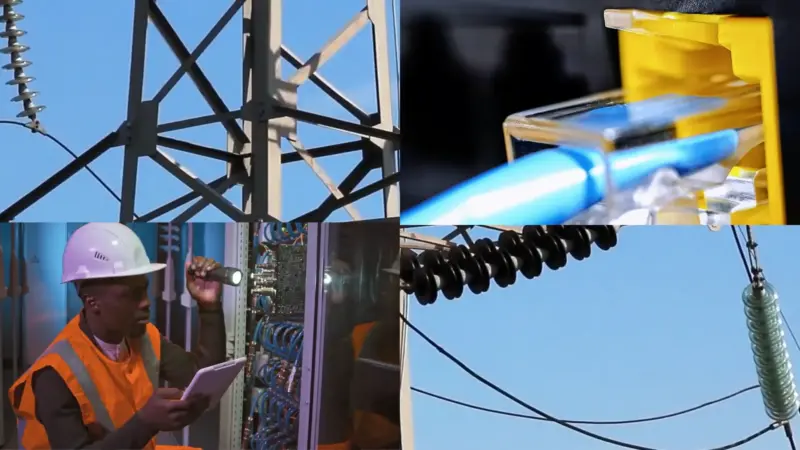
Screenshot of the video, “Why there are so many power outages in Africa”, from the Afrique en 365 jours YouTube channel, created with Canva Pro.
This article is part of the Global Voices April 2026 “Spotlight” series, “Human Perspectives on AI“. This series provides an insight into how the World Majority uses AI, the impact of its use and implementation on different communities, what this AI experiment could mean for future generations, and much more. You can support this coverage by donating here.
In the global artificial intelligence (AI) race, a fundamental reality affects much of Sub-Saharan Africa. Electricity cuts off several times a day, affecting computer power supplies, and internet connections cost over a quarter of a month’s salary, affecting access to online AI models.
Although the emergence of AI has shaken up established industries and catapulted the world into a new technological era, this revolution is two-fold. The transformation it’s meant to bring to the world is more evident in the Global North than the Global South. Every day, leading tech companies announce the launch of new, increasingly powerful models, while Western governments debate complex regulations. In mainstream narratives, the world that AI seeks to transform also remains disproportionately Western.
Africa struggles to keep up and embrace this revolution. The continent has a population of over 1.5 billion, more than half of whom live in rural areas that often lack electricity. AI adoption, therefore, encounters two structural obstacles before any algorithmic or data issue: electricity and internet access.
Electricity: An invisible and hindering prerequisite
In the 21st century, some people still live without electricity. According to the International Energy Agency data, in 2025, almost 600 million Africans lacked access to electricity. Although this figure accounts for 43 percent of the African population, 85 percent of these people are in Sub-Saharan Africa. This disparity shows that, despite ongoing efforts, electricity coverage remains incommensurate with demographic growth, which exceeds the rate of electrification.
Unequal access to electricity makes these disparities even more evident. While countries like South Africa, Ghana, and Kenya have higher rates of electrification, other countries like Niger, Chad, and South Sudan have very low rates. In these countries, more than 80 percent of the population lives in areas without reliable access to electricity. Even in countries with more advanced electricity supplies, the quality remains uncertain. Power outages in South Africa and Côte d’Ivoire are daily realities that affect businesses, hospitals, and households alike.
Interviewed during the World Governments Summit in Dubai, in February 2026, Walid Sheta, president of Schneider Electric Middle East and Africa, explained the matter to Africanews:
Le vrai défi est de coordonner gouvernements, entreprises et partenaires financiers pour électrifier chaque territoire avec une solution adaptée.
The real challenge is bringing together governments, companies, and financial partners to electrify each region with tailored solutions.
The fact that Africa doesn’t benefit from the wide range of solutions AI offers to many of the continent’s challenges is a major problem. A profound irony lies in the paradox that countries that would gain the most from AI are often those with the least means of accessing it.
Various AI tools and platforms specializing in agriculture, medicine, finance, tech, and more require continuously operating smart devices, servers accessible 24/7, and stable networks. These prerequisites are lacking in many regions.
Despite these fundamental shortcomings, and while a large proportion of the population experiences daily power outages, African governments and leading tech companies continue to announce national AI strategies, innovation hubs, and partnerships with Google and Microsoft. Folli Herbert Amouzougan, IT specialist and internet governance and digital policy expert in Togo, describes the gap between the political rhetoric surrounding AI and the basic infrastructure reality in Sub-Saharan Africa:
Je qualifierai d’aberrant ce décalage entre les discours politiques sur l’IA et la réalité des infrastructures de base en Afrique subsaharienne. Je pense que ces déclarations sont semblables à un saut dans le vide et qu’il ne sert à rien de mettre la charrue avant les bœufs. Il m’est inconcevable de réaliser n’importe quelle prouesse technologique dans un pays sans assainir et stabiliser le secteur énergétique prioritairement et doter le pays en question d’infrastructures de base: un réseau électrique efficace, efficient et opérationnel couvrant au moins 95% du territoire. L’on ne peut construire une tour (IA) sans la bonne fondation (infrastructure énergétique et de connectivité).
I would say the gap between the political rhetoric surrounding AI and the basic infrastructure reality in Sub-Saharan Africa is untenable. I believe these pronouncements are like leaping into the unknown, and there’s no point getting ahead of ourselves. Achieving any technological feat in a country without first improving and stabilizing the energy sector and equipping it with basic infrastructure, such as an efficient and functional electricity grid that covers at least 95 percent of the country, is inconceivable to me. You cannot build a tower (AI) without a solid foundation (energy and connectivity infrastructure).
Expensive and slow internet connectivity
Although electricity is the first obstacle that innovative projects encounter, poor-quality internet access delivers the fatal blow. Both elements are inextricably linked. While internet penetration in Africa is growing, bandwidth quality and speed remain another challenge Africans face.
In 2024, Sub-Saharan Africa accounted for 75 percent of the world’s expansion in mobile internet coverage. Yet, the continent’s internet penetration rate in rural areas remains among the lowest in the world. Internet quality poses particular problems for AI users. Its high latency makes the user experience frustrating and renders it unusable for real-time applications.
Connection stability has become another crucial factor. Work sessions with AI tools that cut off every 10 minutes due to signal instability aren’t feasible for serious professional use. That said, in suburban and rural areas, this type of disruption remains the norm rather than the exception.
Aside from the gross access rate, the relative cost of connectivity is of great concern. In many Sub-Saharan African countries, 1 GB of mobile data can cost between 2 and 10 percent of the average monthly income, making intensive use of cloud-based AI applications completely unaffordable for most.
Practical consequences
Infrastructural constraints put Sub-Saharan Africa’s startups and small and medium-sized enterprises (SMEs) wishing to incorporate AI into their workflows at a competitive disadvantage. We must first resolve the OpenAI API access issues before taking the next step. In practice, this disadvantage results in higher costs, VPN connections, expensive mobile data usage, longer lead times, and, sometimes, a complete inability to access the most advanced tools on the global market.
AI is also expected to transform education through personalized learning, virtual tutors, automated assessments, and the generation of educational resources. However, all these promises require reliable internet access in educational establishments.
According to UNESCO, the vast majority of primary and secondary schools in Sub-Saharan Africa are not connected to the internet. Under such circumstances, educational inequalities are likely to worsen further. Students in major connected cities will therefore benefit from educational AI tools, while those in rural areas will miss out.
Solar energy: A promising but partial solution
Due to a lack of centralized electricity grids, off-grid solar energy has emerged as an alternative solution in many rural areas. Companies like M-Kopa in Kenya and Bboxx in several Eastern and Western African countries enable households without grid access to access solar energy through solar panels and pay-as-you-go systems.
However, these solutions have their AI limitations. Small solar panels effectively power lamps, mobile phones, and even small household appliances, but cannot continuously power high-performance computers, Wi-Fi routers, and local servers required to run AI models locally.
With AI meant to redefine access to knowledge, health, employment, and governance, connectivity is no longer just about convenience, but also about fairness and fundamental rights.
As long as millions of people in Sub-Saharan Africa don’t have access to reliable electricity or affordable internet, the rhetoric on “AI for all” will remain meaningless. While solutions such as solar energy, undersea cables, offline AI models, and targeted public and private investments exist, what’s missing is a political and economic commitment to addressing these challenges.
Not only will Google DeepMind and Anthropic laboratories decide the future of AI, but also Niger’s classrooms without electricity, the Republic of the Congo’s rural health centers, and Nairobi’s startups that are innovating despite the constraints and creativity they entail.