



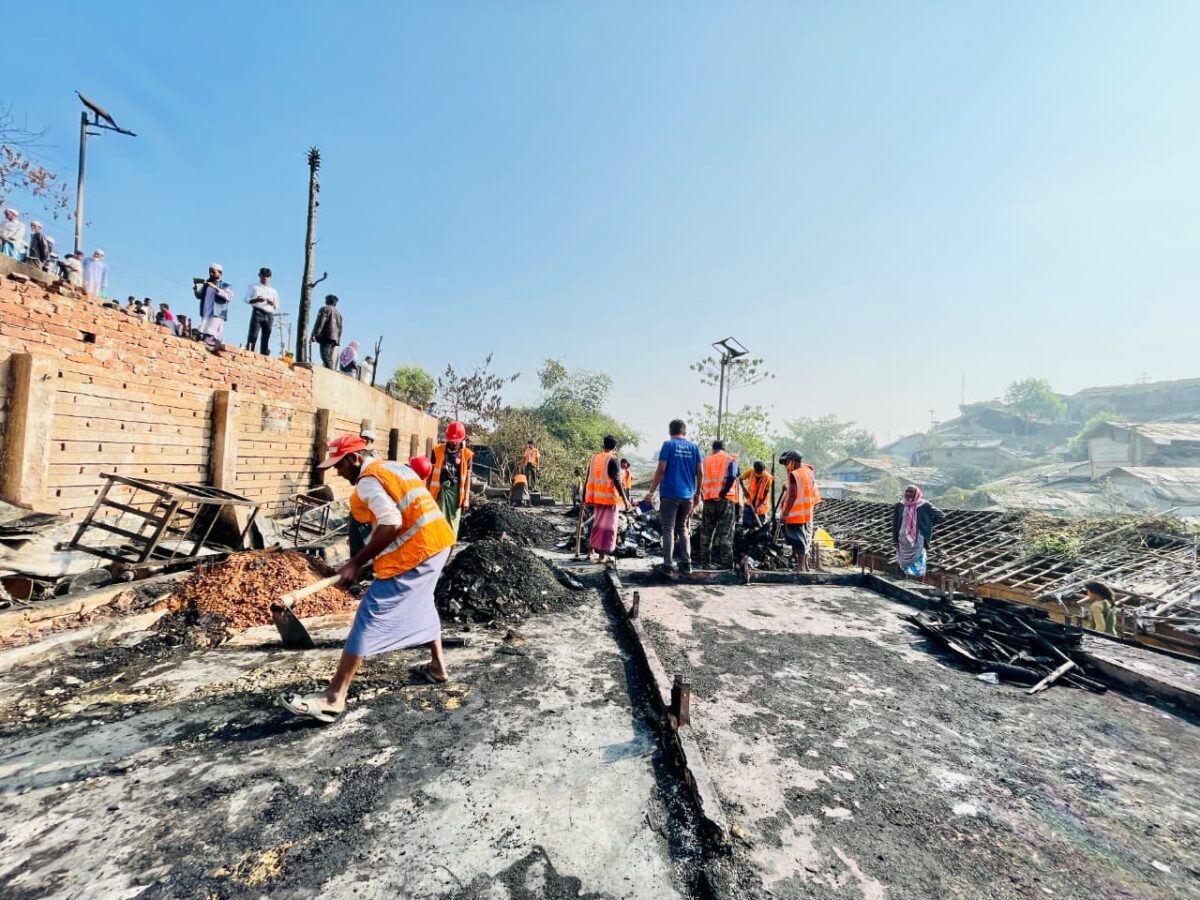
Volunteers and workers clear debris from blackened ground following a devastating fire in Camp 11 on February 13, 2026, at approximately 3:20 a.m. Photo by Maung Thein Myint, Human Rights Defender, Refugee Advocate, and Documentary Researcher. Used with permission.
Mohammad Ali had already lost everything once. On March 22, 2021, a Disaster Management Unit volunteer rushed toward the flames engulfing Camp 9 in Ukhia, Cox’s Bazar, the largest refugee camp in Bangladesh, his extinguisher raised like a weapon against the inevitable. “As we were dousing it, fire engulfed the other side,” he would later recall. “When our extinguishers ran out, we rushed home. We couldn’t take any belongings. We just took our children and ran.”
By the time the inferno subsided that evening, fifteen people were dead, 45,000 refugees were displaced, and more than 10,000 shelters had vanished into ash and memory. What stands out in the humanitarian record is not just this catastrophe but the sheer recurrence: between May 2018 and December 2025, 2,425 documented fires have struck the world’s largest refugee settlement in Southeast Bangladesh, affecting over 100,000 individuals and destroying more than 20,000 shelters.
This is not the story of accidents. Rather, it chronicles how a refugee crisis has metastasized into something more insidious — an infrastructure of permanent crisis.
The mathematics of vulnerability
Consider the spatial layout of Camp 5 in Ukhia, where on January 7, 2024, flames consumed 900 shelters in several hours, displacing around 5,000 refugees, including 3,500 children. The fire challenged responders not merely through its intensity but through the very design of the settlement itself: strong winds funnelled flames through narrow corridors, water hydrants depleted within minutes, access roads too cramped for fire trucks, and households resisting the demolition of their shelters to create firebreaks even as flames approached.
“We were all asleep when fire broke out,” Rasheda, a 42-year-old mother of five, told Save the Children after losing her home in that same January blaze. “I quickly woke my husband, elderly mother-in-law, and children — we left the shelter, and that saved our lives. We could not save any belongings. Have nothing left to wear this winter.”
Within Cox Bazar, fire is not a risk to be managed. Instead, it becomes an inevitability engineered into the settlement’s DNA. Every shelter is made of of bamboo, tarpaulin, and plastic rope, with no fire resistant materials. The population density exceeds 95,000 people per square kilometer in some blocks of the camp, and most families cook with open flames inches from their neighbors in structures that become tinder-dry each winter.
Lance Bonneau, IOM’s chief of mission, articulated this with careful bureaucratic precision: “When fires strike overcrowded camp settings, the impact extends far beyond damaged infrastructure. Families lose shelter, essential belongings, and access to basic services.”
What remains unspoken is that such impacts are not unfortunate externalities but predictable outcomes of political decisions — to warehouse nearly one million people on inadequate land with far too few resources.
Fire as a weapon: The arson economy
However, not all fires emerge from structural inevitability. Increasingly, flames have become tactical instruments in a shadow war for territorial control. In March 2023, a Bangladesh Ministry of Defence investigation concluded that the fire that destroyed 2,800 shelters and displaced 12,000 people was “planned sabotage.”
Htway Lwin, a Rohingya community leader, described how gunfire between rival factions preceded the blaze: “There was a gunfight between two gangs. As soon as the huts were set on fire, members of one gang did not allow the refugees to put out the fire.” Cox’s Bazar Police Chief Mahfuzul Islam confirmed that “several Rohingya sources reported how insurgent group ARSA men set fire,” referring to the Arakan Rohingya Salvation Army, one of at least ten armed groups operating within the camp.
Killings of refugees by militant organizations rose from 22 in 2021 to 90 in 2023. Meanwhile, abductions increased nearly fourfold, with over 700 kidnappings in the first nine months of 2023 alone, compared to approximately 200 in 2022 and 100 in 2021.
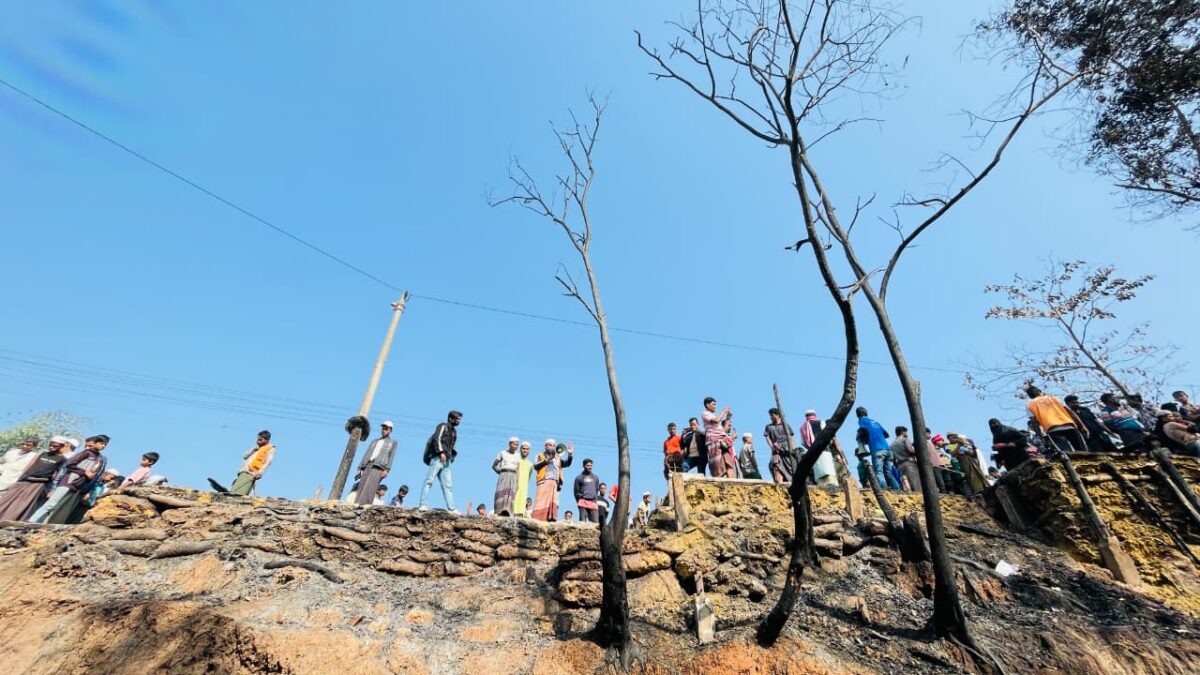
Residents stand along a raised embankment overlooking the charred remains of shelters after a fire broke out in Camp 11 in the early hours of February 13, 2026, around 3:20 a.m. Photo by Maung Thein Myint, Human Rights Defender, Refugee Advocate, and Documentary Researcher. Used with permission.
“Someone from ARSA threatened [Camp 11] residents just ten days ago,” explained Nurul, a Block C resident, to The New Humanitarian. “We complained to the police, who told us to be watchful and conduct night patrols.” Ten days later, fire consumed his neighborhood.
Groups like ARSA and the Rohingya Solidarity Organization (RSO) wage turf wars through flame, transforming the camps into what one humanitarian official called “a city of a million people — there are nice neighborhoods and bad neighborhoods.” These are not organic urban divisions but militarized zones where forced recruitment, extortion, and disappearances have become routine.
The political economy of ashes
Understanding fire in Cox’s Bazar requires mapping its economic architecture. When flames swept through Camp 11 on March 5, 2023, the immediate humanitarian response cost included emergency shelter materials, non-food item kits, water trucking, medical services, and food distributions for 16,000 affected refugees.
Each fire triggers a cascade of hidden costs: families lose identification documents and are forced to undergo months-long bureaucratic battles for replacement. Children miss education when learning centers burn — in January 2024, at least 1,500 students lost access to schooling overnight. Medical records vanish, complicating disease management. Social networks fragment as families relocate to different blocks.
This fire safety theater reveals the system’s central paradox. Humanitarian actors optimize for emergency responses — training volunteers, positioning extinguishers, and conducting awareness campaigns — that rarely arrive in time while the root of the fires remains unaddressed. Plans for 50,000 semi-permanent fire-resistant shelters, announced with fanfare, now languish unfunded after the international aid cuts in early 2025.
Barbed wire and blocked exits
Nowhere does the fire-security paradox manifest more lethally than in the barbed wire fencing that encircles the camps. Installed ostensibly for security, these barriers became death traps during the March 2021 inferno. At least fifteen people perished, with hundreds injured attempting to climb or cut through the wire as flames approached.
The fencing remains. It prevents unauthorized movement to maintain camp security. However, what this security apparatus actually secures is a population rendered maximally vulnerable — contained enough to prevent flight, but not protected enough to ensure survival when disaster strikes.
The sustainable solution mirage
How many times must these refugees witness fire consuming their lives? The question haunts every humanitarian briefing, every donor appeal, every investigative report.
Omar Khan, a 35-year-old teacher in Camp 5, placed responsibility squarely on camp authorities after the January 2024 blaze: “Camp authorities are responsible for the scale of devastation.” Others accused officials of failing to ensure adequate access to basic assistance and emergency services, despite the camps experiencing over 300 fires in six years.
Following the March 2021 catastrophe, António Vitorino, IOM’s Director General, declared, “This disaster is a terrible setback that exacerbates the humanitarian needs. We will need to start from zero to rebuild.” Starting from zero, however, is precisely what humanitarian architecture in Cox’s Bazar has perfected — not as a failure but as an operating system.
Kaiser Rejve, CARE Bangladesh’s Head of Programs, described the organization’s response after a January 2026 fire displaced 2,185 people: “Beyond immediate response, we are committed to strengthening prevention efforts. We will incorporate dedicated fire safety sessions into shelter upgrade and maintenance modules to raise awareness and promote safer practices.”
This fire safety theatre reveals the system’s central paradox. Humanitarian actors optimize for theoretical emergency responses — training volunteers, positioning fire extinguishers, and conducting awareness campaigns — while the fundamental conditions that guarantee fires remain untouched.
Sustainable solutions exist in theory: relocate families to less-dense configurations, construct fire-resistant shelters using concrete and metal, create adequate firebreaks, remove barbed-wire fencing, and establish professional fire services within camps.
Each of these interventions, however, collides with the fundamental political reality. The Bangladesh government does not intend for these settlements to be permanent, despite housing people for eight years and counting, so any significant, long-term investment faces steep political obstacles.