



If you’ve delved into the worlds of Star Trek, The Terminator or William Gibson’s cyberpunk novel Neuromancer, you’ll know that enhanced, electronic vision is a staple of science fiction. Now, what was once futuristic fiction is becoming a reality.
Researchers have developed bionic eyes that can restore some lost vision. These devices’ capabilities are currently basic, but they have been steadily improving in recent years.
One day, they might even offer features that transcend the limits of natural human eyesight – for instance by manipulating images in a way the human eye cannot or by seeing beyond the spectrum of visible light.

Technology that boosts people’s physical and mental abilities is no longer the preserve of science fiction. In this series, we explore cutting-edge ways that human capabilities could be augmented both now and in the near future – and the ethics of these innovations.
To date, implants have focused on combatting problems with the retina, the light-sensing layer of cells inside the back of the eye. Akin to the film in the back of a camera, the retina allows us to see the outside world. When things go badly wrong with it, the result can be a total loss of vision.
Work to fix retinal blindness with implants began more than two decades ago. One of the first devices, developed by the German manufacturer Retina Implant AG, featured a light-sensing chip placed under a person’s damaged retina. This connected with their remaining healthy retinal cells, which then transmitted the chip’s vision signal from the eye to the occipital cortex, the brain region where vision is perceived.
Surgery to implant the chip took about eight hours. This included creating a recess in the skull behind the ear to implant a power receiver and then connecting this with a wire beneath the skin to the chip.
The device offered only rudimentary vision, with patients seeing flashes of light that corresponded roughly to the shape of the object they were looking at. Many implants also broke over time, possibly because of the frequent rapid movements of the eye or corrosion caused by its salty liquid interior. Retina Implant AG ceased operations in 2019, citing its lack of medical progress as one of the main reasons.
The other leading early device, Argus II, combined a glasses-mounted camera with a chip surgically inserted on top of the retina. The camera’s picture was converted into a signal and transmitted wirelessly to the chip (along with power), which then stimulated healthy cells in the damaged retina using an array of 60 electrodes.
Despite positive early results and FDA authorisation in 2013, ARGUS II also ultimately failed to deliver sufficiently convincing results. It was discontinued in 2019.
Newer approaches
Despite these setbacks, investigators have persisted in trying to create artificial vision.
A newer approach is to use an external camera that wirelessly transfers power and image data to a chip implanted in the occipital cortex. This built research that placed electrical probes directly into the occipital cortex to stimulate visual perception.
This approach can help both patients with diseases of the retina and those with conditions affecting the optic nerve, which connects the retina to the brain. But exactly how much resolution can be achieved with this technique isn’t clear, as the retina’s high resolution and complex signal processing is lost.
One company trying this technique, Belgium-based ReVision Implant, is launching its first human clinical test in October 2026.
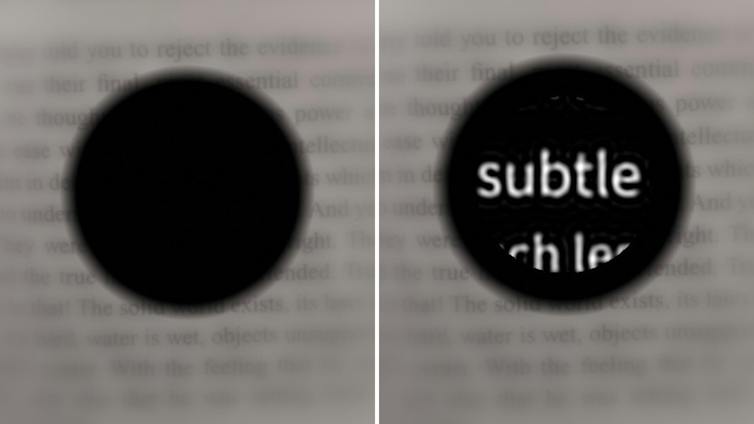
Another option is to use spectacles that transmit both images and power to a surgically inserted subretinal chip via an infrared signal. A device using this technique, Prima, has been tested in a specific disease of the retina called dry age-related macular degeneration (AMD), a leading cause of blindness.
Palanker Lab/Stanford Medicine
In a small clinical trial, the device restored functional central vision to 81% of patients, allowing them to read letters, numbers and words. The device is now authorised in 30 European countries.
As AMD is far more common than the inherited retinal diseases treated by most earlier devices, this device is much more appealing to investors. However, there are ethical questions here. Unlike patients with inherited retinal diseases, most with AMD still have good peripheral vision, so have much to lose if things go wrong. The complex surgery to implant a subretinal chip is far from zero risk.
Super-human vision?
Because these technologies relay visual information electronically, extra functionality could potentially be built into them. With Prima, patients can already use optical zoom, while algorithms that could allow for image sharpening have been proposed.
In the future, it is possible that devices may emerge that use cameras capable of seeing beyond the visible light spectrum. This could potentially offer thermal imaging and night vision. One device offering near-infrared vision has already been tested in primates.
But while exciting, these will probably not offer enhanced vision until the currently rudimentary artificial vision is advanced to the point that these “optional extras” become more relevant.
For now, there are still many biomaterial and electrical challenges preventing retinal implants from offering full, long-term vision restoration. However, a potentially greater challenge comes from competing biological solutions, such as stem cells, which are in the early stages of human trials.
These have also had a few false dawns and there are big obstacles to overcome in terms of cell survival and integration. But if new human retinal cells can replace those lost to disease, they could one day overtake bionic eyes entirely as the solution for vision restoration.
