



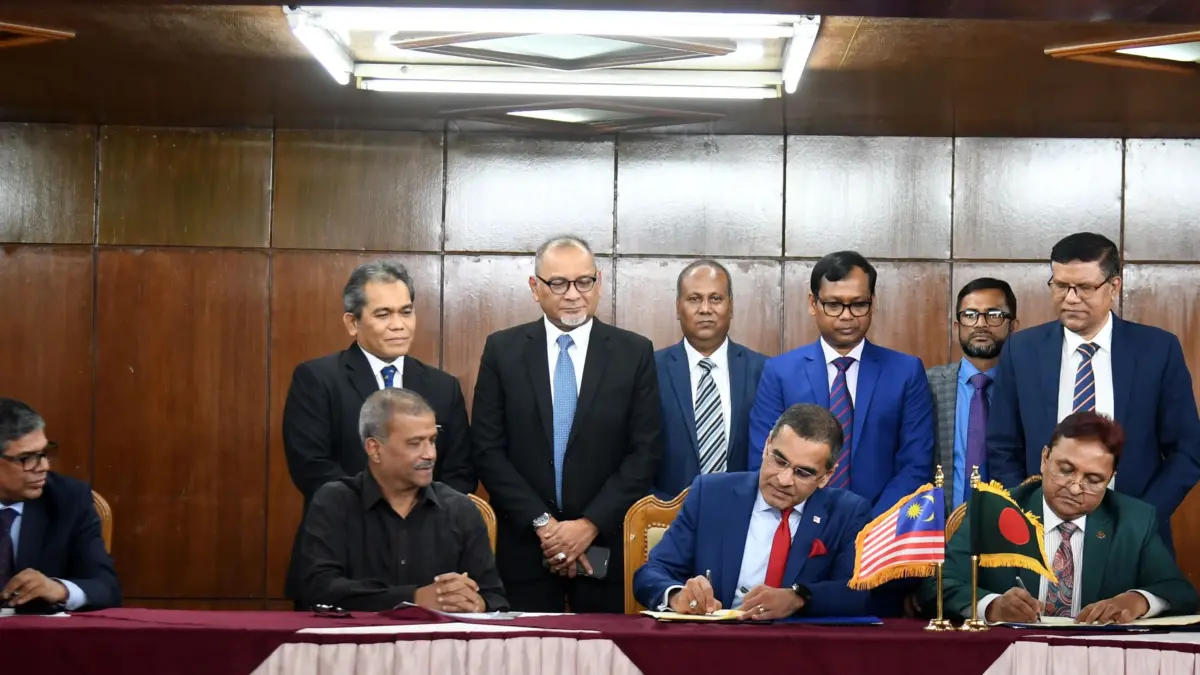
On Saturday, October 5, 2024, a Memorandum of Collaboration (MOC) was signed in Dhaka between the Wage Earners Welfare Board and Malaysia’s PERKESO, regarding the expansion of the labor market in Malaysia. Image via Wikipedia by Press Information Department of Bangladesh. Public Domain.
Officials in both Bangladesh and Malaysia’s have made repeated attempts to reform the countries’ labour migration relationship, leading to numerous suspensions and reopenings over more than three decades.
Howeverm, on August 30, 2026, Bangladesh’s State Minister for Local Government, Rural Development and Cooperatives, Mir Shahe Alam, announced that Malaysia would recruit around 200,000 Bangladeshi workers over six months, with departures expected to begin in late September. He also referred to a plan to send 10,000 workers without requiring them to bear migration costs.
Two days later, however, Malaysia’s government spokesperson Fahmi Fadzil clarified that the figure of 200,000 workers did not represent an official government position. The clarification introduced fresh uncertainty over the scale and timing of the recruitment drive.
The mixed signals came as the two countries were trying to reset a labour migration corridor that has faced repeated allegations of excessive recruitment fees, syndication and worker exploitation.
Repeated reopenings, repeated suspensions
Bangladesh first entered into an agreement with Malaysia for the systematic transfer of labour in 1992, followed by another agreement in 1994 that provided for the recruitment of 50,000 workers annually, mainly for the construction sector. Between 1992 and 1998, around 307,000 Bangladeshi workers were issued permits to work in Malaysia. But recruitment was halted in 1997 amid a rise in unauthorised migration. During that period, local brokers could charge workers between USD 2,000 (approximately BDT 245,700) and USD 3,000 (approximately BDT 368,600) for authorised migration.
In an effort to reduce recruitment malpractice and costs, the two governments turned to a government-to-government model (G2G model) in 2012. The programme initially aimed to recruit around 30,000 Bangladeshi workers for Malaysia’s palm-oil sector. More than 1.4 million people registered and workers were selected through a lottery system. The G2G arrangement substantially reduced migration costs, but it struggled to meet its recruitment targets.
The system was later replaced by the G2G Plus arrangement. Under the model introduced in 2016, Malaysia selected only 10 Bangladeshi recruiting agencies. Although the agreed migration cost was around BDT 37,000-40,000 (approximately USD 300 to USD 325), later reports put the amount actually paid by workers at an average of around BDT 300,000 to 400,000 (approximately USD 2,450 to USD 3,260). Allegations of syndication, high costs and other irregularities eventually led Malaysia to suspend recruitment again in 2018.
Recruitment resumed following a new memorandum of understanding signed in December 2021. Between 2022 and 2024, 476,672 Bangladeshi workers were sent to Malaysia through 101 recruiting agencies. But by June 2024, the labour market had again closed to new Bangladeshi recruits amid concerns over high migration costs and worker exploitation.
Against this history of repeated closed and reopened borders, the latest attempt to reset recruitment has revived a familiar question: whether the new arrangement can reduce the financial burden on workers and prevent the problems that undermined earlier recruitment systems.
The latest debacle
On August 28, 2026, Bangladesh’s Ministry of Expatriates’ Welfare and Overseas Employment outlined a broader recruitment arrangement involving 338 entities. Malaysia had directly selected 25 recruiting agencies, while 312 others were approved to work as associates. The state-run Bangladesh Overseas Employment and Services Limited, or BOESL, was also included.
Under the same arrangement, Malaysia had agreed in principle to take 10,000 workers on a zero-cost basis. Prospective migrants were also warned not to make payments, undergo medical examinations or hand over their passports until formal instructions were issued.
That warning stands out against the record of the previous recruitment cycle.
In July 2026, Bangladesh revoked the licences of 49 recruiting agencies over alleged syndication and irregularities linked to Malaysia-bound recruitment. The Anti-Corruption Commission alleged that agencies under investigation had sent 267,276 workers to Malaysia and collected more than BDT 45.45 billion (approximately USD 370 million) in excess fees. The government-approved recruitment cost was BDT 78,990 (approximately USD 645), yet investigators alleged that some workers were charged as much as five times that amount. Concerns over high recruitment costs have continued into the new cycle, with industry sources warning that migration expenses could exceed BDT 600,000 (approximately USD 4,900).
The financial burden is not limited to the Malaysia corridor. Bangladesh’s Labour Force Survey 2024 found that migrant workers spent an average of BDT 463,000 (approximately USD 3,778 ) on recruitment. With average monthly earnings of BDT 42,599 (approximately USD 348), recovering that expense took about 10.9 months on average.
For some families, however, the financial loss begins even before a worker leaves Bangladesh.
Paying for a journey that never happened
For a 22-year-old worker originally from Sherpur, Bangladesh, the financial loss began with a job abroad that he never reached.
Speaking to Global Voices by phone and asking to remain anonymous, he said he began preparing to migrate to Malaysia around 2024 after hearing about work opportunities through a local intermediary. By the time the process stalled, his family had spent around BDT 500,000 (approximately USD 4,079). The money came from their savings, the sale of land and loans — around BDT 220,000 (approximately USD 1,795) of which were borrowed at interest.
The payments were made in stages for visa processing, medical costs and other expenses. Much of the process was handled through a local intermediary rather than directly with a recruiting agency, and the worker said he did not receive receipts for all of the money he paid.
“At first they said it would take two or three months, but six or seven months passed. Whenever I asked for an update, the intermediary gave a different answer but never gave me a clear one. I had already done the medical and submitted my passport. Eventually they told me the Malaysian market had closed and there was nothing more they could do.”
By then, however, the full amount had already been paid, leaving him and his family with the financial burden.
“I thought I would go to Malaysia, earn money, and repay the loan. But I could not go. I got some of the money back, but they still have not returned the rest. Whenever I call, they just say, ‘Give us some more time.’ I do not know how long I am supposed to keep waiting. I am still here, but I am still paying off the debt I took to go abroad.”
The consequences also reached the rest of the household. His mother, who also spoke to Global Voices by phone and asked to remain anonymous, said, “My husband died a long time ago. We only had a small piece of land, so I sold it. I also borrowed money with interest and somehow managed the rest for my son. I thought that if he could go abroad and earn well, we would repay everything. But he could not go. Now we still have to keep paying the interest, whether we have enough for food or not.”
A wider pattern of recruitment debt
The family’s experience sits within a broader pattern of high recruitment costs and debt among Bangladeshis seeking work in Malaysia. Research by Verité, an independent nonprofit organization advancing fair labor worldwide, on the Bangladesh–Malaysia migration corridor found that workers paid an average of about USD 5,000 (approximately BDT 614,400) in recruitment-related costs, often financing the journey through multiple loans. Among the workers surveyed, 73 percent spent at least half of their monthly salary on recruitment debt, while 43 percent reported wage deception.
The role of intermediaries has also been identified as a major driver of those costs. An International Organization for Migration (IOM) study on recruitment practices in Bangladesh found that aspiring migrants often rely on sub-agents and informal intermediaries because they have little direct contact with recruiting agencies or do not fully understand the formal process. The study identified reducing the unauthorised involvement of such intermediaries as a key step towards lowering migration costs.
A separate IOM study on migrant debt found that limited information about official migration channels can push prospective workers towards intermediaries who charge high fees. It also identified limited access to formal finance and legal remedies as factors that can deepen migrant indebtedness.
What remains unclear in the new recruitment cycle
As Bangladesh and Malaysia move towards restarting recruitment, key details of the process remain unsettled. By September 30, 2026, the Bangladesh High Commission in Kuala Lumpur had begun attesting job-demand letters, but the government had yet to announce the final recruitment cost, departure timeline, or full procedure. Expatriates’ Welfare and Overseas Employment Minister Ariful Haque Chowdhury said an official announcement would be made soon.
The structure of the new arrangement has also drawn criticism from within the recruitment industry. Some Bangladesh Association of International Recruiting Agencies (BAIRA) members argued that the 312 associate agencies should have direct access to Malaysia’s Foreign Workers Centralised Management System rather than relying on the 25 principal agencies to process workers. Other recruiters rejected concerns about renewed syndication, saying associate agencies could still obtain job demand and recruit workers.
In November 2025, UN human rights experts expressed renewed concern over the continued exploitation, deception and deepening debt bondage of Bangladeshi migrant workers in Malaysia. They called on both governments to investigate reported abuses, provide effective remedies including restitution and debt relief, strengthen oversight of recruitment practices and cooperate to dismantle exploitative recruitment networks.
The recruitment corridor has also faced repeated suspensions amid recurring allegations of syndication, excessive recruitment costs and worker exploitation. Malaysia suspended recruitment of Bangladeshi workers in 2018 following controversy surrounding the limited-agency system, and again in June 2024 amid concerns over excessive migration costs and workers arriving without jobs. The repeated disruptions have renewed concerns over whether restricted recruitment arrangements can ensure transparency and protect workers from exploitation.
Meanwhile, the Malaysian government has warned agencies not to collect money or passports before formal instructions are issued. Migration researcher Shariful Hasan also told The Daily Star that any reopening should clearly establish who controls recruitment, how much workers are required to pay and who is accountable when problems arise.
Bangladesh and Malaysia have made several government-level agreements over the years, but problems such as syndication, excessive recruitment costs and human rights abuses remain unresolved. Remittances are a major source of support for Bangladesh’s economy, yet migrant workers continue to bear significant human and financial costs. This highlights the need for urgent reforms by both governments that are transparent and centred on the rights and protection of workers.
