



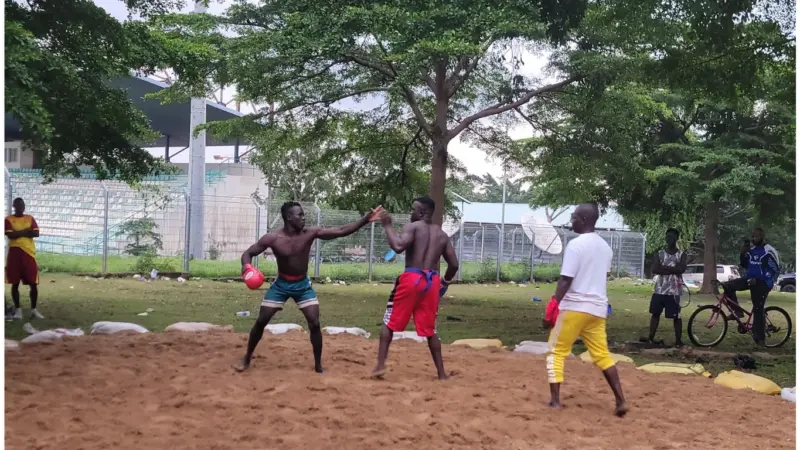
Dambe fighters at the National Open of the Traditional Sports Tournament in Nigeria. Photo by Nshua Cali-Dibang, used with permission.
By Nshua Cali-Dibang
As Dambe fighters gather for a contest, the scene can look like a simple fight. Two opponents face one another, surrounded by drums, chants and spectators waiting for the first strike. Yet behind the spectacle is a tradition deeply associated with the Hausa people of Nigeria and West Africa.
Dambe is a traditional combat sport historically practised by Hausa communities, particularly among butchers and tradesmen. According to BBC Sport, the sport was associated with festivals and harvest periods and was regarded as a test of bravery. Its history has also been connected to preparing men for warfare and, in some communities, rites of passage.
Dambe is going global
For generations, therefore, Dambe has existed within particular communities and social relationships. But today, the sport is moving beyond those traditional settings. Its appearance on social media has introduced it to audiences far beyond Nigeria. Dambe Warriors, for example, used YouTube to transform local competitions into content for a global audience, with millions of views coming from outside Nigeria.
This visibility presents an important opportunity. Greater exposure can create new audiences, income and recognition for fighters. BBC Sport reported that Dambe’s online popularity had grown dramatically, while promoters hoped the sport could move beyond its local origins and become internationally recognised.
But visibility also raises a question about who gets to define Dambe as it enters the mainstream.
Connected beliefs and traditions
One of the clearest examples is the spiritual dimension surrounding some Dambe fighters. Reporting by Al Jazeera documented fighters wearing amulets, undertaking fortification rituals and using herbal preparations before competitions. These practices demonstrate that, for some practitioners, Dambe is connected to beliefs and traditions that extend beyond the physical contest.
This raises an important question about how Indigenous cultural practices are interpreted. An object that may appear to an outside observer as decoration can carry a completely different meaning for the person who wears it. Rather than deciding what these practices mean from outside, their meaning should be understood through the voices of the people and communities who practise them.
Influence of professional sporting structures
Dambe is also changing structurally. Modern organisers are introducing rules intended to make competitions safer and easier to follow. According to BBC Sport, African Warriors introduced three three-minute rounds, a points system, and clearer definitions of knockdowns as part of efforts to make the sport safer and fairer.
These changes are not necessarily a threat to tradition. Professionalisation can bring better opportunities, safety measures, sponsorship and income for fighters. The same BBC report documented fighters earning prize money and organisers attracting international interest.
Yet modernisation raises another question: what should be preserved, and who decides?
The question of preservation
If Dambe becomes increasingly commercialised, who establishes the policies governing it? Should decisions come primarily from government and sports administrators, private promoters, cultural institutions, traditional authorities, or the communities that have historically practised the sport?
There may not be a simple answer. Regulation can provide structure and safety, while professionalisation can create opportunities that traditional competitions may not have been able to offer. But if decisions about the future of Dambe are made without meaningful participation from its communities, there is a risk that the sport’s cultural context becomes secondary to its commercial value.
This is where Dambe becomes relevant to Indigenous rights.
Dambe’s future
Cultural heritage is not simply something to be displayed during festivals or packaged for outside audiences. It can be living knowledge, practised by communities and adapted by each generation. The question is therefore not whether Dambe should remain exactly as it was in the past. Communities themselves may want the sport to change.
The more important question is whether they have a meaningful voice in deciding how it changes.
As Dambe moves from community arenas to YouTube channels, organised championships and professional sporting structures, its future should involve the people who have carried the tradition forward. Fighters, elders, organisers, cultural practitioners and community members should be part of conversations about its regulation, representation, commercialisation and preservation.
The future of Dambe does not have to be a choice between tradition and modernity. The sport can grow while remaining connected to its cultural roots.
But growth should not mean that the communities that gave Dambe its meaning become spectators in the story of its future.
The question is no longer simply how far Dambe can go. It is who gets to decide where it goes.