



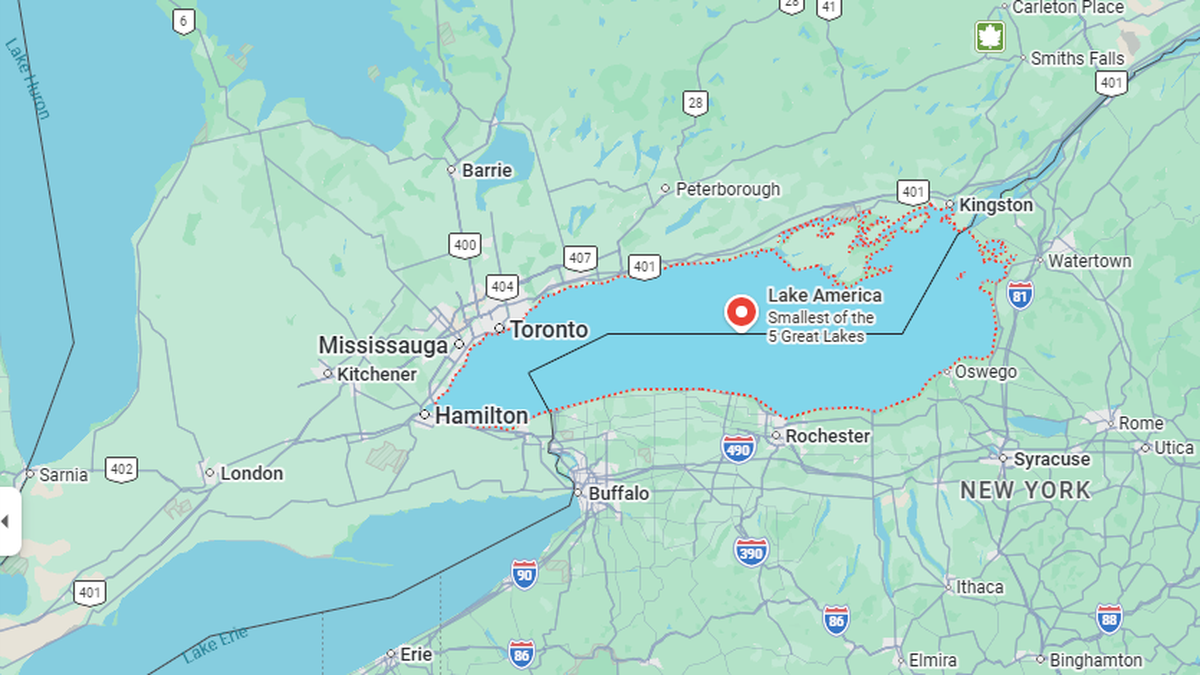
A dispute over the name of Lake Ontario escalates as Canada erects a large sign amid Trump’s renaming efforts. Both nations remain at odds over trade.
The conflict between Canada and the United States over the name of Lake Ontario intensified recently, as Ontario’s Premier Doug Ford unveiled a significant sign proclaiming “Lake Ontario. Now and Always.” This move directly follows an executive order from United States President Donald Trump, who has mandated that federal agencies refer to the lake as “Lake America.”
On Saturday, President Trump shared a video showing himself kicking down a representation of the Lake Ontario sign, replacing it with one stating Lake America, all while dancing to the song “YMCA” by the Village People. Trump’s actions have become emblematic of a broader trade dispute with Canada, which has arisen amidst ongoing tensions marked by a 50% tariff on Canadian steel imposed by the United States and retaliatory tariffs from Canada.
Google Maps has also reflected the name change for its US users following the president’s order, altering the official designation of Lake Ontario to Lake America. The tech giant clarified that while this name change applies to its US users, Canadians will continue to see the lake referred to as Lake Ontario. A Google spokesperson noted, “those in Canada will continue to see ‘Lake Ontario’ on Google Maps, and those outside … the US and Canada will see both names.”
Prime Minister of Canada Mark Carney has firmly rejected Trump’s renaming initiative, emphasising the historical significance of the name Ontario, which is derived from an Indigenous Wendat word meaning, “the lake is beautiful, the lake is great.” He proclaimed that the name alteration ignores the long-standing Indigenous history tied to the lake.
The contention surrounding Lake Ontario’s name brings to mind a previous dispute, during Trump’s second presidency, where an order was issued to rebrand the Gulf of Mexico as the Gulf of America. Premier Doug Ford remarked, “No one’s going to call it Lake of America. It’s been Lake Ontario for hundreds of years. It’s going to continue being Lake Ontario.” He expressed that Trump’s attempts to rename the lake could be viewed as an effort to bolster his image amid domestic criticism.
Alongside Ford, Manitoba’s Premier Wab Kinew compared Trump’s campaign to an ageing rock band struggling to create new hits, implying the former president’s initiatives are unsuccessful in genuine terms. Kinew stated, “He’s trying to bring back that, and he’s trying to play the hits for his base. But I think everybody here thinks it’s a little sad, and it’s not his best work.”
The Grand Chief of the Wendat Nation, Pierre Picard, condemned Trump’s move, underscoring its implications for Indigenous history. “I want to tell him that it is unacceptable for us, as a nation, to have a president who can eradicate our history, our culture and our identity,” Picard stated.
Further escalating the situation, Trump expressed disdain for Canada in a social media post, labelling it as “the worst” and claiming, “I don’t want Canadian anything. They’ve been ripping us off for decades, and it’s going to stop.” This statement serves to highlight the ongoing trade war atmosphere gracing US-Canada relations.
Lake Ontario, covering an area of 7,340 square miles, ranks as the smallest of North America’s five Great Lakes, which also include Lake Superior, Lake Michigan, Lake Huron, and Lake Erie. The significance of its name, deeply rooted in Indigenous heritage, stands as a focal point of contention in this escalating diplomatic spat.