



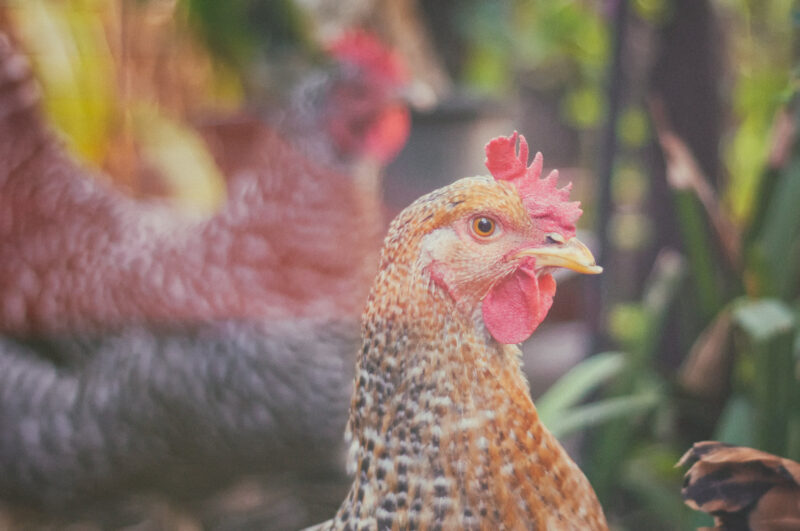
A chicken. Photo by David Goehring via Flickr, CC BY 2.0.
Sisak, a city known for its manufacturing industry and for operating the second largest oil refinery in Croatia, has been receiving an unusual amount of media coverage about chickens. Citizens have come out in their numbers against a series of proposed industrial poultry facilities, which locals and non-governmental organizations (NGOs) claim will have an adverse effect on the natural environment, reduce living standards, and engage in the inhumane treatment of animals.
By April 2026, protest organizers said they had identified 24 planned poultry projects across three Croatian counties, being advanced separately by two investors: agricultural conglomerate MHP (formerly Myronivsky Hliboprodukt), one of the largest poultry companies in Europe, and Premium Chicken Company (PCC), owned by the Croatian holding company Renaissance Capital d.o.o. (LLC), not to be confused with the similarly named Moscow-based investment bank Renaissance Capital (RenCap).
PCC, which said that more than 90 percent of production from its proposed Sisak-Moslavina project would be intended for export, valued its proposed investment at EUR 608 million (just over USD 708 million), while MHP’s separate Sisak-area project — paused in 2025 — was valued at EUR 350 million (close to USD 408 million).
The first major national protest back in February saw around 5,000 people take to the streets in Zagreb, according to organizers. More than 1,000 people attended a follow-up protest in Sisak a couple of months later, backed by over 160 civil society organizations, including Friends of the Earth Europe and Greenpeace.
Over 51,000 people signed a petition to voice their opposition, for reasons ranging from the state’s lack of transparency regarding environmental assessments to allegations of favoritism towards specific investors. They’ve received encouragement from several celebrities, including actor Goran Višnjić, who played Dr. Luka Kovac in the American hospital drama, ER. Speaking in an Instagram reel, Višnjić urged citizens to join the February 21 protest and warned of the threats to the ecosystem, including both the Kupa and Sava rivers. “We’ll be left with pollution, stench, destroyed nature, and the shutdown of around 250 domestic farms,” said Višnjić.
MHP-owned Perutnina Ptuj-Pipo has several poultry-farm projects in northern Croatia that have generated mixed sentiments from those that live in the immediate vicinity. While some living near the company’s existing farm in Hrženica told HRT they had experienced few or no problems, residents of the small village of Apatija — which ironically, means “apathy” in English — are firmly against the idea of a facility that, according to the company’s civic initiative, would be built around 400 meters from their homes.
They’ve established the Apatija Civic Initiative, but are more commonly recognized by their vibrant posters and prominent logo. Their grassroots campaign claims that the project, which is being advanced by the Slovenia-based Perutnina Ptuj Group through its Croatian subsidiary, will lead to the extinction of the village. Citing figures from the Croatian Chamber of Economy, they worry that the farm — the planned capacity of which has increased by nearly 50 percent from the initial proposal — would produce 3.5 million chickens per year, roughly a tenth of total production in Croatia.
Central to the concerns of locals is the threat the investment poses to domestic production and losing the remaining OPG (Family Agricultural Holding) or family farm dynamic, which characterizes the local industry in favour of industrial processes. “We don’t want to become an industrial village […] Apatija has no sewage system; where will 6,500 tons of manure and 60 million liters of wastewater go?” asks resident Marko Denačić.
Apatija is a part of the city of Ludbreg, whose mayor, Dubravko Bilić, has brushed off their worries, claiming that such projects are essential to the nation’s economic growth. He also cited the need to increase domestic production, and played down concerns over overall production numbers.
Though Sisak-Moslavina county’s prefect said in March that PCC’s proposed project will not be included in the region’s spatial plan, environmental organizations and citizens want stronger guarantees — chiefly, that the project will not be broken down, repackaged, or resubmitted in the future once the media attention dies down.
Their resistance has borne some fruit: even as the company reiterated its long-term investment commitment to Croatia, MHP said in May 2026 that it had withdrawn from its Sisak-area project because the local community did not support it. According to Greenpeace International, local authorities subsequently confirmed that MHP’s withdrawal canceled 12 of the 24 Sisak-Moslavina county subprojects, while PCC continued to pursue the remaining 12. The withdrawal did not cover the separate Apatija and Veliki Pažut projects being pursued by MHP-owned Perutnina Ptuj-Pipo.

Sunset in Sisak. Photo by Aktron via Wikimedia Commons, CC BY 3.0.
Who are the investors?
Renaissance Capital is owned by Ukrainian entrepreneur Andrii Matiukha, founder of the FAVBET group, a betting and gambling business operating in Ukraine, Croatia and Romania. Under multiple LLCs, FAVBET captured much of the Ukrainian market following sanctions imposed on competitors over suspected ties to Russia.
The March 2023 sanctions effectively removed Parimatch, then Ukraine’s largest bookmaker, leaving FAVBET and VBET as the only two licensed bookmakers. By 2024, Opendatabot ranked FAVBET first by revenue among Ukraine’s largest gambling companies, with UAH 21.32 billion (almost USD 479 million) in income — 38 percent of the combined income recorded in its index.
In April 2026, Ukraine’s state regulator PlayCity revoked the licence of Favbet Game Slots LLC and fined it more than UAH 933 million (nearly USD 20 million) after inspectors found 108 machines without evidence of the inspection required by law. In a separate decision on May 29, PlayCity also revoked the casino licences of Favorit Casino Company and Favbet VIP Casino, citing alleged links to Russia. The companies challenged the decisions in court.
The Ukrainian tabloid Oligarh alleged that a cluster of anonymous Croatian-language websites was promoting the poultry project as part of a campaign to recast Matiukha as a socially responsible investor. It also pointed to an October 2025 sponsored article for Croatian daily Jutarnji List, which described Matiukha as someone who “continuously supports the Ukrainian people” and “shows that entrepreneurship can have a human face.”
The other major investor in the farm projects is MHP which, under the control of oligarch Yuriy Kosiuk, has become the continent’s largest poultry producer. Nicknamed “The Chicken King,” Kosiuk has been attacked by farmers and politicians over MHP’s receipt of significant financing from international public institutions, accusations that it undercut European competition following the removal of customs duties, and criticism of its environmental record and animal welfare standards.
In 2023, the International Finance Corporation (IFC), the European Bank for Reconstruction and Development (EBRD) and the United States International Development Finance Corporation (DFC) announced a USD 480 million financing package for MHP, comprising USD 130 million from the IFC, USD 100 million from the EBRD and USD 250 million from the DFC. The financing was intended to help MHP sustain its operations, refinance debt and expand sustainable power generation amid Russia’s invasion of Ukraine.
Separately, French President Emmanuel Macron criticized the European Union’s (EU) duty-free treatment of Ukrainian poultry imports, arguing that it benefited Kosiuk at the expense of French and other European farmers. “We are not interested in making money for this man,” Macron said. “It is not the goal; it doesn’t help Ukraine.” MHP rejected that characterization. In 2020, Forbes estimated Kosiuk’s personal wealth at USD 1.1 billion.
Although company representatives have sought to draw attention away from criticisms, those living in the Vinnytsia region of Ukraine warn of the risks such projects pose to homes and livelihoods. In a report based on a March 2017 fact-finding mission, the Czech non-profit Arnika said villagers reported damage to homes from heavy truck traffic, social pressure within communities to lease farmland, and waste sites that threatened local streams and soil.
Related concerns — including alleged air, land and water pollution, inadequate consultation and property damage — formed part of a 2018 complaint to the IFC’s independent Compliance Advisor Ombudsman. In February 2025, the ombudsman found indications of environmental, social and safety harms and possible shortcomings in IFC’s oversight, and opened a compliance investigation, which remains ongoing. Activists have faced threats of retribution, including physical violence at the hands of private security. MHP has denied any reprisals.
Accusations of favoritism in the planning process
The handling of the project applications — and the subsequent backlash against it — has revealed several potential problems with Croatia’s planning process. Many NGOs feel the government is too lax with companies that provide subpar environmental impact assessments (EIAs), or attempt to minimize the footprint of their development.
They fear failing to account for the complete scope of projects: given the interconnected nature of the facilities, allowing investors to submit separate requests for EIA permits on a facility-by-facility basis, instead of assessing the cumulative environmental impact, makes it easier for them to “circumvent [the] purpose of the EIA directive.” The president of the Parliamentary Committee on Agriculture, Marijana Petir, in addressing the question of fragmenting the development, echoed a similar perspective, noting, “We did not receive clear answers from investors to such inquiries.”
Speaking on behalf of the civic initiative Siščani ne žele biti smetlišćani (in English: People of Sisak don’t want to be scavengers), Snježana Sužnjević Vago expressed frustration with the lack of support from the government: “They did not hear us in May 2025 […] they did not respond to our requests to suspend the EIA procedure because the project is not in line with the spatial planning documentation and is unfeasible in terms of obtaining a building permit.” Vago was referring to a May 2025 protest in Sisak against PCC’s proposed poultry-processing complex and biogas plant — not MHP’s decision to pause its separate Sisak project.
On March 3, 2026, the Ministry of Environmental Protection and Green Transition terminated the EIA procedure for PCC’s complex after the City of Sisak determined that it was incompatible with the applicable spatial plans. The March 2024 document at issue was a certificate of conformity with spatial plans, not an EIA certificate. The advisory expert commission had previously issued a positive opinion on the project’s environmental acceptability despite citizens’ objections, but that opinion did not constitute final project approval. PCC said it would not abandon its wider project.
Activists are seeking the dismissal of the local and state officials involved in the process, and say they’d like for the government to declare such projects not in keeping with the kind of investment the Croatian state should be pursuing, and conduct a review of all approved EIAs.
Balancing investment with quality of life
Small, post-industrial cities like Sisak were hit hard by the 2020 earthquake, and suffer from a lack of new employment opportunities. Analysis of the planned facilities raised doubts over whether the mega farms would even necessitate large amounts of skilled workers as investors claim, or whether a combination of increasing automation and cheap foreign labor would be used to fill the positions.
Those opposed to the projects are also seeking to protect small-scale, locally operated agriculture. Eurostat reports that in 2024, 14.9 percent of Croatia’s eggs for consumption were produced on holdings with fewer than 5,000 laying hens. Separately, Sisak’s city market reported that 117 family agricultural holdings — as opposed to poultry farms specifically — held the “Products of the Croatian Farmer” certificate in 2023. Through the From Field to Table programme, launched in 2017, certified farms supply kindergartens and schools with fruit, vegetables, pasta and honey.
Looking towards the future, there is a desire to see proposed projects which fall in line with EIAs, satisfying domestic supply quotas before focusing on the export market, and making sure corporations do not receive preferential treatment from political leaders during the planning process. The message from locals is clear: Croatia is open for business, but protecting communities and their quality of life is something they’re unwilling to compromise.