



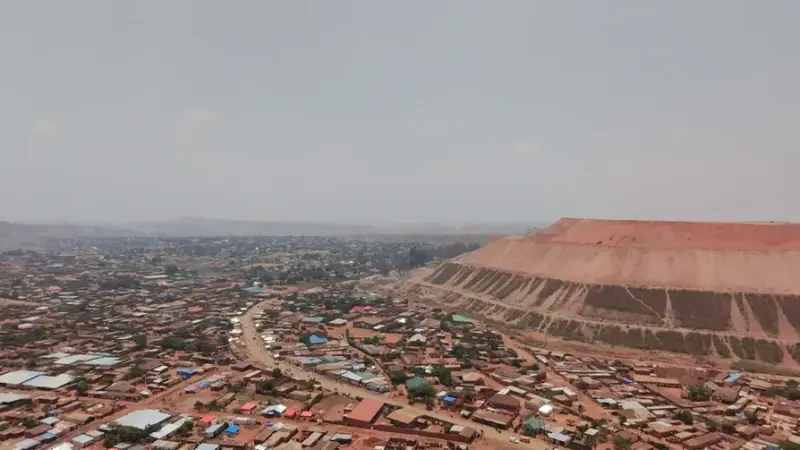
A residential area beside a large industrial mining site. Photo by Afrewatch. Used with permission.
In the Democratic Republic of the Congo (DRC), about 1,500 students and 68 staff members at the Galaxy School in Kolwezi breathe in some of the most polluted air ever recorded in this region. Their school sits less than 500 meters away from a mining waste disposal site.
Almost 98 percent of the hourly fine-particle levels exceed World Health Organization safety thresholds. This figure alone confirms what the latest scientific studies conducted in the Lualaba mining area have revealed.
The DRC is often hailed as a key player in the green energy transition, largely because the mineral resources within its borders are essential to producing batteries, solar panels, and other green tech. However, independent scientific studies on the scale of the contamination paint an alarming picture of the environmental cost in the Lualaba mining areas.
Using independent methodologies in separate laboratories, studies conducted by Source International (a specialist Italian environmental sciences organization), Rights and Accountability in Development (RAID), and AfreWatch, in collaboration with Professors Célestin Banza Lubaba Nkulu and Arthur Kaniki Tshamala from the University of Lubumbashi (UNILU), all reached similar conclusions.
Research published in June 2026 found widespread air and water pollution, as well as contaminated sediments surrounding the major copper and cobalt mines. This has serious health consequences for residents, especially children. These studies support the complaints and allegations that communities impacted by mining companies in southeastern DRC have made for several years.
The DRC produces competitive quantities of copper and accounts for three-quarters of global cobalt production, an essential mineral for electric vehicle battery manufacturing and many energy transition technologies. These studies were conducted near the Tenke Fungurume Mining (CMOC), COMMUS (Zijin Mining), and Mutanda Mining (Glencore) industrial sites.
Meanwhile, the Initiative for Good Governance and Human Rights (IBGDH ASBL) questioned the DR Congolese state’s inability to protect people from the country’s copper and cobalt mining giants, arguing that the human rights violations were committed with total impunity. The organization criticized:
Les revenus miniers justifient-ils le sacrifice d’une génération ? À Kolwezi, les vies humaines sont en danger de mort… Le silence des autorités ne serait plus une simple lenteur administrative, mais une complicité tragique.
Does mining revenue justify sacrificing an entire generation? In Kolwezi, human lives are in imminent danger. The authorities’ silence would no longer be a mere administrative delay, but a tragic complicity.
Deadly chemical footprints
In their report, researchers found that fine-particle concentrations (PM2.5 and PM10) routinely exceeded WHO guidelines. At some sites, these levels reached up to six times the acceptable threshold. Almost 98 percent of the study’s hourly measurements exceeded the safety limits, indicating ongoing, rather than occasional, exposure to potentially toxic air.
One of the most concerning examples involves the Galaxy School in Kolwezi, less than 500 meters from a mining waste disposal site. Here, researchers recorded some of the study’s highest air pollution levels. About 1,500 students and 68 staff members attend this school every day. Studies show that these particles have a chemical footprint characteristic of industrial mining residue, ruling out road traffic, domestic combustion, and artisanal mining as primary sources.
According to Nathan Nkulu, a community leader and Musonoi district resident, the findings are alarming. He told Global Voices:
Nous vivons dans une situation très difficile du fait de notre proximité avec les installations et les remblais des entreprises KCC et COMMUS, qui nous entourent. Surtout pendant la saison sèche, la poussière toxique envahit nos maisons ; parfois, un véritable nuage de poussière recouvre tout le quartier.
Due to our proximity to waste rock from the KCC and COMMUS mines, we are experiencing an extremely challenging situation. During the dry season in particular, toxic dust invades our homes, sometimes clouding the entire district.
For Flaviano Bianchini, executive director of the environmental NGO Source International, this is a case of severe pollution. In his report, he stated:
Au cours de nos nombreuses années de surveillance de la pollution sur des sitesminiers industriels à travers le monde, ces résultats comptent parmi les plus préoccupants que nous ayons jamais documentés en matière de qualité de l’air.
In all our years of pollution monitoring at industrial mining sites worldwide, these results are among the most concerning we’ve ever recorded.
Heavy metal water contamination
Beyond air quality, researchers have also highlighted concerning water resource contamination, detecting high concentrations of copper, cobalt, manganese, arsenic, lead, and even uranium in several rivers, lakes, and community wells.
A community well in Kolwezi, just 200 meters from a tailings pond, was found to be 100 times more acidic than recommended levels, with manganese concentrations reaching up to 14 times the health limit. At such levels, manganese is toxic to the central nervous system.
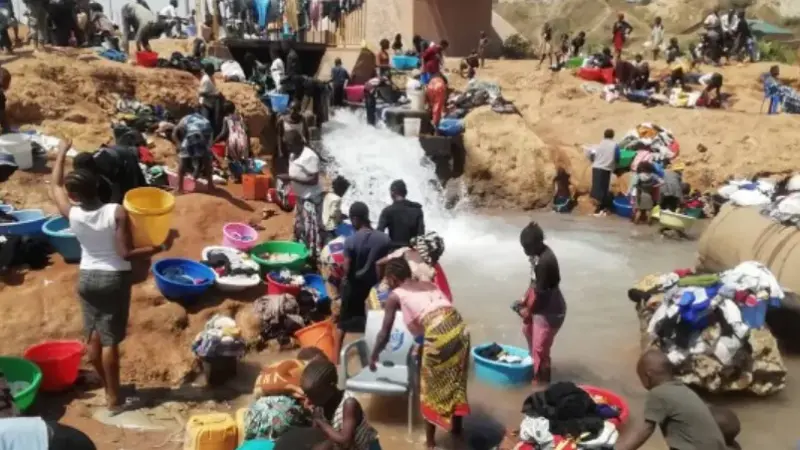
Lacking in drinking water, residents of the Kolwezi district use the water discharged from mining companies. Photo by Simplice Bambe. Used with permission.
Professor Célestin Banza describes the contaminated sediments accumulating in the waterways as a “chemical time bomb.” According to him, the local residents’ chronic exposure is likely to pose serious health risks, such as neurological disorders, renal diseases, chronic poisoning, and developmental disorders in children.
Downside to the green energy transition
DRC is often hailed as a solution country to the energy transition. However, people living near mining companies often find themselves caught in the grips of industrial copper and cobalt mining, overwhelmed by the intensity of activity in Kolwezi and the surrounding areas.
According to the IBGDH, vegetation is dying, making the pollution obvious to the naked eye. Gardens and crops are withering away, depriving families of their resources. The organization has pointed the finger at Ruashi Mining, a company belonging to the Chinese Jinchuan group, holding it responsible for the air pollution that has gotten so bad as to cause chronic nosebleeds in the surrounding districts.
Mines are not only expanding, but they are also encroaching upon communities that ultimately bear the brunt of the energy transition’s mineral race. Some districts are buckling under the burden of the mining expansion and its operations. Other communities are simply disappearing. As the state looks to clear land for mining operations, they forcibly evict residents, displacing many and causing some to become homeless.
Some at-risk populations
The region’s health professionals have reported an increase in persistent coughs, nosebleeds (epistaxis), eye irritation, and breathing difficulties.
The reproductive health of women living near these mining sites has also raised serious concerns. Communities have reported cases of miscarriages, menstrual problems, and congenital disorders, which they attribute to the pollution. These testimonies, which align across districts, are not yet supported by an epidemiological investigation establishing a direct causal link. However, scientists say this is the next crucial step.
For Emmanuel Umpula, AfreWatch Executive Director, we already have all the evidence we need to take action:
Les communautés vivant aux abords de ces mines paient de leur santé, de leurs récoltes et de leurs rivières le prix des ambitions énergétiques mondiales. Elles nous le disent depuis des années, et la science confirme aujourd’hui ce qu’elles affirmaient. Il est temps que les entreprises agissent, et que le gouvernement de la RDC renforce l’application de ses lois environnementales.
Communities living around these mines pay for the global energy ambitions with their lives, harvests, and rivers. They have been telling us for years what scientists now confirm. It’s time these companies acted, and the DRC government enforced its environmental laws more strictly.
Meanwhile, to sustain the energy transition, global demand for copper and cobalt continues to rise. New scientific data have reignited the debate on mining operators’ environmental and social responsibilities in the DRC. For now, the “polluter-pays” principle remains a commitment that communities impacted by copper and cobalt mining are still waiting to see enforced.