



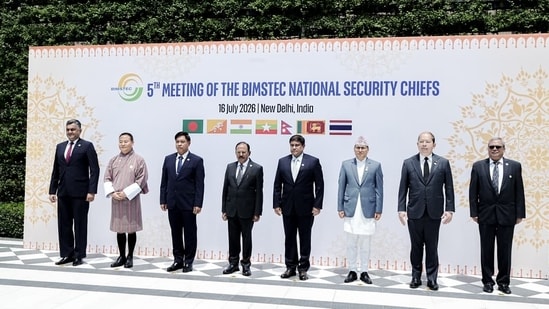
Ajit Doval convened BIMSTEC security leaders to adopt maritime guidelines and strengthen regional cooperation on security challenges in New Delhi.
National Security Adviser Ajit Doval hosted the fifth Meeting of the National Security Chiefs of the Bay of Bengal Initiative for Multi-Sectoral Technical and Economic Cooperation (BIMSTEC) in New Delhi on Thursday. This event brought together delegations from Bangladesh, Bhutan, Myanmar, Nepal, Sri Lanka, and Thailand to discuss regional security cooperation and emerging strategic challenges.
The meeting highlighted the role of BIMSTEC as a crucial connector between South Asia and Southeast Asia, regions that are increasingly significant in global geopolitics due to their strategic location in the Indian Ocean. Over the years, BIMSTEC has expanded its cooperation into various sectors, such as regional security, disaster management, transport, trade connectivity, technology, and cultural exchanges.
During the discussions, a comprehensive overview of progress in security cooperation was presented by the BIMSTEC Secretary General, who informed member nations about developments across several areas of collaboration within the group.
The security chiefs engaged in extensive deliberations on actionable measures to enhance regional security, focusing on combating terrorism and organised crime, improving cybersecurity, ensuring maritime and energy security, fostering regional connectivity, and strengthening disaster management systems. The talks also addressed the necessity for a collective response to new and emerging security threats that confront the region.
A significant outcome of the meeting was the adoption of guidelines aimed at enhancing the maritime aspect of humanitarian assistance and disaster relief (HADR). These guidelines are designed to enable BIMSTEC member states to coordinate and execute relief operations more efficiently and effectively during humanitarian crises and natural disasters.
Additionally, a set of guiding principles was endorsed for maritime law enforcement agencies involved in interactions at sea. These principles aim to foster better predictability, promote safety, and enhance cooperation among maritime agencies in BIMSTEC nations during operational engagements.
As BIMSTEC approaches its 30th anniversary next year, participant nations reiterated their commitment to bolstering regional collaboration and institutional capacities. They stressed the importance of increasing knowledge-sharing initiatives and close cooperation to address both traditional and non-traditional security challenges while reinforcing the region’s ability to tackle evolving threats.