



Fifty five per cent of the country’s 11 most influential institutional investors, who collectively manage around RM2.5 trillion (US$624 billion) in assets, have committed to increasing allocations towards climate solutions or transition finance — up from 40 per cent in 2024, according to the State of Investor Climate Transition in Malaysia 2026: Stronger Foundations report by the Asia Investor Group on Climate Change (AIGCC), a regional network of institutional investors working to advance climate action and net-zero investment across Asia.
The findings also put Malaysia ahead of the regional average, where 49 per cent of Asian investors have made similar commitments. The Malaysian analysis forms part of AIGCC’s broader State of Investor Climate Transition in Asia 2026 report, which assessed 240 of Asia’s largest institutional investors using 28 climate-related indicators.
The report suggests that Malaysian investors are making steady progress in embedding climate considerations into investment decisions, with improvements recorded across governance, policy engagement and climate investment.
Beyond investment commitments, 64 per cent of Malaysian investors now recognise climate change as a financial risk or opportunity, while 55 per cent have made net-zero commitments. Similarly, 55 per cent have also established policies to integrate climate considerations into governance frameworks and investment processes and the same proportion demonstrates board-level oversight of climate-related issues.
However, these figures remain below regional averages in several areas. Across Asia, 75 per cent of investors have climate integration policies and 70 per cent have board-level oversight of climate-related issues.
The report also found only 36 per cent of Malaysian investors have established interim emissions reduction targets, while just 27 per cent have publicly released climate transition plans outlining how they intend to achieve their long-term net zero ambitions.
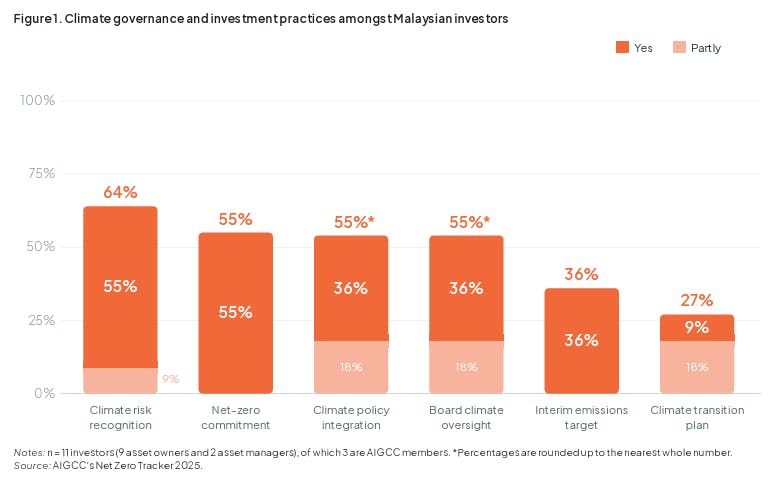
Image: State of Investor Climate Transition in Malaysia 2026: Stronger Foundations/AIGCC.
Rebecca Mikula-Wright, chief executive officer of AIGCC, said the findings indicate Malaysia’s institutional investors are building stronger foundations for climate transition while supporting national decarbonisation ambitions.
“Increasing investments in climate solutions is aligned with the government’s ambition to achieve 40 per cent renewable energy capacity and focus on sustainable energy levers under its National Energy Transition Roadmap by 2035,” she said.
Mikula-Wright added that maintaining this momentum would require closer collaboration between investors, businesses and policymakers to establish a supportive regulatory and policy environment capable of attracting greater climate investment.
Climate investment emerged as one of the strongest-performing areas in the assessment, reflecting growing alignment with Malaysia’s sustainable finance agenda.
The report also noted that the Securities Commission Malaysia’s Capital Market Masterplan 2026-2030 positions sustainability as a central pillar of capital market development, with a focus on mobilising financing for climate mitigation, transition, adaptation and resilience.
Despite the increase in investor commitments, AIGCC cautioned that translating those pledges into actual capital deployment will depend on expanding the pipeline of bankable domestic climate projects.
The report highlighted that some Malaysian institutional investors are currently deploying climate-focused funds in developed markets first to establish proof of concept while local investment opportunities continue to mature.
It said stronger policy frameworks, investable projects and de-risking mechanisms would be needed to channel more institutional capital into Malaysia’s transition priorities.
Rizal Rickman Ramli, president and group chief executive of Permodalan Nasional Bhd (PNB), one of the largest institutional investors in Malaysia, said climate considerations are becoming increasingly central to its long-term investment strategies.
“As a long-term institutional investor managing the financial futures of millions of Malaysians, we recognise that climate risk is investment risk. Our whole-of-portfolio approach to integrating climate considerations reflects our commitment to delivering sustainable returns for our unitholders while contributing to Malaysia’s transition to a low-carbon economy,” he said.
Under its refreshed Sustainability Framework, PNB has committed to investing RM15 billion (US$3.6 million) in green and transition assets by 2030 while reducing its portfolio emissions intensity by 35 per cent over the same period from its 2022 baseline.
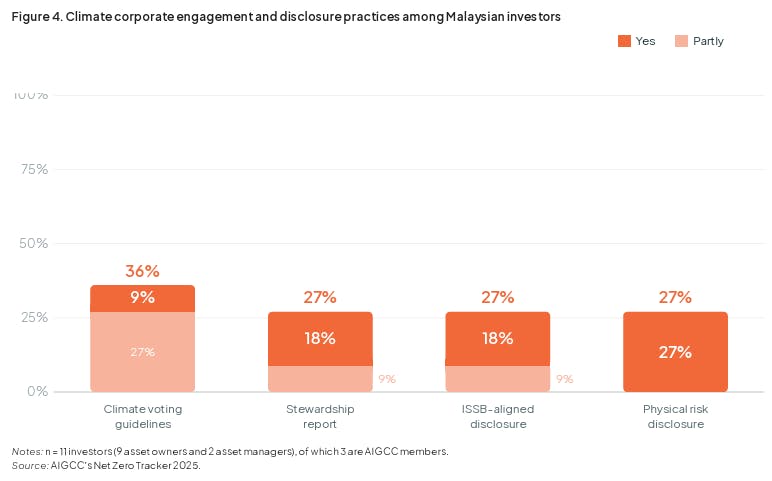
Image: State of Investor Climate Transition in Malaysia 2026: Stronger Foundations/AIGCC.
While climate investment commitments have strengthened, the report also highlighted several areas where Malaysian investors continue to lag regional peers.
Only 36 per cent of investors have established fossil fuel transition policies, compared with 48 per cent across Asia, indicating more work is needed to support the orderly transition of higher-emitting sectors.
Stewardship and climate-related disclosures also remain relatively underdeveloped.
The report found that just 36 per cent of Malaysian investors incorporate climate considerations into proxy voting guidelines, while only 27 per cent publish stewardship reports, climate disclosures aligned with the Task Force on Climate-related Financial Disclosures (TCFD) or International Sustainability Standards Board (ISSB) frameworks, or detailed assessments of physical climate risks.
Nevertheless, AIGCC expects these areas to improve as Malaysia’s sustainability reporting framework continues to mature.
The National Sustainability Reporting Framework, introduced in 2024, adopts the ISSB standards as the baseline for sustainability disclosures and is being implemented in phases to improve the consistency and comparability of corporate reporting.
In February this year, the Securities Commission Malaysia and Bank Negara Malaysia announced they had begun developing similar sustainability reporting guidance for financial institutions. AIGCC also recently submitted feedback on Malaysia’s proposed Sustainable Finance Taxonomy during its public consultation in April.
The report said these initiatives could harmonise Malaysia’s disclosure landscape and strengthen investor transparency on climate stewardship over time.