



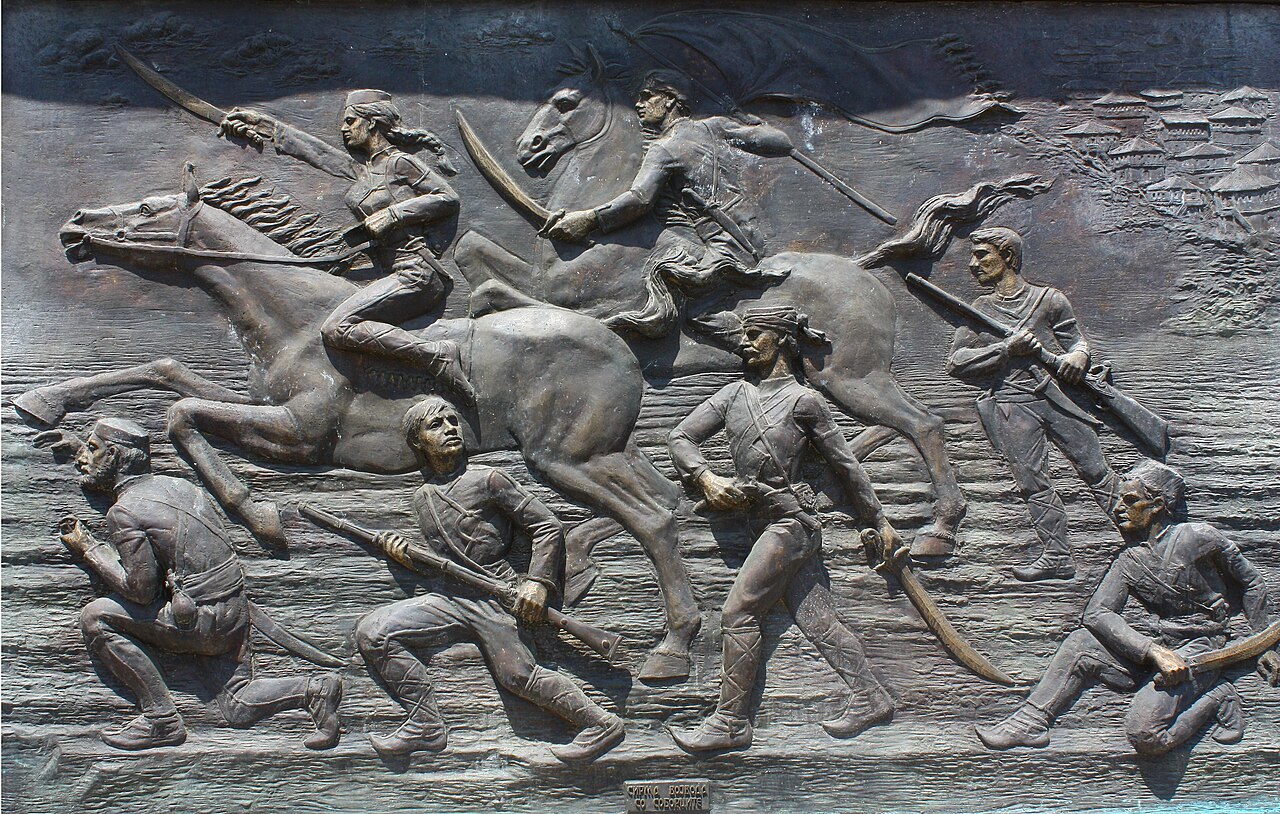
Plaque of Sirma Voyvoda (on horseback, first from left) and her troops in Skopje, North Macedonia. Photo by Rašo via Wikimedia Commons, CC BY-SA 3.0.
In contemporary Balkan discourse, under the influence of global culture wars, tradition is often presented as something fixed, simple and strictly patriarchal. Yet the region’s history, folklore and popular memory contain more complicated examples: women who became socially recognized as men, queer or gender-nonconforming men with visible ritual roles, and female heroes who temporarily crossed into male identity in order to fight for their community.
These examples should not be romanticized as proof that Balkan societies were secretly egalitarian. Most of them existed within patriarchal systems, as a sort of “exception that proves the rule,” reconfirming the “traditional” female role as obedient daughter who should grow into mother and housewife. What they do show is that the past (or at least people’s imagination) wasn’t as rigid as today’s defenders of “traditional values” often claim.
Sworn virgins
One of the best-known examples is the Balkan sworn virgin, known in Albanian as burrnesha or virgjinesha, and in South Slavic contexts as virdžina. In the highland parts of northern Albania, Montenegro, Kosovo and the wider Dinaric highlands, a daughter in a family without a suitable male heir would assume the social role of a man. This usually meant a vow of celibacy, masculine clothing and behavior, and public recognition as head of household.
The practice was not modern emancipation. It was often a patriarchal solution to a patriarchal problem: if inheritance, honor and household authority were organized through men, society allowed a daughter to “become” a social man when no biological man was available. The sworn virgin would gain the responsibility of running the family, alongside freedoms denied to other women, such as wearing men’s clothing and publicly socializing with men while smoking and drinking tea. However, all this came at the cost of celibacy, with no chance of marriage, sexual expression or motherhood.
A 2022 BBC article concludes that “only a dozen ‘sworn virgins’ are left in the world, as an ancient Balkan tradition where women live as men dies out.”
Men in non-traditional, effeminate roles
A different example appears in Aleksandar Manić’s 2005 documentary “Šutka Book of Records,” which presents several colorful portraits of extraordinary inhabitants of Šuto Orizari, the majority ethnic Roma municipality in the Macedonian capital of Skopje.
The film follows local eccentric champions, including, as the synopsis puts it, “the local homosexual in his colourful wardrobe” who is “no less respected” than other distinctive local figures.
According to a subplot beginning at 45:55 in the video, two openly gay men who display a flamboyant, gesture-filled speaking style, are engaged by families of young boys about to undergo the Muslim ritual of circumcision. The men are considered the best decorators and prop masters for the event, which includes the sourcing of a special bed.
This example needs careful handling. While Roma and Muslim communities or Balkan societies in general are not free of homophobia, the scene complicates stereotypes. In a community often described from the outside via narratives of poverty or negative conservative stereotypes, the film shows a more layered social world, where a queer figure can be visible, valued and woven into society’s ritual and religious life.
Women warriors, in drag
The third and richest set of examples comes from folklore. In a recent text for the Macedonian feminist platform Meduza, Leni Frčkoska revisits Macedonian folk tales through the motifs of “shift of sex” and the “woman-warrior.” The title of the text, which can be translated as “The Hero was a Girl! A Feminist Re-reading of the Motifs of Sex Change and the Woman Warrior in Macedonian Folklore,” is an abridged version of her PhD thesis.
Frčkoska notes that folklore tends to reproduce conservative and patriarchal lessons, but also contains subversive female figures that disturb those lessons from within. The woman-warrior motif is often related to gender-bending. In these stories, the protagonist is a girl from a family with no sons. She disguises herself as a man, enters the male-coded world of battle, proves herself as a hero, and usually returns to her previous female role once the danger has passed. Frčkoska summarizes that, in several Macedonian variants, the period of being masked as a male soldier ends after victory, and the youngest daughter returns to her earlier female role.
Quoting a detail from a Macedonian folk tale collected by Marko Cepenkov in the mid-19th century, Frčkoska says that it displays this pattern. After the battle, the heroine loosens her hair, opens her robe to show her breasts, and tells the prince:
Дејгиди синче царево, горска еребица в раце ти дошла и не си успеал да ја ватиш за в кафез да ја клајш. Јас девојче си бев и девојче сум си, види ми косите, види ми ‘и боските и седи ми си со здравје.
Alas, son of the emperor, you had a partridge [free bird] in your hand and you allowed it to fly away, instead of putting her in a cage. I was a girl, and I am a girl: look at my hair, look at my breasts – and now farewell…”
Public nudity was and still is a taboo according to Balkan patriarchal mores, so the line is not merely a bodily revelation; it’s a narrative reversal. The “male warrior” has already succeeded; only then does the story reveal that the hero was a woman all along. The body becomes the sign that reclassifies the fighter, but only after courage has been proven.
The Macedonian folk song “Kruševo aber pristigna” (“A call came to Kruševo”) offers a popular version of the same gender-bending logic. The song tells a fictional story of a call that came to the town of Kruševo for families to send their grown sons as komiti (guerilla fighters) to village of Smilevo, famous as a hotbed of anti-Ottoman revolutionary activity. A man called Stojan has no sons; he has only his daughter, Todorka. Instead of accepting this as the end of the family’s public duty, Todorka asks her father to equip her so she can go as a komita.
Wearing a man’s disquise, Todorka joins the fighters so convincingly that, as the song says, “no one recognized Todorka as a girl.” In this instance, the gender-bending is more precise than simple cross-dressing. The song shows a temporary bending of the rules that decides who may fight as opposed to staying at home in a nurturing — and essentially helpless — female role, who may represent the family, and who may enter national heroic memory.
The song remains popular today, having been revived by contemporary performers, including Macedonian pop-folk star Stojne Nikolova. Her modern interpretation, seen in the video clip below, celebrates Todorka as a patriotic heroine without necessarily naming the gender politics of the story. Yet, those politics are there: a daughter steps into the empty place reserved for a son, defending her father’s honor.
The motif also has echoes in historical biographies from the region, across a spectrum of disguise, warriorhood and later, patriotic memory.
Sirma Vojvoda (1776–1864), a female hajduk (a mix of rebel, brigand and freedom fighter) from the Debar region, is probably the closest historical parallel to Todorka. She is remembered as a leader of highland fighters battling Ottoman oppression. A breast-related detail also entered her folk memory: according to a footnote in the song about her collected by the Miladinov Brothers, the men in her band recognized she was a woman only when the buttons on her chest were torn. She remained their leader after her demasking.
Čučuk Stana (1795–1849/50) belongs to a related, but slightly different tradition. Connected with the Serbian uprisings and remembered in Serbian epic poetry, she was not primarily a “secret male identity” figure. Rather, her story shows a woman entering the “male world” of hajduks, armed resistance and heroic reputation. Accounts of her youth also say that she and her sisters wore men’s clothes outside the home because they had no adult brother to protect them.
Milunka Savić (1890/1892–1973) brings the motif into documented 20th century military history. During the Balkan Wars, she joined the Serbian army by cutting her hair, putting on men’s clothes and presenting herself as a man, reportedly in place of her brother. After her gender was discovered, she remained in combat and later became one of the most decorated women soldiers of World War I.
These historical figures help illustrate that female warriors in drag were not just a fairy-tale fantasy. In different forms, women in Balkan history crossed into roles reserved for men — secretly or visibly, temporarily or permanently — as heroines who remain in the memory of subsequent generations.
Although contemporary readers may relate, examples of gender-bending in the Balkans don’t fit neatly into modern identity categories such as transgender, gay, lesbian or non-binary. They do, however, challenge the dogma that gender diversity is foreign to the Balkans, or that tradition is limited to binary models of masculinity and femininity. Nothing is ever simple in the Balkans, including its patriarchal past and present.